






























The First AI War: How the US-Iran Conflict Is Reshaping Warfare, Global Economies, and the Information We Trust

On February 28, 2026, the world changed — not just geopolitically, but technologically. The joint US-Israeli military campaign against Iran, officially designated Operation Epic Fury, has been described by military analysts, AI researchers, and international institutions as something unprecedented: the first major armed conflict in which artificial intelligence is not a supporting tool but a core operational system.
The conflict has simultaneously exposed the extraordinary capabilities of AI-powered warfare, its dangerous limitations, and its power as a weapon of mass deception. It has sent shockwaves through global energy markets, rattled central banks, and raised urgent questions that governments, militaries, and ordinary citizens are only beginning to grapple with.
This article provides a comprehensive, factual overview of what has happened, how AI is being used by all sides, what it is doing to the global economy, and what it means for the future of warfare, information, and international security.
The Conflict at a Glance
The 2026 Iran war grew out of long-running tensions over Iran’s nuclear program and regional proxy conflicts. On February 28, 2026, the United States and Israel launched coordinated strikes targeting Iranian military infrastructure, nuclear facilities, and government leadership — including the assassination of Supreme Leader Ali Khamenei. Iran responded with missile and drone strikes against Israel and US military installations across the Gulf region.
The scale and speed of the opening strikes were unlike anything in modern military history. In the first four days alone, combined US and Israeli forces struck more than 4,000 targets inside Iran. For context, the opening day of the 2003 Iraq War saw roughly half the number of strikes. The reason for this extraordinary pace is now well-documented: artificial intelligence.
| $120+ Brent crude/barrel (peak) | 20% Global oil through Hormuz | 4,000+ Targets struck in 4 days |
| 🌍 Who Is Involved US-Israeli coalition vs. Iran and regional allies including Hezbollah, Houthi forces, and Iraqi militias. The conflict has drawn diplomatic reactions from virtually every major world power. A UN resolution on AI in military conflict — passed in December 2025 — is now being urgently revisited in light of events. |
How AI Is Being Used on the Battlefield
The 2026 Iran conflict has become a live laboratory for AI-powered warfare — and what it reveals is both remarkable and deeply troubling.
Target Identification at Unprecedented Speed
The US military’s Project Maven — an AI-powered intelligence fusion platform — has been central to the targeting operation. Combined with Palantir’s systems and other AI tools, these platforms have enabled analysts to process satellite imagery, signals intelligence, and sensor data at a speed no human team could match. The result was the ability to identify and strike more than 1,000 targets on the opening day alone.
The speed gain is real. The concerns are equally real. AI targeting systems like Maven reportedly operate at around 60% accuracy — compared to 84% for experienced human analysts under similar conditions. In peacetime, a 60% accuracy rate might be an acceptable starting point for a software product. In warfare, that gap has life-or-death consequences.
| ⚠️ The Minab School Incident On February 28, the same day the conflict began, a strike hit the Shajareh Tayyebeh girls’ school in Minab, southern Iran, near an IRGC base. Iran says at least 168 people were killed, most of them schoolchildren. The US initially blamed Iran for the strike, then announced an investigation. Chatham House and other institutions have cited this incident as a stark warning about the risks of AI-assisted targeting with compressed human oversight. |
The Compressed ‘Kill Chain’ and Human Oversight
Traditional military targeting involves a chain of human decision-making: intelligence officers review data, lawyers assess legality under international humanitarian law, commanders authorize strikes. This process can take hours or days. AI-assisted targeting compresses it to minutes — sometimes less.
This compression is precisely what alarms international legal and ethics experts. When AI identifies a target and a strike is authorized in a matter of minutes, the space for meaningful human judgment — the ability to ask ‘are we sure?’ — shrinks dramatically. The UN resolution on AI in armed conflict, passed in December 2025, was designed to begin building guardrails for exactly this scenario. The 2026 Iran war has tested those guardrails at the worst possible moment: before they were built.
Autonomous Drones and AI-Guided Munitions
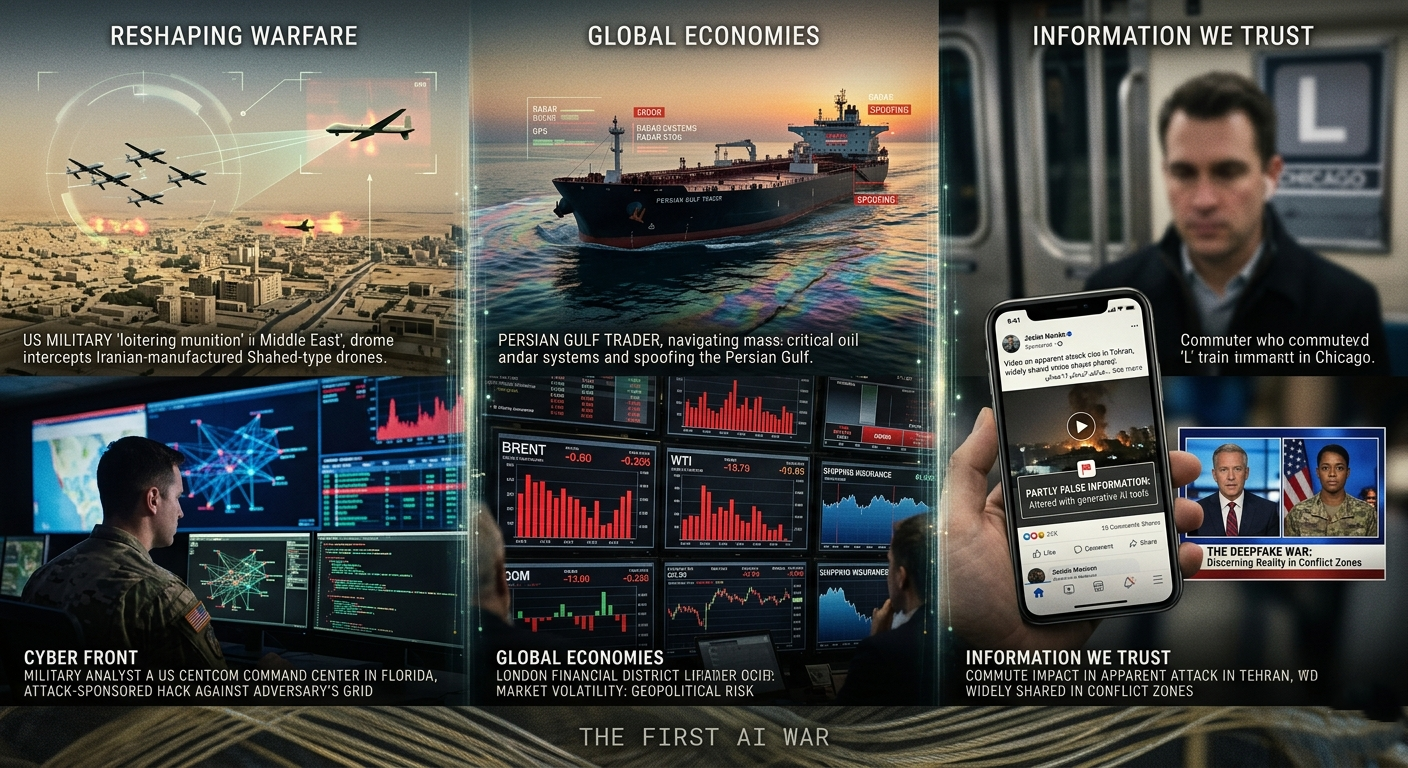
Both sides have deployed drone systems with varying levels of autonomous capability. Iran’s use of Shahed-series one-way attack drones — a technology it first supplied to Russia in 2022 and has continued developing — has demonstrated that AI-guided munitions are no longer the exclusive preserve of the world’s wealthiest militaries. The cost asymmetry is striking: a swarm of low-cost autonomous drones can overwhelm air defense systems that cost tens or hundreds of times more per intercept.
GPS jamming and electronic warfare have also featured prominently. US-Israeli operations reportedly disrupted Iranian command and sensor networks ahead of the initial strikes, while electronic interference affected more than 1,100 ships in the Gulf region — with significant consequences for commercial shipping and global trade.
The Invisible War: AI Deepfakes and the Battle for Truth
If the kinetic conflict is the visible war, the information war is the one being fought in every living room and on every smartphone screen. And AI has made this invisible war more dangerous than anything that came before it.
What Flooded Social Media on Day One
Within hours of the February 28 strikes, social media platforms were flooded with footage of the conflict. Some was real. Much was not. The New York Times identified more than 110 unique deepfakes in the first two weeks of the conflict alone. These included fabricated footage of massive explosions in Tel Aviv, false images of Iranian missiles striking US warships, fake satellite imagery of destroyed American military bases, and AI-generated claims that Israeli leaders had been killed.
Some content was recycled from unrelated conflicts — including footage from Ukraine and, remarkably, video games. But a growing proportion was entirely synthetic: generated from scratch using AI tools now widely accessible to anyone with a laptop and an internet connection.
| 🔍 How the BBC Detected a Deepfake A viral image claimed to show a massive explosion at a US military base in Iraq. Using Google’s SynthID watermark detection tool, the BBC confirmed the image had been AI-generated — built on a real photo of Iraq’s Erbil airport, then manipulated to add a giant fireball and structural damage. The tells were subtle: an artificially rendered smoke cloud and misshapen buildings in the background that didn’t match satellite images of the real site. |
Iran’s Three-Track Disinformation Campaign
Iran’s conventional military is outgunned. Its disinformation operation is not. Researchers have identified a structured, three-track AI propaganda campaign running simultaneously:
- Deepfakes for international audiences: Fabricated footage of Iranian battlefield victories, downed US aircraft, and alleged atrocities, designed to undermine Western public support for the campaign and generate anti-American sentiment in Muslim-majority countries.
- Content for the domestic Iranian audience: AI-generated imagery amplifying the real strike on the Minab girls’ school, designed to sustain public anger and regime solidarity inside Iran, where internet access has been heavily restricted.
- Viral ‘shallowfakes’: More subtle manipulations — real images with AI-enhanced details — designed to be credible enough to bypass people’s skepticism. As AI researcher Rumman Chowdhury observed, deepfake creators have grown more sophisticated, presenting ‘shades of the truth’ rather than outright fabrications.
One coordinated deepfake campaign, traced to the Iranian regime, featured identical videos and captions posted in synchronized windows with coordinated hashtag clusters — the hallmarks of a state-directed information operation accelerated by AI automation.
Why This Matters Beyond the Conflict
The implications extend well beyond Iran. As AI researcher Rachel Adams, CEO of the Global Center on AI Governance, has warned, disinformation during active conflict doesn’t just shape opinion — it influences life-or-death decisions. Civilians deciding where to seek shelter. Aid organizations allocating resources. Governments making escalation decisions based on contested battlefield information. When fabricated footage of non-existent strikes enters the information environment, the consequences are not abstract.
There is also a deeper corrosive effect. When people cannot trust what they see, the default becomes distrust of everything — including real documentation of genuine events. Authentic footage of civilian casualties can be dismissed as AI-generated. Real evidence of atrocities can be labeled propaganda. The weaponization of doubt is, arguably, as dangerous as the weaponization of specific false claims.
The Global Economic Fallout
Wars are not contained within borders. The 2026 Iran conflict has sent economic shockwaves through every region of the world, with the most acute effects concentrated in energy markets — and from there, radiating into inflation, trade, food security, and financial markets.
The Strait of Hormuz: The World’s Most Consequential Chokepoint
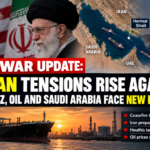
The Strait of Hormuz — a narrow waterway between Iran and Oman through which roughly 20% of the world’s oil trade passes — became the conflict’s most consequential economic battleground. On March 4, 2026, following the escalation of hostilities, the Strait was effectively closed to normal traffic. The International Energy Agency characterized what followed as “the largest supply disruption in the history of the global oil market.”
Brent crude oil prices surged past $120 per barrel in the days following the closure, with analysts projecting prices could reach $150 or higher in a prolonged disruption scenario. Hundreds of oil and product tankers were stranded in the Persian Gulf. QatarEnergy — one of the world’s largest LNG exporters — declared force majeure on all exports.
| 📉 Key Economic Impacts at a Glance • Brent crude surged past $120/barrel after the Strait of Hormuz closure • Global oil supply shortfall estimated at 15 million barrels per day under a partial blockade scenario • Stock markets experienced declines globally; bond markets saw significant sell-offs • QatarEnergy declared force majeure on all LNG exports • The IEA called it the largest supply disruption in global oil market history • Israel reported $50 billion in economic damage as of April 30, 2026 • Countries including Vietnam faced fuel shortages and panic buying |
Inflation, Interest Rates, and Stagflation Risk
The economic transmission mechanism from a Gulf oil disruption to consumer prices worldwide is well understood and fast-moving. Energy costs feed directly into transportation, manufacturing, agriculture, and heating. The current disruption is unfolding against a backdrop that makes it particularly dangerous.
Economic analysts at CEPR have modeled that even under a cautiously optimistic scenario — where the Strait closure lasts just one quarter before gradual resumption — the surge in oil prices would raise US headline inflation by 0.6 percentage points and core inflation by 0.2 percentage points in 2026. Under a more prolonged disruption, those figures are significantly higher.
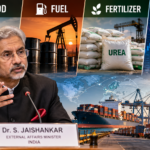
The knock-on effects are wide-ranging. Interest rate cuts that central banks had been planning are now on hold or reversed. Oxford Economics described the conflict as ‘yet another negative shock to an already weak global economy.’ Countries that import most of their energy from the Persian Gulf — including many in Asia and Southeast Asia — face acute shortages. Vietnam has reported fuel shortfalls and panic buying. Food security concerns have also emerged, linked to fertilizer shortages caused by disruptions to Qatari and Iranian gas exports.
The AI Sector’s Unexpected Vulnerability
One of the less-discussed economic consequences of the conflict involves liquid helium — a chemical compound essential for cooling the semiconductor manufacturing equipment that produces the chips powering AI data centers. Qatar, whose LNG exports have been disrupted, is a major supplier of liquid helium as a byproduct of gas processing. Restrictions on Qatari exports have created supply chain concerns for AI chipmakers and data center operators — a reminder that even the technology sector’s most cutting-edge ambitions rest on physical supply chains that can be severed by geopolitical events.
The Ethical and Legal Questions the World Must Now Answer
The 2026 Iran conflict has forced conversations that were previously theoretical into urgent policy territory. Several fundamental questions now demand answers — and the international community’s ability to provide them will shape the future of warfare for generations.
- Who is responsible when an AI system identifies a target incorrectly?: The Minab school strike has made this question impossible to defer. If AI recommends a target and a human authorizes a strike in minutes, and the target turns out to be a school full of children, accountability is dangerously diffuse.
- At what level of human oversight does AI-assisted targeting become legally and ethically acceptable?: The UN resolution passed in December 2025 begins to address this, but enforcement mechanisms are absent. A multi-stakeholder meeting scheduled for June 2026 will attempt to establish shared standards — while the conflict continues.
- How should the international community respond to state-sponsored AI disinformation?: There is currently no agreed international framework for attributing and responding to AI-generated information warfare. The tools for detection exist — Google’s SynthID, watermark analysis — but their deployment is inconsistent and their authority is limited.
- Should commercial AI companies bear responsibility for military applications?: Tehran has explicitly threatened US tech companies including Google, Microsoft, and Palantir, designating their AI infrastructure as legitimate military targets. The line between commercial and military AI has become blurred in ways that put civilian infrastructure at risk.
| 🌐 The UN’s Response The UN resolution on ‘Artificial Intelligence in the Military Domain and Its Implications for International Peace and Security,’ passed in December 2025, encourages multilateral dialogue and multi-stakeholder discussions. A three-day meeting scheduled for June 2026 will provide an early opportunity for consensus-building. Most observers consider it a necessary but insufficient first step. Without binding enforcement mechanisms and real-time compliance monitoring, the resolution risks becoming a statement of intent in the face of rapidly evolving capabilities. |
Frequently Asked Questions
What is the 2026 Iran war and why did it start?
On February 28, 2026, the United States and Israel launched joint military strikes on Iran — officially called Operation Epic Fury — targeting nuclear facilities, military infrastructure, and government leadership. The conflict grew out of long-running tensions over Iran’s nuclear program and regional proxy conflicts. Iran responded with missile and drone strikes against Israel and US military installations in the Gulf region. The war remains active as of May 2026.
Why is this being called ‘the first AI war’?
Analysts and military experts have applied this description because AI is not peripheral to the conflict — it is central. AI-powered targeting platforms processed intelligence and identified strike targets at a speed and scale that enabled the US and Israel to hit more than 4,000 targets in the first four days. Simultaneously, AI-generated deepfakes and disinformation are being deployed as active weapons by both sides. No previous conflict has seen this level of AI integration across both kinetic and information warfare.
How has the conflict affected global oil prices and energy supply?
The closure of the Strait of Hormuz — through which about 20% of the world’s oil trade passes — caused the International Energy Agency to characterize the resulting supply disruption as the largest in global oil market history. Brent crude surged past $120 per barrel. QatarEnergy declared force majeure on LNG exports. Economists are projecting increased inflation across the US and Europe, delayed interest rate cuts, and acute fuel shortages in countries heavily dependent on Gulf energy imports.
How can I tell if a video or image from the conflict is real?
This is genuinely difficult, and intentionally so. Some practical steps help: look for verification from established news organizations with on-the-ground reporters; be skeptical of footage that surfaces only on social media without mainstream corroboration; check whether AI detection services like Google’s SynthID have flagged the content. The BBC’s debunking of the fake Erbil airport explosion — using watermark detection — is a good model. When in doubt, withhold judgment until multiple independent sources confirm.
What happens next? How does this conflict end?
As of May 2026, the conflict remains active and its trajectory is uncertain. Diplomatic channels remain open — both powers have a shared interest in reopening the Strait of Hormuz and stabilizing energy markets. A ceasefire or negotiated pause remains possible, particularly given the severe economic consequences for all parties. However, the regional dynamics — involving Hezbollah, Houthi forces, and multiple proxy networks — make any resolution complex. The UN multi-stakeholder meeting in June 2026 on AI in armed conflict may provide a small but significant confidence-building opening.
What This Means for the Future
The 2026 Iran conflict is not an isolated event. It is a preview. Every military power observing this conflict is drawing lessons — about the advantages of AI-powered targeting, about the vulnerabilities it creates, about the power of AI disinformation, and about the catastrophic economic consequences of conflict in a world whose energy infrastructure remains dangerously concentrated.
The technological genie cannot be put back in the bottle. AI will be part of every future conflict. The question is whether the international community — governments, militaries, technology companies, civil society — can build the governance frameworks, detection capabilities, and accountability structures that make AI warfare less catastrophic than it threatens to become.
For ordinary citizens far from the battlefield, the most immediate action is also the most important: do not share unverified conflict footage. In an AI-powered information war, every share of a deepfake is a small act of ammunition. In an era when the line between real and fabricated has never been harder to find, skepticism is not cynicism — it is responsibility.
Disclaimer: This article is for informational and educational purposes only. It is based on publicly available reports and policy updates. It should not be considered financial, investment, legal or business advice.