















































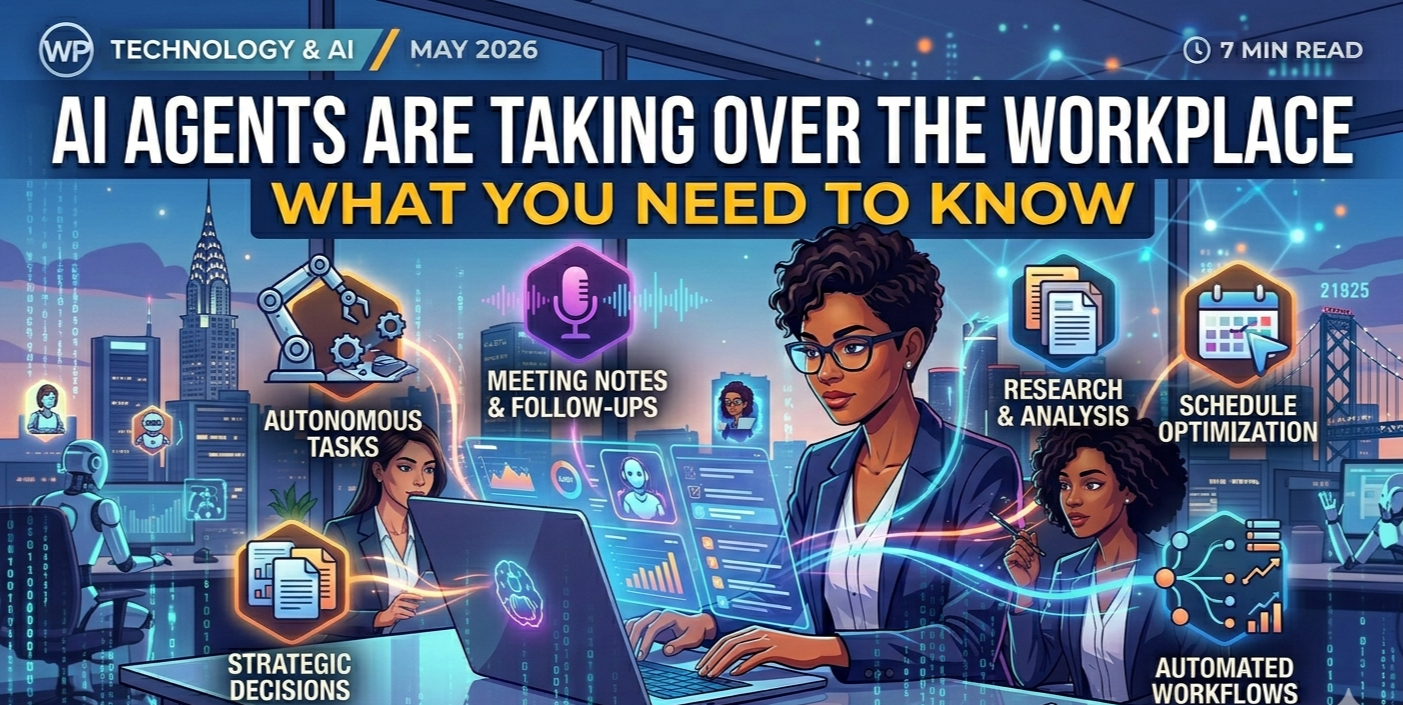

Something significant is happening in workplaces around the world right now, and it’s moving faster than most people realize. The conversation has shifted from AI that answers your questions to AI that gets things done for you — entirely, autonomously, and at scale.
These are called AI agents, and they are the defining technology story of 2025 and 2026. If you’ve heard the term thrown around but aren’t quite sure what it means — or why it matters — this article will give you a clear, honest picture of what’s happening, what it means for your work, and what to do about it.
What Is an AI Agent, Exactly?
The easiest way to understand an AI agent is to compare it to a standard AI chatbot. When you ask ChatGPT a question, it gives you an answer. That’s it. You do the rest — you copy the answer, paste it into a document, send the email, take the action.
An AI agent doesn’t stop at the answer. It understands your goal, creates a plan, and executes a series of steps across multiple tools and systems — all on your behalf. Instead of you telling a computer exactly how to do something, you simply describe what outcome you want, and the agent figures out how to deliver it.
A marketing manager, for example, might instruct an AI agent to monitor competitor activity, compile a weekly briefing, draft a response strategy, and schedule a team meeting to review it — all without lifting a finger beyond giving the initial instruction. That’s the shift from generative AI to agentic AI, and it’s reshaping the nature of knowledge work.
| $7.8B AI Agent Market in 2025 | $52B+ Projected by 2030 | 83% Orgs planning agentic AI |
Why Is Everyone Talking About AI Agents Right Now?
The timing isn’t accidental. Several things converged in 2025 to move AI agents from research labs into real workplaces.
1. The Models Finally Got Good Enough
Agentic AI requires models that can reason across multiple steps, maintain context over long tasks, and recover gracefully from errors. In 2024, most models weren’t reliable enough for this. By mid-2025, that changed. OpenAI’s latest models showed over 200% gains on complex reasoning benchmarks. Claude 4.5 Sonnet demonstrated the ability to maintain focus on complex software engineering tasks for extended periods with high accuracy. The underlying horsepower finally matched the ambition.
2. A Universal Standard Was Established
One of the biggest practical barriers to AI agents was that every tool spoke a different language. Getting an AI agent to work across your email, your CRM, your calendar, and your project management platform required custom engineering for each connection.
Anthropic’s Model Context Protocol (MCP) solved this in 2025 by creating a universal standard for how AI agents connect to external tools and data sources — the HTTP of the agentic world. By late 2025, there were more than 10,000 public MCP servers deployed, making plug-and-play agent integration a practical reality for the first time.
3. Businesses Moved from Curiosity to Commitment
In 2025, 83% of organizations surveyed in the Cisco AI Readiness Index said they planned to deploy agentic AI systems. That’s not experimental curiosity — that’s a strategic bet. AI platforms like Salesforce Agentforce surpassed 9,500 paid enterprise deals. Microsoft, IBM, Google, and Anthropic all made agentic AI the center of their commercial strategies. The infrastructure for a genuinely agentic enterprise is no longer theoretical.
Where AI Agents Are Making the Biggest Impact
AI agents aren’t being deployed uniformly across every task. The early production wins are concentrated in areas with high volume, well-defined workflows, and clear success metrics. Here’s where the real-world results are already showing up.
Customer Service and Support
This is arguably the most mature deployment area. AI agents in customer service can resolve tickets, process refunds, reschedule deliveries, apply credits, and proactively notify customers about issues — all without a human in the loop. A logistics company whose delivery van breaks down can now have an agent automatically reschedule the delivery, issue a service credit, and text the customer a new window — in seconds.
| 🏭 Real-World Example A telecommunications company deployed AI agents that autonomously detect network anomalies, open a field service ticket, and alert the affected customer — an entire resolution workflow that previously required three separate teams. |
Sales and Revenue Operations
AI sales agents are qualifying leads, booking meetings, following up with prospects, and updating CRM records — continuously, without fatigue. Unlike the rigid chatbots of five years ago, these agents learn from past interactions, improve their approach over time, and coordinate across email, calendar, and CRM in a way that genuinely resembles having a junior sales representative on staff around the clock.
Healthcare and Clinical Administration
Healthcare is one of the most significant long-term opportunities for AI agents, and progress has been dramatic. Microsoft’s AI Diagnostic Orchestrator solved complex medical cases with 85.5% accuracy — far above the 20% average for experienced physicians on the same benchmarks. Beyond diagnostics, AI agents are reducing administrative burden by maintaining contextual awareness across patient records, handling appointment scheduling, and supporting clinical documentation.
Software Development
Developers are seeing some of the most dramatic productivity gains. GitHub reported a 25% year-over-year jump in code commits in 2025, with AI assistants and agents driving much of that acceleration. In 2026, AI agents are moving beyond writing code to understanding the full history and relationships within code repositories — catching what changed, why, and how different components interact. This is what GitHub’s chief product officer calls ‘repository intelligence.’
Finance and Operations
Inventory management, supply chain monitoring, financial reconciliation, and compliance reporting are all being handled — at least partially — by AI agents in leading organizations. The pattern is consistent: high-volume, rule-bound tasks that previously required significant human time are now being automated, freeing up teams for higher-judgment work.
The Gap Between Hype and Reality
Here’s where it’s important to inject some honesty into a conversation that can get very breathless very quickly.
The adoption numbers are impressive. The production numbers tell a more complicated story. While around 79% of enterprises say they’ve adopted AI agents in some form, only about 11% are running them in full production. The gap is real — and it reflects the genuine difficulty of integrating autonomous AI systems into legacy processes, governance structures, and accountability frameworks.
| ⚠️ The Governance Problem Gartner predicts over 40% of agentic AI projects will be canceled by end of 2027 — not because the technology doesn’t work, but because organizations failed to build the right governance, accountability, and oversight structures around it. The organizations succeeding with AI agents treat governance as a design constraint from day one, not an afterthought. |
The organizations getting the most out of AI agents share a consistent pattern: they identify a specific, high-volume process, redesign it with an agent-first mindset (rather than simply layering AI on top of a broken process), establish clear success metrics, and build human oversight into the architecture. Agents that work without any human-in-the-loop are the exception, not the rule.
What This Means for Your Career
The most common fear about AI agents is the obvious one: if an agent can do my job, what happens to me? It’s a legitimate question, and the honest answer isn’t a blanket reassurance.
Specific tasks — particularly routine, high-volume, rule-based work — are being automated at an accelerating pace. Administrative work, basic data analysis, templated communication, and repetitive reporting are the clearest targets. If your role is built primarily around these activities, the pressure is real and worth taking seriously.
At the same time, the most credible forecasts point to a transformation of roles rather than wholesale elimination. Microsoft’s chief product officer described the emerging reality this way: “the future isn’t about replacing humans — it’s about amplifying them.” In 2026, every employee — from analysts to executives — is increasingly a supervisor of agents: defining goals, reviewing outputs, making judgment calls, and managing the AI team doing the execution.
The skills with growing value right now are the ones agents can’t easily replicate: strategic judgment, creative problem-solving, relationship management, ethical reasoning, and the ability to ask the right questions. Equally valuable is the ability to design, deploy, and manage AI agents themselves — a skill set that’s moving rapidly beyond developers into the hands of business users.
| 💡 Career Advice for 2026 Don’t wait for your employer to hand you AI agent training. Identify the most repetitive parts of your own job and experiment with automating them using available tools. The professionals building a track record of successful agent deployments are becoming significantly more valuable — not less. |
Frequently Asked Questions
Are AI agents the same as chatbots?
No — and the difference is significant. Chatbots respond to questions. AI agents take actions. A chatbot might tell you when your package is delayed; an AI agent would automatically reschedule the delivery, apply a credit to your account, and send you a notification. Agents operate across multiple systems and can execute multi-step tasks independently.
Do AI agents make mistakes?
Yes, and this is one of the most important practical considerations. Current AI agents are impressive but not infallible — they can misinterpret instructions, make errors in judgment, and occasionally take actions with unintended consequences. This is why best practice in enterprise deployments always includes human-in-the-loop oversight for high-stakes decisions, audit trails, and clearly defined escalation paths for edge cases.
Which industries will be most affected by AI agents?
Based on current deployment trends, the most immediate impact is being felt in customer service, sales, healthcare administration, software development, and financial operations. However, analysts expect AI agents to reach every knowledge-work sector within the next two to three years. Vertical AI agents — highly specialized systems built for specific industries — are currently the fastest-growing segment, expanding at over 60% annually.
How much do AI agents cost to deploy?
Costs vary enormously depending on the platform, complexity, and scale of deployment. Many no-code platforms now allow basic agent deployment in 15 to 60 minutes with minimal upfront cost. Enterprise deployments involving custom integrations and governance infrastructure can run into the hundreds of thousands of dollars. The ROI case, however, is increasingly well-documented — BCG research found that agentic AI has helped companies achieve productivity gains of 15% to 30%, with some reporting improvements of up to 80% on specific workflows.
Is agentic AI regulated?
Regulation is catching up, though it varies significantly by region. The EU AI Act, which went into enforcement in late 2025, introduced a four-tier risk classification system. High-risk AI systems — those handling healthcare, employment, or critical infrastructure decisions — face detailed compliance requirements around transparency, human oversight, and ongoing monitoring. In the US, regulation has been slower and more fragmented. Organizations deploying AI agents should map their systems against relevant regulatory frameworks before scaling.
The Bottom Line
AI agents are not coming. They are already here, already operating inside real organizations, already handling real workflows. The question for businesses and professionals in 2026 is not whether to engage with agentic AI, but how to do it thoughtfully.
The organizations pulling ahead are the ones that resist two temptations: ignoring the technology because it feels premature, and deploying it recklessly because the hype is intoxicating. The measured, governance-first, human-supervised approach is producing the real wins.
For individuals, the most durable career move is also the most direct one — start using AI agents to handle the repetitive parts of your own work, and invest your freed-up time in the judgment-intensive work that machines still can’t do. That exchange is the heart of the agentic era.