
















































Adani Power Overtakes Infosys: India’s Stock Market Is Telling You Something Big About the Future

Adani Power’s stock is up 67% in 2026 and has just crossed Infosys in market cap for the first time. Infosys is down 29%. This is not just a stock story — it is a signal about where India’s economy is heading. Here is what happened, why, and what it means for your investments.
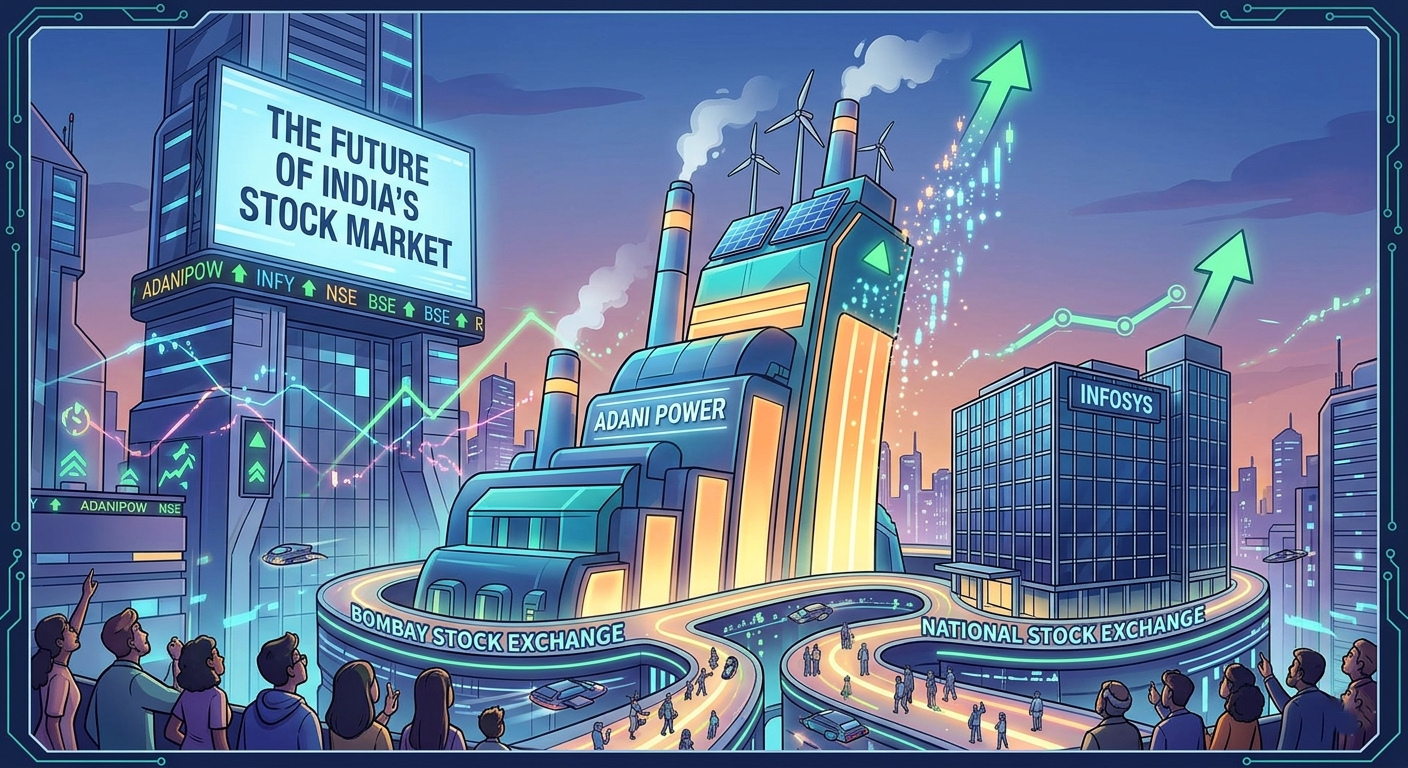
| In the history of India’s stock market, a handful of moments have announced a shift in economic eras. Today — May 27, 2026 — may be one of them. For the first time ever, Adani Power has overtaken Infosys in market capitalisation. The energy giant closed the day at ₹252.60 per share with a market cap of ₹4.77 lakh crore, nudging past Infosys at ₹4.69 lakh crore. The numbers themselves are close. The story behind them is enormous. |
📊 The Numbers at a Glance: May 27, 2026
| ⚡ | 67% | Adani Power stock gain in 2026 alone — vs Sensex down ~11% |
| 📹 | 123% | Adani Power’s gain over the last 12 months — nearly 3x in a year |
| ⚡ | ₹252.60 | Adani Power’s 52-week high hit today — a new all-time record |
| 🏢 | ₹4.77L Cr | Adani Power market cap today — India’s 11th most valuable company |
| 💻 | ₹4.69L Cr | Infosys market cap today — slipped to 12th position |
| 📉 | -29% | Infosys share price decline in 2026 — near 52-week low of ₹1,089 |
| 📉 | -11% | BSE Sensex performance in 2026 — a down year for India’s benchmark |
| 💰 | ₹6,498 Cr | Adani Power Q4 FY26 EBITDA — up 27% year-on-year |
⚡ vs 💻 Adani Power vs Infosys: The Full Picture
| Metric | ⚡ Adani Power | 💻 Infosys |
| Sector | Energy / Power | IT Services |
| Stock Price (today) | ₹252.60 (52-week HIGH) | ₹1,159 (near 52-week LOW) |
| Market Cap | ₹4.77 lakh crore (Rank #11) | ₹4.69 lakh crore (Rank #12) |
| 2026 Performance | ⬆️ +67% | ⬇️ -29% |
| 1-Year Performance | ⬆️ +123% | ⬇️ -33% from peak |
| Q4 FY26 EBITDA | ₹6,498 Cr (+27% YoY) | Revenue guidance: 1.5–3.5% FY27 |
| Key growth driver | India power demand + capacity expansion | Weak IT demand + AI disruption fears |
| Expansion plan | 18.2 GW → 42 GW capacity by FY32 | Cautious hiring; AI-led restructuring |
🔥 Why Adani Power Is on Fire in 2026
Adani Power’s 67% rise in 2026 is not hype or speculation. It is backed by real fundamentals that are directly tied to India’s economic growth story.
| 🌡️ | India’s Heatwave + Soaring Power Demand 2026 has delivered India’s most intense heatwave in recorded history. Peak power demand hit record levels, with air conditioner usage surging across homes, offices, and data centres. Adani Power’s plants ran near full capacity to meet demand. Higher utilisation = higher revenue = higher profits. |
| 🧠 | The AI Data Centre Boom Every AI model being trained or run in India needs enormous amounts of electricity. Amazon, Google, Microsoft, and Reliance Jio are all building massive data centres in India — and all of them need power contracts. Adani Power is signing long-term Power Purchase Agreements (PPAs) with these data centre operators. |
| 🚀 | Capacity Expansion to 42 GW Adani Power is doubling down on growth. Its current installed capacity of 18.2 GW is being expanded to 42 GW by FY32 — a 2.3x increase. The market is pricing in future earnings from this expansion, not just current ones. |
| 💰 | Strong Q4 FY26 Results Q4 EBITDA of ₹6,498 crore was up 27% year-on-year — far ahead of analyst estimates. Net profit also beat expectations. When a company delivers results that are better than expected, institutional investors pile in. |
| 🇮🇳 | India’s Infrastructure Supercycle India is in the middle of a once-in-a-generation infrastructure buildout: highways, railways, ports, airports, smart cities, and data centres. Every new infrastructure project needs power. Adani Power is positioned at the intersection of every major government capex theme. |
💻 Why Infosys Is Struggling in 2026
Infosys falling 29% in 2026 is not a company failure — it is a sector story. The entire Indian IT services industry is navigating a perfect storm of headwinds that has nothing to do with Infosys’ quality or management.
- AI is disrupting IT services. The bread-and-butter of Indian IT — outsourced software development, testing, maintenance, and back-office work — is increasingly being automated by AI tools like GitHub Copilot, Claude, and GPT-4. Clients who once hired 100 engineers now need 40, and want to pay less. Infosys guided FY27 revenue growth of just 1.5–3.5% — its weakest guidance in years.
- Global IT spending is cautious. US and European companies — Infosys’ largest clients — are cutting discretionary IT budgets amid economic uncertainty, high interest rates (the Warsh Fed effect), and their own AI-led restructuring. Less client spending = less outsourcing revenue for India’s IT giants.
- The rupee depreciation silver lining is fading. Indian IT companies earn in dollars but pay costs in rupees. A weaker rupee usually boosts their reported profits. But in 2026, even this currency tailwind has not been enough to offset the demand weakness.
- The stock had already run too far. Infosys hit an all-time high of ₹1,727.85 in the past year, driven by AI optimism. When the reality of subdued growth guidance landed, the correction was sharp. From peak to today, the stock has fallen 33%.
| Important context: Infosys is still a profitable, cash-generative, world-class company. It has ₹59,000 crore in cash, pays strong dividends, and will adapt to the AI era just as it adapted to every technology shift before. This is a valuation reset, not a collapse. The question is how long the reset takes. |
🧠 The Bigger Signal: What This Market Shift Is Telling India
The Adani Power-Infosys market cap crossover is more than a stock market event. It is a mirror of India’s economic transformation.
For two decades, India’s identity in global markets was built on software and services — Infosys, TCS, Wipro, HCL. India was the world’s back office, then its innovation centre. IT stocks dominated the Sensex and Nifty’s top-10 rankings.
Today, that narrative is sharing space with a new one: India as a physical infrastructure powerhouse — power, roads, ports, data centres, semiconductors, defence. The companies riding this wave — Adani Power, NTPC, Larsen & Toubro, Bharat Electronics — are displacing IT names in the top market cap rankings.
Neither story is wrong. Both are true simultaneously. India is building new physical infrastructure while its digital economy evolves. But the stock market is voting on which story it believes in more right now — and today, energy won.
| The investment implication: Many retail Indian investors built wealth over the last 20 years by betting on IT stocks. The next 20 years may reward those who bet on India’s physical infrastructure — power, logistics, manufacturing, and defence. The Adani Power story is the loudest early signal of that shift. |
💰 What Should Indian Investors Do? A Practical Guide
This article is not investment advice. But here is what informed, evidence-based thinking looks like in the current environment:
If you hold Infosys or other IT stocks:
Do not panic-sell based on today’s market cap headline. Infosys is fundamentally solid. The weakness is cyclical and sector-wide, not a company-specific collapse. If you have a long-term horizon (5+ years), IT stocks at current valuations could represent an entry point rather than an exit signal. Watch the quarterly guidance closely for signs of a demand recovery.
If you are looking at energy / power sector stocks:
The fundamentals are strong but the run has been steep. Adani Power has surged 123% in a year. Stocks that run this fast can correct sharply on any negative news. If you are entering now, stagger your purchases (SIP-style), don’t put all your capital in at once, and have a long enough horizon to ride out volatility.
The diversification lesson this market is teaching:
- A portfolio concentrated in IT in 2024 would have underperformed badly in 2026
- A portfolio that included energy, infrastructure, and defence alongside IT would have delivered far better returns
- Sector rotation is a real phenomenon: what leads the market in one cycle often lags in the next
- India’s energy transition story — from fossil fuels to renewables to nuclear — has a decade-long runway of growth
❓ Frequently Asked Questions
Why has Adani Power’s stock surged so much in 2026?
Three main drivers: India’s record heatwave boosting power demand to all-time highs; the AI data centre boom creating massive new electricity demand; and Adani Power’s aggressive capacity expansion plan to 42 GW by FY32 giving the market confidence in future earnings. Q4 FY26 EBITDA of ₹6,498 crore, up 27% year-on-year, confirmed the fundamentals match the stock price.
Why is Infosys share price falling in 2026?
AI-led disruption of IT services (reducing demand for outsourced software development), weak global IT spending by US and European clients, and a muted revenue growth guidance of just 1.5-3.5% for FY27 have all combined to pressure Infosys and the broader IT sector. The stock corrected sharply after the guidance disappointed the market.
Is Adani Power a good investment now?
This article does not provide personalised investment advice. What can be said objectively: Adani Power’s fundamentals are strong, backed by real demand and a credible capacity expansion plan. However, after a 123% run in 12 months, the stock is pricing in significant future growth. Investors entering now should be aware of valuation risk and invest with a long-term horizon. Consult a registered financial advisor before making any investment decision.
Has Infosys permanently lost its status?
No. Infosys remains India’s second-largest IT company by revenue, employs over 300,000 people globally, and generates strong cash flows. The market cap dip below Adani Power reflects current sector sentiment, not a permanent structural downgrade. If global IT demand recovers and Infosys successfully pivots its AI strategy, the stock could re-rate significantly.
What does this mean for the Sensex and Nifty?
The Sensex is down approximately 11% in 2026, reflecting broader market uncertainty driven by FII outflows ($5 billion withdrawn in early 2026), global rate concerns, and sector rotation. However, sectors like energy, infrastructure, defence, and manufacturing have outperformed. This divergence suggests a selective market — not a broad bear market, but a rotation from old leadership to new.
Disclaimer: This article is for informational and educational purposes only. It is based on publicly available reports and policy updates. It should not be considered financial, investment, legal or business advice.