





























Iran-USA Deal and the Strait of Hormuz: What Is Happening, What It Means for Oil, and Why Every Indian Should Care

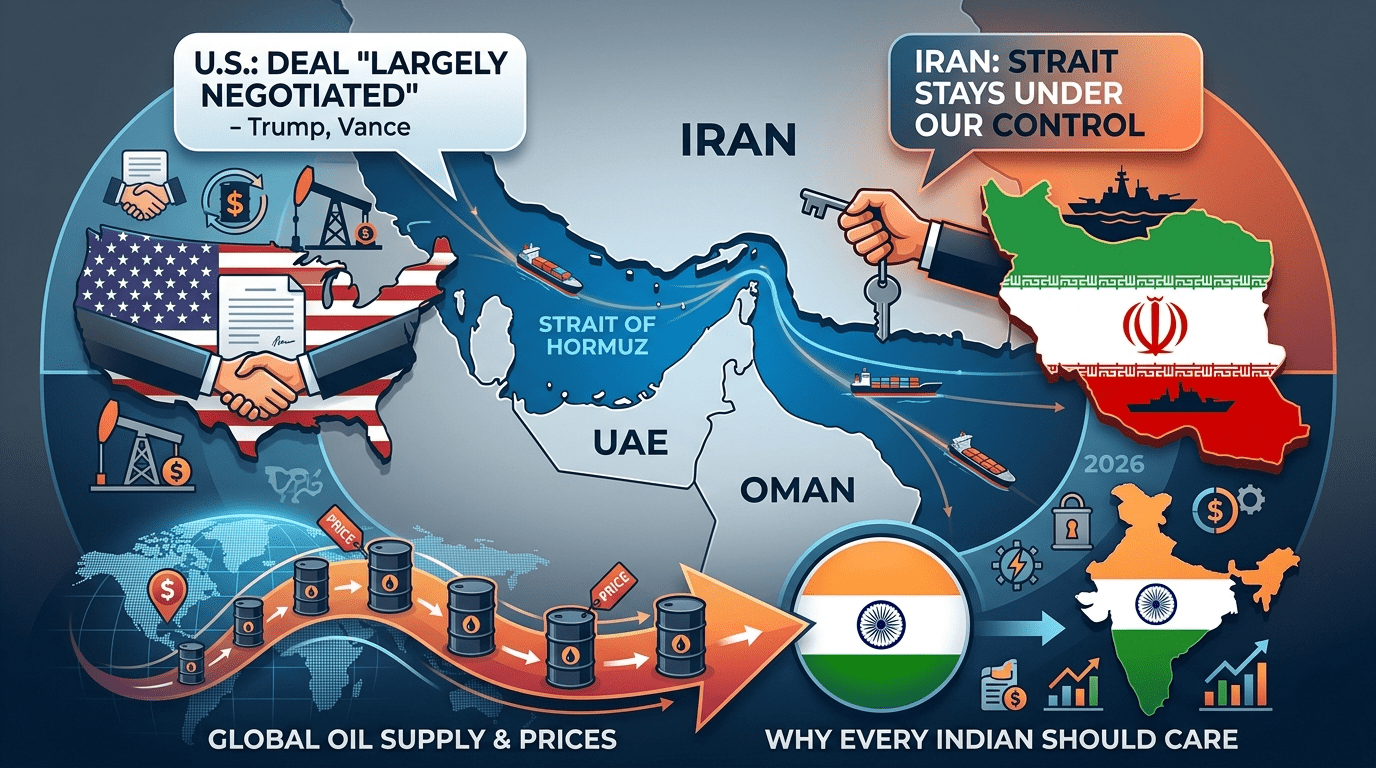
Trump says a deal is ‘largely negotiated.’ Iran says the Strait stays under its control. VP Vance says they’re ‘very close but not there yet.’ The world’s most important shipping lane is at the centre of the biggest geopolitical story of 2026. Here is the full picture in under five minutes.
| The situation right now: The US and Iran are in the final stages of a two-phase framework agreement. Phase One: reopen the Strait of Hormuz and extend the ceasefire for 60 days. Phase Two: deep negotiations on Iran’s nuclear programme, frozen assets, and Lebanon. Trump posted on Truth Social that the deal is ‘largely negotiated.’ Iran’s negotiator fired back that concessions were won ‘through missiles, not talks.’ VP Vance told reporters: ‘very close, not there yet.’ This story is moving fast — here is everything you need to understand it. |
🗺️ Why the Strait of Hormuz Matters to the Whole World
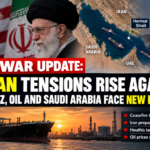
The Strait of Hormuz is a narrow waterway between Iran and Oman, barely 34 kilometres wide at its narrowest point. Through it passes approximately 21% of the world’s total oil supply — roughly 17–20 million barrels every single day. If you close this strait, you do not just disrupt Iran and its neighbours. You disrupt every economy on Earth that uses oil — which is every economy on Earth.
When Iran began restricting Hormuz access in early 2026 as the US-Iran conflict escalated, global oil prices spiked sharply, inflation in the United States hit its highest level in years, and India’s import bill ballooned. India imports over 85% of its crude oil. Every dollar rise in oil prices costs India approximately ₹80–85 crore per day in additional import costs. The Hormuz closure was not just a Middle East story. It was an India story.
🕜 How Did We Get Here? The War Behind the Deal
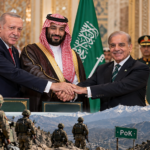
The current US-Iran conflict escalated sharply through late 2025 and early 2026. The US and Israel conducted coordinated airstrikes on Iranian nuclear and military infrastructure. Iran’s response included missile strikes on US bases in the region and, critically, restricting navigation through the Strait of Hormuz — the most powerful economic weapon in Tehran’s arsenal. Pakistan emerged as the unlikely mediator, with PM Shehbaz Sharif facilitating communication channels between Washington and Tehran.
A fragile ceasefire has been in place since approximately April 2026. But ‘ceasefire’ and ‘peace deal’ are very different things. The ceasefire stops the bombs. The deal being negotiated now is supposed to stop the structural confrontation — the nuclear programme, the sanctions, and the question of who ultimately controls the world’s most strategically important waterway.
🤝 What the Deal Actually Involves: Phase 1 and Phase 2
According to US officials, CNN, and Axios reporting from multiple sources, here is the two-phase framework:
Phase 1 — Immediate (Already Partially Agreed)
- Iran reopens the Strait of Hormuz to full commercial shipping, de-mines the waterway, and restores pre-war navigation status
- The US lifts its naval blockade on Iranian ports
- Iran is allowed to resume limited oil and fuel sales
- A formal Memorandum of Understanding (MoU) formalises the ceasefire extension for 60 days
Phase 2 — The Hard Part (30–60 Days of Talks)
- Iran’s highly enriched uranium stockpile: Trump demands removal and destruction; Iran insists it stays
- Uranium enrichment: the US wants a decade-long suspension; Iran has shown no willingness
- Frozen Iranian assets: estimated at over $100 billion; Iran wants them back immediately
- Lebanon: the US and Israel want the Iran-backed Hezbollah disarmed; Iran refuses
| The sticking point in plain English: Iran’s chief negotiator Mohammed Bagher Ghalibaf said on X that his country obtains ‘concessions through missiles, not through talks.’ Translated: Tehran is willing to open Hormuz in exchange for sanctions relief and frozen assets — but it will not voluntarily give up the nuclear programme that it considers its ultimate insurance policy. That gap between what Trump needs to sell a deal domestically and what Iran will actually agree to is the central problem that has kept this at ‘largely negotiated’ rather than ‘fully signed.’ |
🇮🇳 What This Means for India
India has a direct, material stake in this deal. The economic implications are immediate and significant. A fully reopened Strait of Hormuz means Indian oil imports — which rely heavily on Gulf suppliers — become cheaper, faster, and more reliable overnight. The rupee gets breathing room. The RBI gets more flexibility to cut interest rates without inflation pressure from oil. Indian Airlines, manufacturers, and every consumer who uses LPG cylinders will feel the difference within weeks.
More broadly, India has navigated this conflict with characteristic strategic balance: buying Russian oil at a discount throughout, maintaining diplomatic channels with both Tehran and Washington, and watching Pakistan’s unexpected role as mediator with close attention. As the Rubio-Jaishankar meetings in May 2026 confirmed, India and the US are aligned on wanting Hormuz open and Iranian nuclear ambitions contained — even if they disagree on methods.
❓ What Happens Next?
The most likely immediate scenario is a signed MoU for Phase 1 within the next 7–14 days, reopening Hormuz and triggering a global oil price drop. That alone would be the most consequential geopolitical event of 2026 for commodity markets, inflation, and monetary policy globally.
Phase 2 is harder. The nuclear question has resisted resolution for over two decades. A 60-day negotiating window will not solve it. The real question is whether enough trust can be built in Phase 1 to make both sides willing to genuinely negotiate rather than grandstand in Phase 2. Iran’s supreme leader Ayatollah Khamenei has not publicly approved any framework — and without that, nothing the negotiators agree is binding.
This story is not over. But for the first time in years, the possibility of a genuine US-Iran settlement is being taken seriously by both sides. The world is watching the 34-kilometre strait that controls 20% of its oil. So should you.
| The India bottom line: A reopened Strait of Hormuz = lower oil prices = lower petrol prices = lower inflation = more RBI rate cuts = cheaper home loans for you. That is the direct chain from a piece of water in the Persian Gulf to your EMI. Watch this deal carefully. |
❓ FAQs
Has the Iran-US deal been signed?
Not yet as of June 2, 2026. Trump described it as ‘largely negotiated.’ VP Vance said the US was ‘very close but not there yet.’ Iran has not confirmed any signed agreement and its negotiators have publicly contradicted Trump’s characterisation. A formal MoU for Phase 1 (Hormuz reopening) is the immediate target, but as of this writing, it has not been signed.
Is the Strait of Hormuz open right now?
Partially. A ceasefire framework from April 2026 allowed some commercial shipping to resume. However, the full pre-war navigation status has not been formally restored. Full reopening is the key deliverable of Phase 1 of the deal currently being negotiated.
Why is Pakistan mediating between the US and Iran?
Pakistan shares a border with Iran and has historically maintained diplomatic ties with Tehran that the US cannot replicate directly. After Operation Sindoor changed South Asia’s strategic landscape in May 2025, Pakistan actively sought to raise its global diplomatic profile. The US channelled key proposals to Iran through Pakistani mediators. PM Trump publicly credited Pakistan’s role, and PM Shehbaz Sharif congratulated Trump on what he called ‘extraordinary efforts for peace.’
Disclaimer: This article is for informational and educational purposes only. It is based on publicly available reports and policy updates. It should not be considered financial, investment, legal or business advice.