








































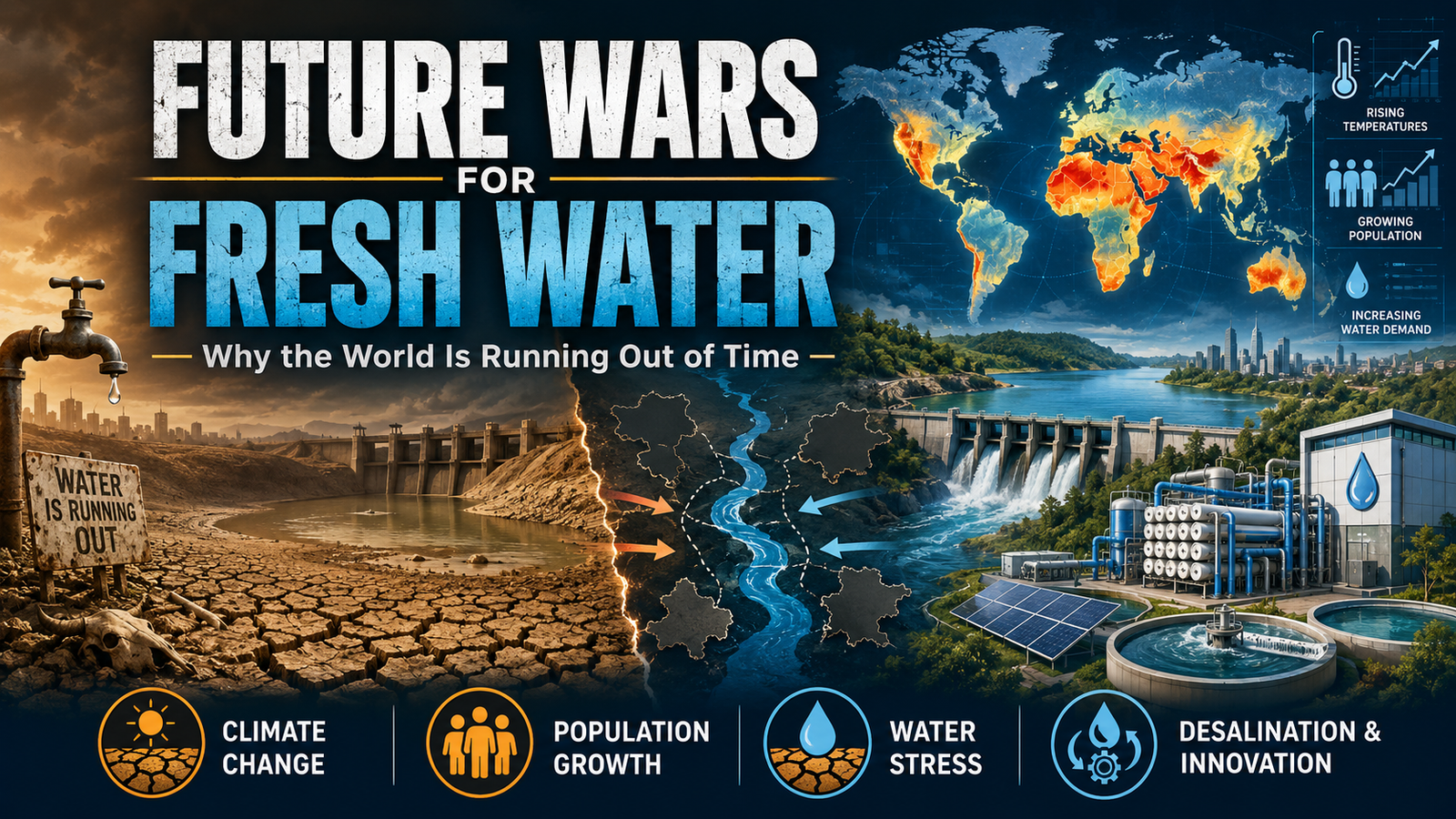
Future Wars May Be Fought for Fresh Water: Why the World Is Running Out of Time

For decades, the world worried about wars over oil. But the next major global conflict may not begin with oil. It may begin with water.
Fresh water is becoming one of the most important resources of the 21st century. Climate change is changing rainfall patterns, glaciers are melting, rivers are becoming unpredictable, groundwater is falling and the global population is still growing.
More people means more demand for drinking water, food, electricity, industry and agriculture. But the amount of usable fresh water on Earth is limited.
This is why experts increasingly warn that water scarcity can become a major driver of conflict.
Why Fresh Water Is Becoming So Important
Water is not only used for drinking. It is used to grow food, produce electricity, run factories, cool data centres, support livestock, clean cities and maintain public health.
Agriculture alone uses most of the world’s freshwater withdrawals. As populations grow, countries need more food. More food means more irrigation. More irrigation means more pressure on rivers, lakes and groundwater.
At the same time, climate change is making water less predictable. Some regions are facing longer droughts, while others are facing sudden floods. This means even countries with rivers and rain cannot always depend on stable water supply.
In simple words, the problem is not just “less water.” The problem is water arriving at the wrong time, in the wrong place, or in destructive ways.
Climate Change Is Changing the Water Cycle
The old water cycle is becoming unstable.
Higher temperatures increase evaporation. Glaciers melt faster. Rainfall becomes more extreme. Rivers may flood one season and dry up the next. Groundwater is being pumped faster than it can naturally recharge.
This creates a dangerous situation for countries that depend on shared rivers.
If upstream countries build dams or divert water, downstream countries may feel threatened. If drought reduces river flow, tension grows. If food production falls, governments face public anger.
That is how water scarcity can become a security issue.
The Population Pressure
The world’s population has crossed 8 billion and continues to rise. Most future population growth is expected in regions already facing water stress, including parts of Africa, South Asia and the Middle East.
This creates a simple but serious equation:
More people need more food.
More food needs more water.
More water demand creates more competition.
If governments fail to manage this pressure, water shortages can lead to migration, protests, food inflation, border tension and internal unrest.
Water does not always directly cause war, but it can make existing political, ethnic, economic and border conflicts much worse.
The World’s Water Flashpoints
Several regions already show how water can become a geopolitical issue.
The Nile River is a major source of tension between Ethiopia, Sudan and Egypt because millions of people depend on the river for agriculture and survival.
The Tigris-Euphrates basin affects Turkey, Syria and Iraq, where dams, drought and conflict are already connected.
The Indus River system is critical for India and Pakistan. Any dispute over water becomes extremely sensitive because both countries are nuclear-armed neighbours.
The Mekong River affects China and Southeast Asian countries. Upstream dams can change water flow for downstream nations.
The Brahmaputra is also strategically important for India, China and Bangladesh.
These are not small local disputes. They are river systems connected to food security, national security and political survival.
Water as a Weapon
In modern conflicts, water infrastructure is often attacked, blocked or used as pressure.
Dams, pipelines, pumping stations and reservoirs can become military targets. Cities can be pressured if water supply is cut. Farmers can be destroyed if irrigation systems fail.
This is why water security is now national security.
A country without stable water cannot have stable agriculture, stable cities or stable public health.
Can Ocean Water Save the World?
The Earth has plenty of water, but most of it is salty ocean water. The dream solution is simple: turn seawater into fresh water.
This is called desalination.
Desalination is already used in countries such as Saudi Arabia, UAE, Israel and parts of Australia. It can provide drinking water to dry regions, especially coastal cities.
But desalination has challenges.
It needs a lot of energy. It can be expensive. It creates salty waste called brine, which must be managed carefully. It is easier for rich coastal countries than for poor inland regions.
So desalination is important, but it is not a magic solution for the whole world.
The Need for a Breakthrough
The world urgently needs cheaper, cleaner and scalable water technology.
Future breakthroughs may come from solar-powered desalination, better membranes, atmospheric water harvesting, wastewater recycling, AI-based water management and low-cost filtration.
If scientists can make ocean-water desalination cheap and clean, it could change global politics.
Imagine a world where dry coastal countries can produce fresh water at low cost. That would reduce pressure on rivers, farmers and groundwater. It could also reduce the risk of water conflicts.
But until that breakthrough becomes affordable for everyone, water will remain a major pressure point.
What India Should Learn
India must take water security seriously.
India has growing cities, rising industrial demand, unpredictable monsoons and heavy dependence on groundwater. Some regions face floods, while others face droughts.
The solution is not only building more dams. India needs rainwater harvesting, river-basin planning, wastewater reuse, drip irrigation, crop diversification, groundwater recharge and better urban water management.
India must also invest in desalination for coastal cities, but not blindly. Desalination should be powered by clean energy and used along with conservation.
Water security should be treated like defence security.
The Future: Cooperation or Conflict
The world has two choices.
Countries can cooperate through river treaties, data sharing, water-saving technology and climate adaptation.
Or they can fight over rivers, dams, borders and food shortages.
The better path is cooperation. But cooperation requires trust, transparency and responsible governance. If countries use water as a pressure tool, conflict risk will rise.
Water should become a bridge between nations, not a battlefield.
Final Thoughts
Future wars may not be fought only for oil, land or ideology. They may increasingly be fought over fresh water.
Climate change is making water more unpredictable. Population growth is increasing demand. Agriculture is consuming huge volumes. Groundwater is declining. Rivers are becoming political flashpoints.
Unless the world develops affordable ways to produce fresh water from oceans, reuse wastewater and manage rivers fairly, water scarcity will become one of the biggest security threats of this century.
The message is clear: the countries that manage water wisely will survive and grow. The countries that ignore water will face crisis, migration, economic stress and conflict.
Water is life. In the future, it may also become power.
FAQs
Will future wars really be fought for water?
Water may not always be the only cause of war, but it can become a major trigger or risk multiplier in regions already facing political tension, drought and food insecurity.
Why is fresh water becoming scarce?
Fresh water is under pressure because of climate change, population growth, pollution, overuse, groundwater depletion and rising demand from agriculture and industry.
Can desalination solve the water crisis?
Desalination can help, especially in coastal regions, but it is still energy-intensive and expensive for many countries. It also creates brine waste that must be managed carefully.
Which regions face high water-conflict risk?
Major risk areas include the Nile, Indus, Brahmaputra, Tigris-Euphrates, Mekong, Jordan River and Lake Chad basins.
What should India do to prepare?
India should invest in water conservation, rainwater harvesting, wastewater reuse, drip irrigation, groundwater recharge, desalination for coastal cities and stronger river-basin management.
Disclaimer: This article is for informational and educational purposes only. It does not predict any specific war. It discusses water scarcity as a growing geopolitical and environmental risk based on publicly available research.