















































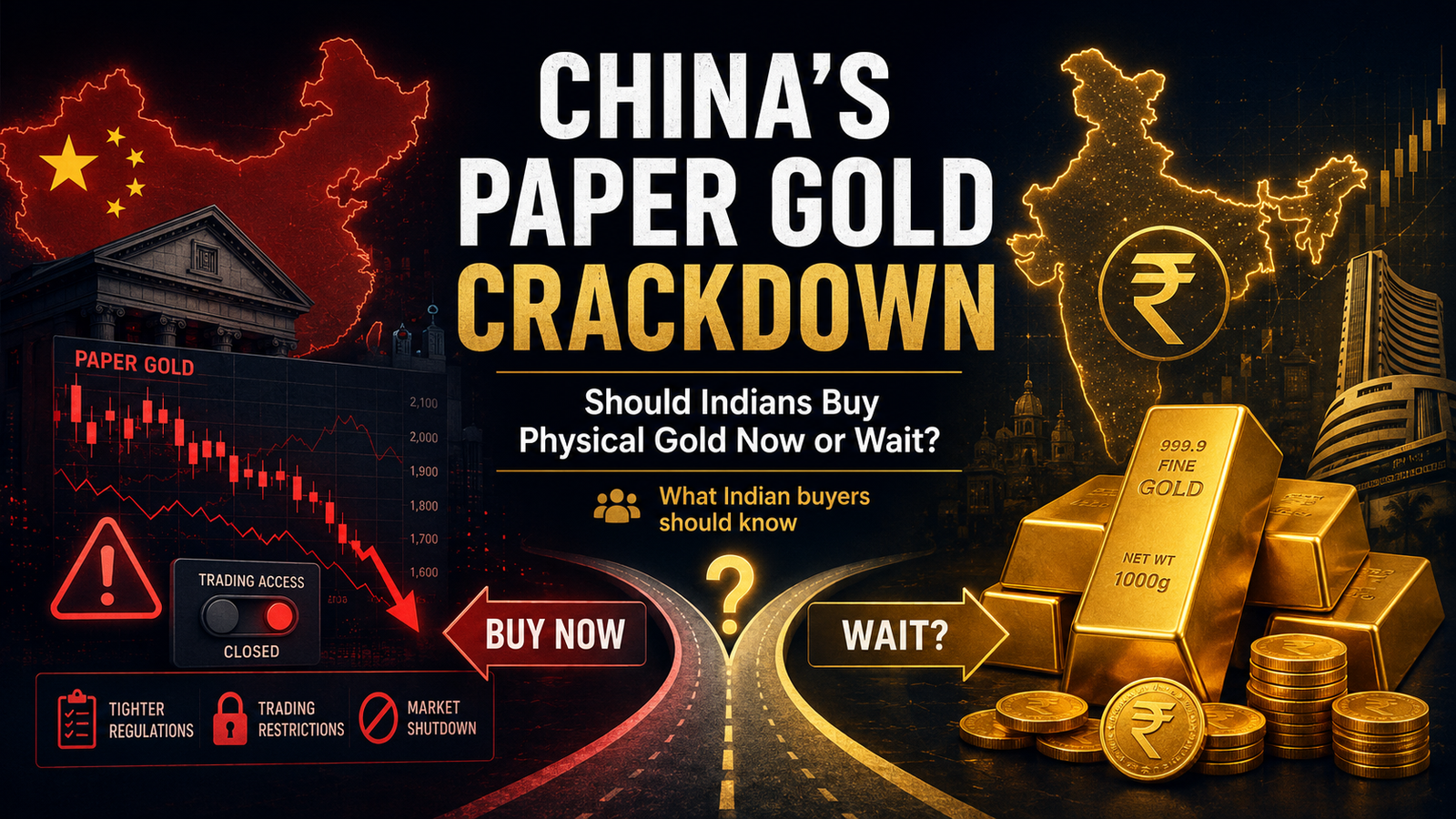
China’s Paper Gold Crackdown: Should Indians Buy Physical Gold Now or Wait?

Gold is back in the spotlight after major Chinese banks began shutting down or scaling back retail precious-metal trading services. Industrial and Commercial Bank of China, or ICBC, said it would stop offering individual precious-metal trading linked to the Shanghai Gold Exchange from July 24. Similar moves have also been reported by Postal Savings Bank of China, Ping An Bank and China Guangfa Bank.
This has triggered a big question among investors: is China quietly moving away from paper gold and toward physical gold?
The answer is important for Indian buyers because China and India are two of the world’s biggest gold markets. Any major shift in Chinese gold demand can affect global prices — and eventually Indian gold rates.
What Is Happening in China?
Chinese banks are not banning gold. They are reducing retail access to certain paper and margin-based precious-metal trading products.
These products allow investors to trade gold exposure without necessarily taking delivery of physical gold. In simple language, many people are trading the price of gold, not holding real gold.
Banks are taking this step after extreme volatility in gold and silver prices. Gold has corrected sharply from its 2026 highs, and banks appear to be reducing risk for retail investors.
So this is partly a risk-control move. But it also reveals something bigger: in uncertain times, paper promises are being questioned, while physical gold remains trusted.
Why Paper Gold Matters
Paper gold includes futures, margin trades, certificates and other financial products linked to the gold price. These instruments increase liquidity, but they can also create huge speculative positions.
Some gold investors believe paper trading keeps physical gold prices under pressure because large volumes of gold exposure can be traded without actual delivery of metal.
This argument has logic, but it should not be oversimplified. Paper gold does not automatically “control” the entire gold market. Global prices are also affected by U.S. interest rates, the dollar, central-bank buying, inflation, geopolitical risk, ETF flows and jewellery demand.
However, if more investors shift from paper gold to physical gold, physical premiums can rise, supply can tighten and long-term price support can become stronger.
China’s Physical Gold Signal
China’s central bank has continued adding gold to its reserves. The People’s Bank of China has been buying gold for many months, and World Gold Council data shows Chinese official gold holdings have continued to rise.
This matters because central banks do not buy gold for short-term trading. They buy it for long-term reserve security.
At the same time, many central banks globally are reducing dependence on the U.S. dollar and increasing interest in gold. This trend supports the idea that gold is becoming more important in the global financial system.
In simple words, big institutions are treating gold as strategic protection.
Why Gold Prices Are Falling Right Now
Despite strong long-term demand, gold has corrected sharply in June 2026. Spot gold recently traded near the $4,000 per ounce level and is heading for one of its worst quarterly performances in years.
The main reason is the U.S. Federal Reserve. If interest rates stay high or rise further, gold becomes less attractive in the short term because gold does not pay interest.
A strong dollar also pressures gold prices.
So the market is currently divided. Long-term demand is strong, but short-term macro pressure is also strong.
What Does This Mean for Indian Buyers?
Indian gold buyers should not panic, but they should pay attention.
If China’s retail investors move away from paper gold and increase physical buying, global physical demand may rise over time. This could support prices later.
But prices may not shoot up immediately. Gold can still fall further if the dollar strengthens, U.S. rates rise or global markets calm down.
For Indian buyers, the best strategy is not emotional buying. The best strategy is phased buying.
Should You Buy Gold Now or Wait?
If you are buying gold for long-term wealth protection, this correction can be used slowly. Do not invest everything at once.
A practical strategy is to buy in parts:
Buy a small portion now if you want long-term exposure.
Keep cash ready in case gold falls further.
Add more if prices correct toward stronger support zones.
Avoid chasing sudden rallies.
For jewellery buyers, buy only what is needed. Making charges, GST and wastage can reduce investment value.
For investors, gold ETFs or gold mutual funds may be more efficient than jewellery.
Will Physical Gold Price Shoot Up?
Physical gold prices can rise strongly if three things happen together: central banks keep buying, Chinese physical demand increases and the U.S. dollar weakens.
But if the Fed remains hawkish, gold may stay under pressure for some time.
So the answer is: physical gold has strong long-term support, but short-term volatility is not over.
Final Thoughts
China’s move to restrict retail paper-gold trading is an important signal. It shows that banks are worried about volatility and retail risk. It also strengthens the debate around paper gold versus physical gold.
For Indian investors, the message is clear: gold remains a powerful long-term asset, but timing still matters.
Do not wait forever hoping gold will crash. Do not buy aggressively because of social media fear. Use this correction to accumulate slowly if gold fits your financial plan.
The smartest gold strategy today is simple: buy gradually, prefer quality, avoid leverage and think long term.
Gold may correct more in the short term, but the global shift toward physical reserves and central-bank gold buying suggests that gold’s long-term story is far from over.
FAQs
Has China banned gold trading?
No. China has not banned gold trading. Major banks are scaling back or stopping certain retail paper and margin-based precious-metal trading services.
Does this mean physical gold will rise immediately?
Not necessarily. It may support physical demand over time, but short-term gold prices still depend on the U.S. dollar, interest rates and global risk sentiment.
Should Indians buy gold now?
Long-term buyers can consider gradual accumulation. Avoid buying everything at once.
Is physical gold better than paper gold?
Physical gold gives direct ownership, but has storage, GST and making-charge issues. ETFs and gold funds may be easier for investment purposes.
Can gold fall more?
Yes. Gold can fall further if U.S. interest rates remain high and the dollar strengthens.
Disclaimer: This article is for informational and educational purposes only. It is not financial or investment advice. Gold prices are volatile. Please consult a qualified financial advisor before making investment decisions.