











































Ethanol Fuel in India: Waste-to-Fuel Solution or Trouble for E20 Car Owners?

India’s ethanol blending programme has become one of the country’s most important energy-security moves. At a time when global oil markets are unstable because of wars, sanctions, shipping disruptions and geopolitical tension, India cannot depend forever on imported crude oil.
This is where ethanol matters.
Ethanol blending means mixing ethanol with petrol. E20 means 20% ethanol and 80% petrol. The idea is simple: replace part of imported petrol with fuel produced inside India.
For a country that imports most of its crude oil, this is not just an environmental policy. It is an economic and strategic policy.
Why Ethanol Blending Is Good for India
India imports a huge share of its crude oil requirement. Whenever oil prices rise globally, India pays more in dollars. That affects fuel prices, inflation, foreign exchange reserves and the rupee.
Ethanol helps reduce this pressure.
Instead of sending money outside India to buy crude oil, part of that money goes to Indian farmers, sugar mills, distilleries and rural industries. This creates a local fuel economy.
According to government data, India’s ethanol blending programme has already helped save large foreign exchange, reduce crude oil substitution and cut carbon emissions. This is why the government calls farmers not only “Annadatas” but also “Urjadatas” — energy providers.
In simple language, ethanol keeps more money inside India.
Why Ethanol Matters During an Unstable Oil Market
The world is no longer a predictable oil market. Conflicts in West Asia, Russia-Ukraine tensions, shipping risks in the Red Sea and Strait of Hormuz, OPEC decisions and U.S. interest rates can all affect crude oil prices.
If India depends only on imported oil, every global shock becomes an Indian economic problem.
Ethanol blending gives India a buffer. It cannot replace all petrol immediately, but even partial replacement reduces risk.
Every litre of ethanol blended into petrol means slightly less crude oil imported from outside.
That is why ethanol blending is part of Atmanirbhar Bharat.
Is Ethanol Made Only from Sugarcane?
This is one of the biggest misunderstandings.
Many people think ethanol in India is made only from sugarcane. That is not true.
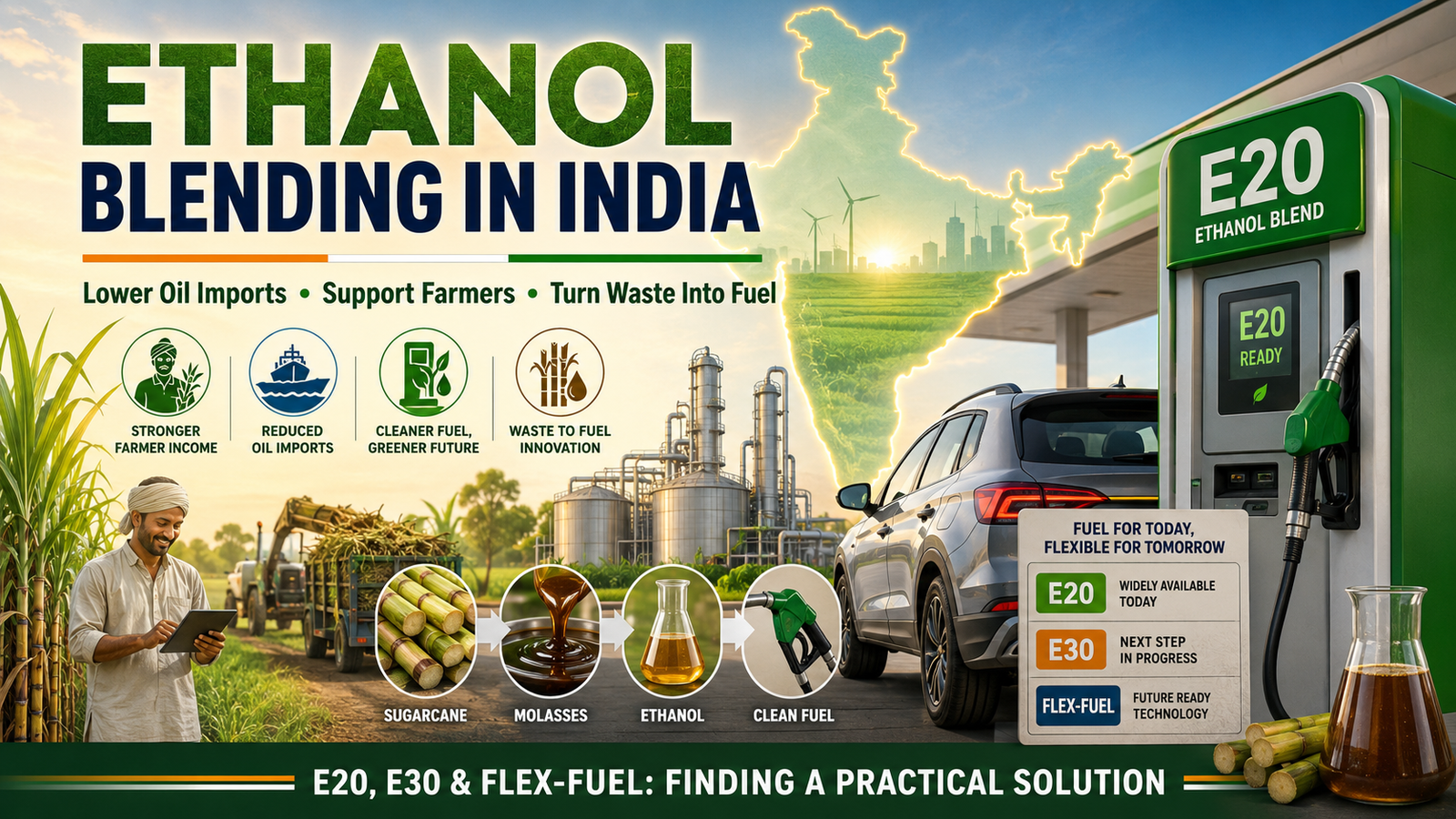
India produces ethanol from multiple sources, including sugarcane molasses, sugarcane juice, syrup, broken rice, maize, surplus grains and newer second-generation sources such as paddy straw, bamboo, bagasse and agricultural residues.
Yes, sugarcane is water-intensive. That concern is valid. India should not blindly expand sugarcane cultivation only for fuel. But a large part of ethanol production also comes from molasses, which is a by-product of the sugar industry.
Molasses is not the main sugar product. It is left behind after sugar processing. Earlier, this by-product had limited use. Now it can be converted into fuel.
That means India is not just growing crops for ethanol. It is also converting industrial by-products and agricultural waste into energy.
Waste to Fuel: The Bigger Opportunity
The future of ethanol in India should not depend only on sugarcane. The real opportunity is waste-to-fuel.
Second-generation ethanol, also called 2G ethanol, can be produced from crop residues such as paddy straw, sugarcane bagasse, bamboo and other biomass.
This is important because India has a major agricultural-waste problem. Farmers often burn crop residue because they have limited alternatives. This causes air pollution, especially in North India.
If that same residue can be collected and converted into ethanol, India can solve three problems at once: reduce stubble burning, produce cleaner fuel and give farmers extra income.
This is the direction India must accelerate.
Who Is Producing Ethanol in India?
India’s ethanol ecosystem includes sugar mills, grain-based distilleries, oil marketing companies and advanced biofuel projects.
Major sugar and ethanol producers include companies such as Balrampur Chini Mills, Shree Renuka Sugars, E.I.D.-Parry, Bajaj Hindusthan Sugar and Dwarikesh Sugar. Many sugar mills have expanded ethanol capacity in recent years.
Public sector oil companies such as Indian Oil, Bharat Petroleum and Hindustan Petroleum play a major role in procurement, blending and distribution.
India is also building 2G ethanol capacity. Indian Oil’s Panipat plant uses paddy straw. Numaligarh Refinery’s project in Assam is based on bamboo. BPCL and HPCL also have paddy-straw-based ethanol projects in Odisha and Punjab.
This shows that India’s ethanol future is becoming more diverse and technology-driven.
The E20, E30 and E40 Concern: People Are Not Wrong
While ethanol blending is good for India, consumer concerns must not be ignored.
Many people bought vehicles advertised as E20-compatible. Now they are worried that the government may move toward E30, E40, E85 or even E100 in the future. Their question is fair: if my car is designed for E20, why should I be forced to use E30 later?
This concern needs a clear answer.
The solution is not to stop ethanol blending. The solution is a smarter transition.
India should follow three rules.
First, E20 should remain the standard fuel for normal petrol vehicles for a predictable period.
Second, higher blends such as E30, E85 and E100 should be used only in vehicles certified for those fuels.
Third, fuel pumps must clearly label ethanol content so consumers know exactly what they are buying.
No consumer should feel cheated after buying an E20-ready car.
What Should the Government Do?
The government should publish a clear 10-year ethanol roadmap.
This roadmap should explain which vehicles can use E20, which can use E30, and which require flex-fuel technology.
Higher ethanol blends should be optional at first, not forced on older vehicles. Flex-fuel vehicles should receive incentives, and consumers should get proper information before buying.
There should also be a pricing benefit. Since ethanol has lower energy density than petrol, higher ethanol-blended fuel should be cheaper enough to compensate for any mileage loss.
This is very important. If people get slightly lower mileage but pay the same price, they will feel the policy is unfair.
What Should Car Companies Do?
Automakers should clearly mention fuel compatibility on every vehicle.
A buyer should know whether the vehicle supports E20, E30, E85 or flex-fuel operation. This information should be printed in the manual, fuel lid, service record and dealership documents.
Companies should also provide affordable upgrade kits or service guidance for older vehicles if needed.
India cannot build public trust through vague statements. It needs clear communication.
Ethanol Is Not a Perfect Solution — But It Is a Practical One
Ethanol will not solve all of India’s energy problems. It cannot fully replace crude oil. It also needs careful feedstock planning, water management and food-security protection.
But it is still a strong practical solution for India.
Electric vehicles are growing, but India will continue using petrol vehicles for many years. Ethanol can reduce emissions and oil imports during this transition.
The best energy strategy for India is not one fuel. It is a mix: ethanol, electric vehicles, CNG, green hydrogen, biofuels, solar and better public transport.
Final Thoughts
Ethanol blending is good for India because it reduces crude oil dependence, supports farmers, saves foreign exchange, lowers emissions and turns waste into fuel.
But the policy must be implemented with honesty.
People who bought E20 vehicles should not be suddenly pushed into E30 or E40 without proper vehicle compatibility. Higher blends should come with flex-fuel vehicles, clear pump labelling and lower prices.
India’s ethanol future should also move beyond sugarcane and focus more on molasses, maize, crop residue, bamboo, bagasse and other waste-based feedstocks.
If done properly, ethanol can become a powerful Indian success story: less imported oil, more farmer income, cleaner fuel and better energy security.
The direction is right. Now the execution must be smart.
FAQs
What is E20 petrol?
E20 petrol contains 20% ethanol and 80% petrol.
Is ethanol made only from sugarcane?
No. Ethanol in India is produced from molasses, sugarcane juice, syrup, maize, broken rice, surplus grains and newer sources like paddy straw, bamboo, bagasse and agricultural waste.
Will E30 damage E20 vehicles?
Vehicles certified only for E20 should not be forced to use higher blends unless the manufacturer confirms compatibility. Higher blends need compatible or flex-fuel vehicles.
Why does ethanol reduce oil imports?
Every litre of ethanol blended into petrol replaces part of imported petrol, reducing India’s crude oil dependency.
What is the best solution for consumers?
Clear fuel labelling, predictable policy timelines, flex-fuel vehicle incentives, lower pricing for higher blends and manufacturer-backed compatibility guidance.
Disclaimer: This article is for informational and educational purposes only. Vehicle owners should check their vehicle manual, manufacturer guidance and official fuel compatibility standards before using higher ethanol blends.