
















































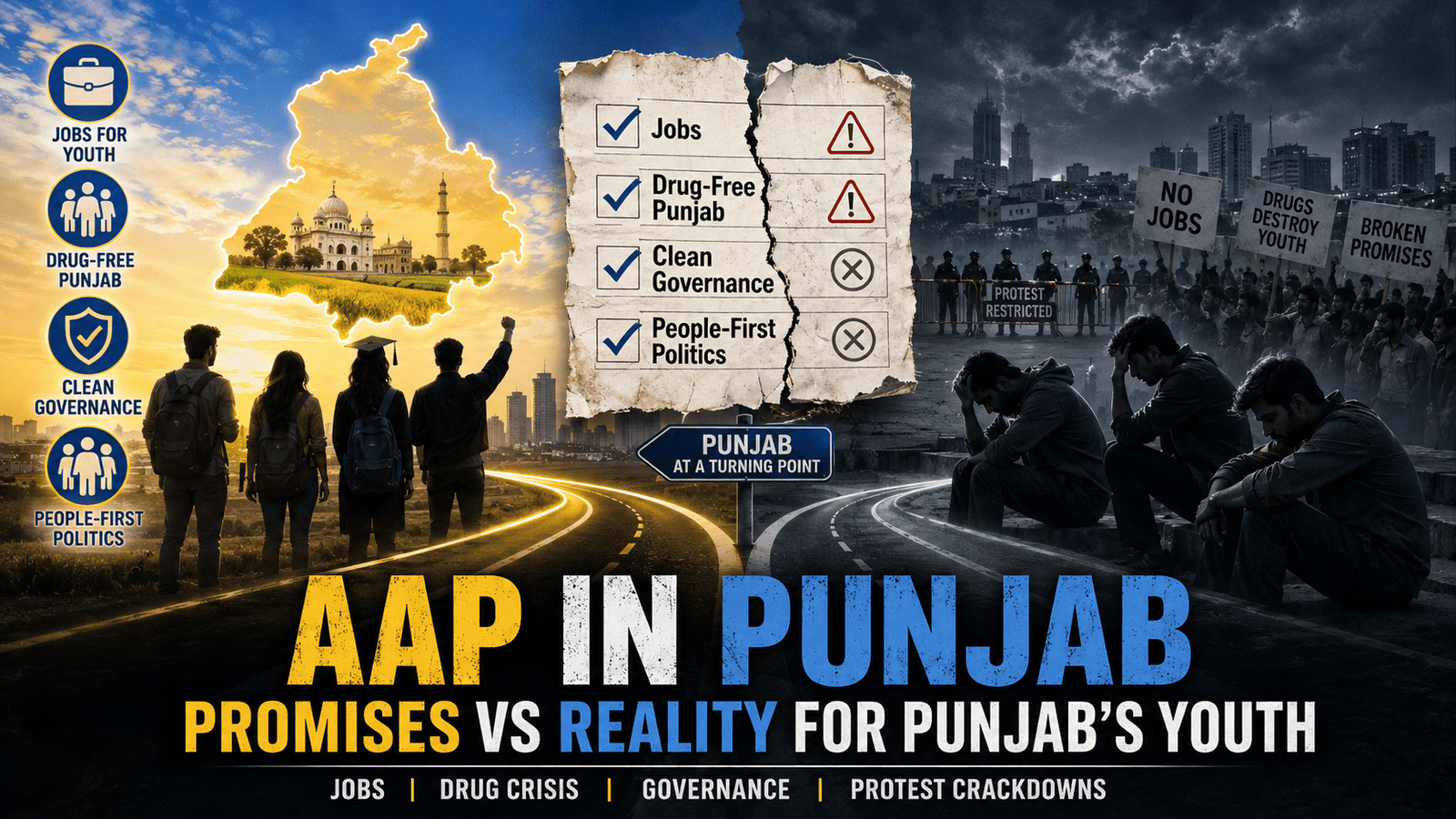
AAP in Punjab: Did the Aam Aadmi Party Fail the Youth and Break Its Biggest Promises?

The Aam Aadmi Party came to power in Punjab with a powerful promise: change. In 2022, many Punjabis voted for AAP because they were tired of old political parties, corruption, unemployment, drugs and broken promises. Arvind Kejriwal and Bhagwant Mann projected AAP as a people’s movement that would listen to the common man, protect youth and bring a new governance model to Punjab.
Four years later, the big question is unavoidable: has AAP delivered the change Punjab was promised?
The answer depends on whom you ask. The AAP government points to free electricity, Aam Aadmi Clinics, government jobs, road works and anti-drug campaigns as proof of delivery. But critics argue that the party’s biggest emotional promises — jobs for youth, a drug-free Punjab, women’s monthly allowance and a politics of peaceful protest — remain either delayed, incomplete or contradicted by ground reality.
What AAP Promised Punjab
Before the 2022 Assembly elections, AAP’s “Punjab Model” placed employment at the center of its campaign. Kejriwal said youth were leaving Punjab because of lack of jobs and promised that AAP would create enough opportunities to make young Punjabis return from abroad.
The party also promised to end the drug mafia, act against corruption, improve schools and hospitals, provide free electricity, support women financially, and bring a people-first governance model.
These promises touched the emotional core of Punjab. The state has suffered from youth migration, drug addiction, farmer distress, law-and-order concerns and a deep feeling that traditional parties failed ordinary families.
AAP did not win Punjab only because people liked freebies. It won because people believed it would be different.
Jobs: The Biggest Youth Question
AAP claims it has provided more than 65,000 government jobs on merit and created lakhs of private-sector opportunities. That is not a small claim and should be acknowledged. Government recruitment, if transparent, is positive.
But Punjab’s youth crisis has not disappeared.
Recent labour data showed Punjab’s unemployment rate in the 15–29 age group at 19.3%, higher than the national average. Rural youth unemployment was even more worrying. This is the core problem: while the government announces jobs, many young people still feel left out, frustrated and forced to protest.
The Patiala apprentice linemen protest exposed this anger. Hundreds of ITI-trained apprentice linemen were protesting outside PSPCL headquarters, demanding recruitment preference and regular employment. The protest ended in a police lathicharge, more than 160 protesters being booked, and a political storm across Punjab.
For a party that built its identity on protest politics, this incident damaged its moral image. AAP often accuses the BJP of suppressing dissent and behaving like a dictatorship. But when job-seeking youth in Punjab faced police force under an AAP government, critics called it hypocrisy.
A government that came to power through protests must be more careful when dealing with protesters.
The Drug-Free Punjab Promise
The drug crisis was one of AAP’s most powerful campaign issues. The party promised to break the drug mafia and make Punjab drug-free. Kejriwal had earlier vowed that the state would be made drug-free within months of AAP coming to power.
But the crisis remains painful.
The government says it has launched “Yudh Nashean Virudh,” arrested thousands and treated more than 90,000 drug abuse victims through de-addiction and OOAT centres. These efforts matter. Rehabilitation is important, and police action against traffickers is necessary.
However, the very fact that tens of thousands still need treatment shows how deep the problem remains. Punjab’s families are not looking only for campaign slogans. They want visible relief in villages, towns and border districts.
When young people continue to fall into addiction, when families still fear drugs reaching their children, and when opposition parties keep raising overdose and trafficking concerns, AAP cannot simply declare victory.
Punjab does not need deadline-based announcements. It needs sustained rehabilitation, border security, police accountability, job creation and community-level prevention.
Women’s ₹1,000 Promise: Delivered, But Very Late
AAP had promised ₹1,000 per month to women above 18. This became one of its most popular election guarantees.
But the promise remained delayed for years. The government finally announced the Chief Minister Mawan-Dhiyan Satkar Yojana in the 2026–27 Budget, nearly four years after coming to power and less than a year before the next election.
Supporters will say AAP eventually fulfilled the promise. Critics will say the timing looks political. If a promise is fulfilled only near the next election, voters naturally ask why it took so long.
Welfare schemes are important, but timing matters. Trust is built when promises are delivered early and consistently, not just when elections approach.
Education and Health: Progress, But Questions Remain
AAP’s strongest claim is in health and education. The government says it opened hundreds of Aam Aadmi Clinics, upgraded classrooms and filled posts. These are visible governance areas and should not be dismissed.
But the larger question is whether these changes are deep enough to transform Punjab’s youth future. Clinics help healthcare access, but they do not solve drug addiction alone. Smart classrooms help education, but they do not automatically create jobs. Announcements must translate into long-term outcomes.
Punjab needs quality higher education, technical training, industrial jobs, startup support, sports infrastructure and mental health services. Without this, youth frustration will remain.
Protest Politics and the Charge of Hypocrisy
AAP rose from anti-corruption protests. Its politics was built on the right to question power. That is why the handling of protests under AAP rule receives sharper scrutiny.
The Patiala lathicharge was not the only controversy. Students at Panjab University were also detained during protests against a lecture involving RSS-linked speakers on Sikh history. That incident happened under the UT police in Chandigarh, not directly Punjab Police, but it still reflected the wider student-rights atmosphere in the region.
The question is simple: if AAP believes protest is democratic in Delhi, it should respect protest in Punjab too.
A party cannot celebrate street movements when it is in opposition and become impatient with street movements when it is in power.
What AAP Got Right
A fair analysis must also mention what AAP claims as achievements. Free electricity has benefited many households. Aam Aadmi Clinics have expanded primary healthcare access. The government claims thousands of merit-based jobs, anti-drug arrests, road repairs, village pond cleanups and industrial investment.
These are not meaningless. But they are not enough to answer the deeper anger among youth.
Punjab’s voters did not only want welfare delivery. They wanted dignity, jobs, safety and a future inside Punjab.
Where AAP Went Wrong
AAP’s biggest mistake may be overpromising.
It promised fast solutions to problems that required deep structural reforms. Drugs, unemployment and migration cannot be solved with slogans or deadlines. They require years of honest governance, police reform, industry creation, border coordination, school-to-job pipelines and mental health support.
The second mistake is image management. AAP often presents itself as morally superior to other parties. But when it faces the same accusations — police action on protesters, delayed promises, advertising politics and centralised control — the backlash becomes stronger.
The third mistake is youth disappointment. Punjab’s youth were supposed to be AAP’s biggest beneficiaries. Instead, many still feel unheard.
What AAP Must Do Now
If AAP wants to regain trust before the next election, it must stop relying only on advertisements and start addressing anger directly.
The government should hold open dialogues with unemployed youth groups, release a transparent job roadmap, audit all recruitment delays, strengthen skill-to-employment programs, and ensure peaceful protesters are not treated like criminals.
On drugs, the government must publish clear district-wise data, increase rehabilitation capacity, protect families of addicts, investigate police-drug nexus allegations and focus on prevention in schools and villages.
On women’s welfare, it must ensure timely payments and avoid last-minute election-style delivery.
Most importantly, AAP must remember its own origin: power should listen to protest, not fear it.
Final Thoughts
AAP came to Punjab as a movement of hope. It promised a new politics that would be different from Congress, Akali Dal and BJP. But four years later, Punjab’s youth are still asking for jobs, families are still fighting the drug crisis, and protesters have faced police action.
The party has delivered some welfare schemes, but it has not fully delivered the transformation it promised.
Punjab does not need another cycle of slogans. It needs real jobs, drug-free villages, accountable police, quality education, social healing and respect for democratic protest.
AAP still has time to correct course. But if it continues to dismiss criticism as politics, it may lose the very people who once believed it was the alternative.
Punjab gave AAP a historic mandate. Now Punjab is asking for a historic performance.
Disclaimer: This article is for informational and opinion-based political analysis only. It does not target any individual personally. It discusses publicly reported events, manifesto promises, government claims and criticism from opposition parties and civil society.