



























PoK Unrest: Food Shortages, Crackdown and Rising Calls Against Pakistan’s Control

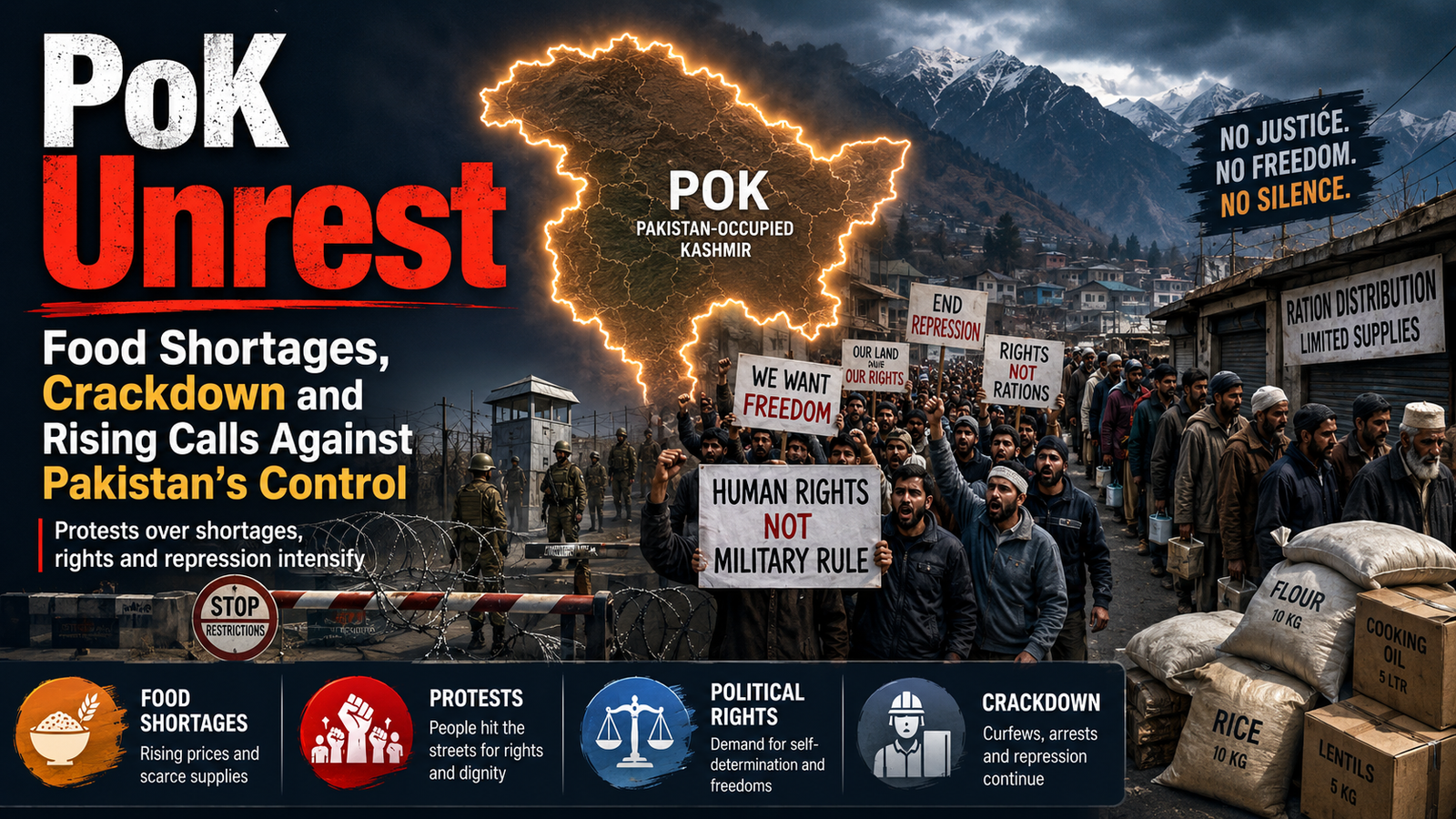
Pakistan-occupied Kashmir is witnessing one of its most serious waves of unrest in recent years. What began as a protest over economic issues, political representation and governance has now turned into a wider movement questioning Islamabad’s control over the region.
Thousands of protesters have gathered in Rawalakot and other areas, raising slogans against Pakistan’s administration and demanding basic rights. Protest leaders have accused Pakistani authorities of blocking food supplies, restricting communication and using force to weaken the movement.
The crisis has now become a major human rights concern.
Why Are People Protesting in PoK?
The current protest movement is led by the Joint Awami Action Committee, also known as JAAC. The group has been demanding economic and political reforms, including lower electricity prices, wheat subsidies, better governance and the abolition of 12 legislative assembly seats reserved for refugees from Indian-administered Jammu and Kashmir who live in Pakistan.
Protesters argue that these reserved seats reduce the political voice of people who actually live in PoK.
The issue became more serious after authorities banned JAAC under anti-terrorism laws. Human rights groups have criticised this step, saying it treats a civil-rights movement like a security threat.
Food Shortages and Blockade Allegations
One of the most serious claims from protesters is that food grains, flour and other essential supplies were blocked or restricted to pressure the movement.
Residents have reportedly struggled with shortages and uncertainty. Many families rushed to buy flour, cooking oil and household essentials because they feared prolonged shutdowns and disruption.
If essential supplies are deliberately restricted to suppress protests, it becomes a serious human rights issue. Food should never be used as a political weapon against ordinary people.
“PoK Is Not Part of Pakistan” Slogans Grow Louder
The most striking development is the political shift in the language of the protests.
At a major gathering in Rawalakot, protesters reportedly declared that PoK is not part of Pakistan. Civil rights activist Sardar Aman Khan said the people of the region do not need Pakistan, but Pakistan needs PoK.
This message shows how deep the anger has become.
For decades, Pakistan has claimed to speak for Kashmir. But the latest protests expose a different reality: many people living under Pakistan’s control are openly questioning Islamabad’s authority.
Human Rights Concerns Are Rising
Reports from the region point to internet shutdowns, arrests, road blockades, clashes, deaths and restrictions on movement.
Amnesty International has described the crackdown as a dangerous escalation and criticised the use of anti-terror laws against a grassroots protest movement. The group also raised concerns over internet shutdowns, arbitrary arrests and deadly use of force.
When communication is cut and protests are treated as terrorism, the world must pay attention.
Why This Matters for India
For India, the unrest in PoK is strategically important.
India has long maintained that Pakistan-occupied Kashmir is part of the Union Territory of Jammu and Kashmir under illegal occupation. The latest protests strengthen the argument that Pakistan’s control over the region is not as stable or accepted as Islamabad claims.
The protests also expose the difference between Pakistan’s international narrative and the reality on the ground. While Pakistan talks about Kashmir globally, people in PoK are demanding food, rights, representation and freedom from repression.
Pakistan’s Narrative Is Under Pressure
Pakistan has often projected PoK as “Azad Kashmir,” meaning free Kashmir. But the current unrest raises a basic question: if the region is truly free, why are protesters being arrested, internet services restricted and civil groups banned?
The anger over food supply restrictions, rising prices, political discrimination and heavy security presence shows that people are losing patience.
This is not just a law-and-order problem. It is a legitimacy crisis.
What the World Should Do
The international community should not ignore the voices coming from PoK.
Human rights organisations, media outlets and democratic governments should demand transparency, independent reporting access and protection for peaceful protesters.
Pakistan must allow free communication, restore essential supplies, release peaceful activists and stop using anti-terror laws to silence political dissent.
People have the right to protest. They have the right to food. They have the right to speak.
Final Thoughts
The unrest in Pakistan-occupied Kashmir is no longer just about electricity bills, wheat subsidies or reserved seats. It has become a wider movement against political control, economic hardship and alleged repression.
When people say “PoK is not part of Pakistan,” it reflects years of frustration reaching a breaking point.
The world must listen carefully. Human rights do not become less important because the region is disputed. Food, freedom and dignity are basic rights.
If Pakistan wants to claim legitimacy in PoK, it must answer the people with justice — not blockades, arrests and force.
Disclaimer: This article is for informational and opinion-based analysis only. It is based on publicly available reports and should not be considered legal, diplomatic or security advice. Allegations of blockade, repression and rights violations should be independently investigated through credible institutions.