













































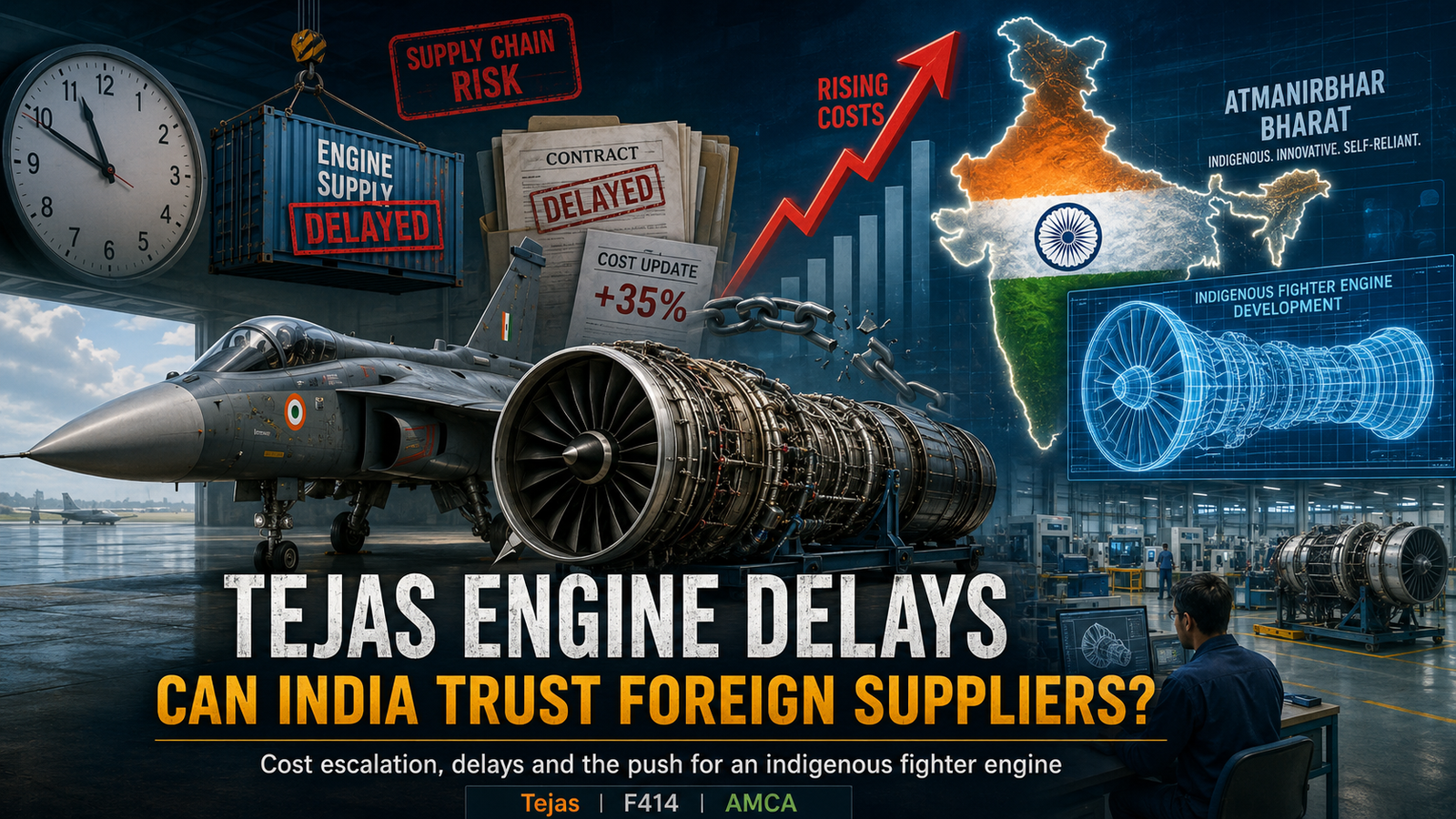
Tejas Engine Delays and GE Price Shock: Can India Trust Foreign Suppliers for Critical Defence Projects?

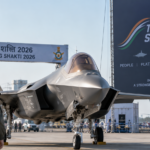
India’s Tejas fighter jet is more than an aircraft. It is a symbol of India’s defence self-reliance, engineering capability and long-term ambition to become a serious aerospace power.
But the Tejas story has also exposed one of India’s biggest vulnerabilities: the fighter jet engine.
Recent reports have again raised concerns over delays in GE F404 engine deliveries for the Tejas Mk1A programme. Separately, India’s negotiations with GE for the more powerful F414 engine for future platforms like Tejas Mk2 and AMCA have reportedly hit a roadblock after a steep cost escalation.
This has triggered a serious debate: can India fully trust foreign suppliers for critical defence technology, especially during war or geopolitical pressure?
The Tejas Problem: Aircraft Is Indian, Engine Is Foreign
India has made major progress in building indigenous airframes, avionics, radars, weapons and electronic systems. Tejas Mk1A is a proud achievement for Indian defence manufacturing.
But the engine remains foreign.
The Tejas Mk1A depends on GE’s F404 engine. Future aircraft like Tejas Mk2, TEDBF and early AMCA versions are linked to the GE F414 engine. This creates a strategic weakness because even if India can build the aircraft, production can slow down if engine deliveries are delayed.
That is exactly the concern today.
Reports say HAL has received only a limited number of F404 engines so far, affecting Tejas Mk1A delivery timelines. One recently delivered engine reportedly failed acceptance parameters, creating another hurdle for the programme.
This does not mean the Tejas project has failed. But it does show that India’s defence production chain is only as strong as its most dependent foreign component.
The GE F414 Price Shock
The bigger concern is the reported price escalation in the GE F414 engine talks for India’s AMCA programme.
According to recent reports, negotiations have hit a roadblock because GE has reportedly demanded a much higher cost than earlier expectations. Some reports claim the proposed cost has increased sharply, even up to three times in certain areas of negotiation.
If true, this raises a difficult question: once a foreign company knows India’s aircraft programme is designed around its engine, does it gain too much leverage?
This is not just a commercial issue. It is a strategic issue.
If India redesigns the aircraft for another engine, it could delay the programme. If India accepts a high price, costs rise. If delivery schedules slip, the Air Force waits longer. In every case, India pays the price for dependency.
Is This Sabotage or Supply-Chain Reality?
Many defence observers are calling this a form of pressure or indirect sabotage. That anger is understandable because India’s fighter production timeline is critical.
However, from a responsible public-policy point of view, sabotage must be proven with evidence. Officially, engine delays have often been explained through supply-chain disruptions, production bottlenecks and technical issues.
But even if it is not sabotage, the outcome is still dangerous.
A critical national defence programme should not depend on whether a foreign supplier delivers on time, keeps prices stable or remains politically aligned with India’s interests.
The lesson is simple: dependency itself is the risk.
Can the U.S. Be a Reliable Defence Partner?
The United States is an important partner for India. India and the U.S. cooperate in defence, technology, intelligence, trade and Indo-Pacific security.
But partnership is not the same as dependency.
India must remember that the U.S. system is driven by its own laws, Congress, export controls, sanctions, corporate interests and geopolitical calculations. Today relations may be strong. Tomorrow, pressure can come from a different administration, a war, a sanctions regime or a policy shift.
If India needs spare parts during a crisis and a foreign supplier delays approval, the aircraft may remain grounded. That is the nightmare scenario for any sovereign military power.
A country cannot outsource its combat readiness.
Why Jet Engines Matter So Much
Fighter jet engines are among the hardest technologies in the world. They need advanced metallurgy, single-crystal turbine blades, high-temperature materials, precision manufacturing, reliability, fuel efficiency and extreme testing.
This is why only a few countries have mastered high-performance military jet engines.
India tried to build the Kaveri engine, but it could not meet the original Tejas requirement in time. That setback forced India to rely on foreign engines.
But the solution is not to give up. The solution is to invest harder, smarter and longer.
Safran and the France Option
India is also exploring deeper engine cooperation with France’s Safran. This is important because France has historically been a more consistent defence partner for India in many areas, including Mirage and Rafale support.
Safran has reportedly expressed readiness for deep technology transfer and cooperation with DRDO for future fighter engines. If structured properly, such a partnership could help India build real engine capability instead of only assembling foreign parts.
But India must be careful here too.
The goal should not be replacing American dependency with French dependency. The goal should be Indian ownership, Indian intellectual property, Indian manufacturing and Indian upgrade capability.
Foreign partners can help. But the engine must eventually become Indian.
What India Must Do Now
India needs a serious national fighter engine mission.
First, India should accelerate indigenous engine development through DRDO-GTRE, HAL, private aerospace firms, academia and global partners.
Second, India should create a long-term jet engine fund. Such technology cannot be built through short-term budget thinking.
Third, India should demand genuine technology transfer, not screwdriver assembly.
Fourth, India should diversify suppliers where necessary, but avoid designing future aircraft around a single foreign engine without backup options.
Fifth, India should build a domestic ecosystem for turbine blades, compressors, coatings, materials, testing facilities and engine maintenance.
Sixth, India should involve private industry more aggressively. Fighter engine development cannot remain only inside government labs.
Atmanirbhar Bharat Needs an Engine
India has shown that it can build missiles, satellites, warships, radars, artillery, drones and aircraft structures. But fighter engines remain one of the final frontiers of defence self-reliance.
Without engine independence, India’s fighter jet programmes will always carry strategic risk.
Tejas, AMCA and future combat aircraft are not just machines. They represent India’s ability to defend itself without waiting for foreign approval.
The time has come to treat jet engine technology as a national mission, not just a defence procurement item.
Final Thoughts
The Tejas engine delays and reported GE F414 price escalation should be a wake-up call for India.
Whether this is called supply-chain delay, commercial pressure or strategic leverage, the lesson is the same: India cannot afford deep dependence on foreign engines for critical defence platforms.
The U.S. may remain an important partner. France may become a valuable engine collaborator. But India’s long-term security must rest on Indian capability.
A truly independent fighter jet is not just one with an Indian name, Indian radar and Indian weapons. It must also have an engine that India can build, repair, upgrade and supply without fear.
India has already built the wings. Now it must build the heart.
Disclaimer: This article is for informational and opinion-based defence analysis only. It does not accuse any company, country or individual of wrongdoing. Reported delays and price escalations should be understood through verified public reporting and official updates.