





























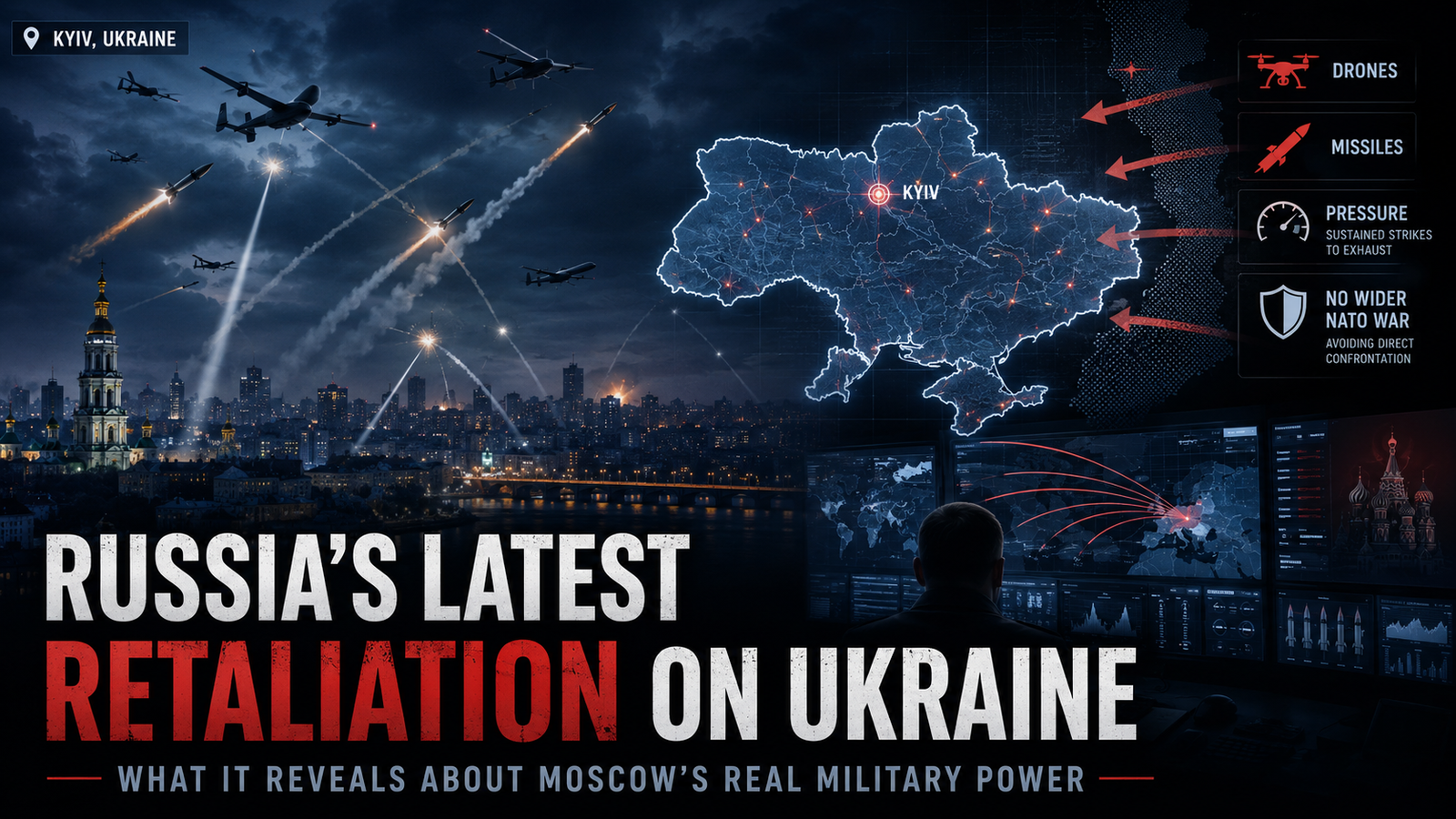
Russia’s Latest Retaliation on Ukraine: What It Reveals About Moscow’s Real Military Power

Russia’s latest massive missile and drone attack on Ukraine has again raised a serious question: if Moscow has this much firepower, why has it not used all of it from the beginning?
The answer is not simple. Russia has powerful missiles, drones, aircraft, artillery, cyber capability, energy leverage and nuclear weapons. But war is not only about having power. It is also about when, where and how to use it without creating consequences that become uncontrollable.
The latest attack on Kyiv shows that Russia still has the ability to launch large-scale strikes deep inside Ukraine. But it also shows that Moscow is using its power in a calculated way — to pressure Ukraine, weaken infrastructure, test Western support and force negotiations on Russian terms.
What Happened Recently?
Russia launched one of its heaviest attacks on Kyiv using hundreds of drones and dozens of missiles. Ukrainian officials said residential buildings, energy-linked facilities and multiple locations across the capital were hit. Civilians were killed and many more were injured.
Moscow described the strike as retaliation for Ukrainian attacks on Russian oil infrastructure and military-linked targets. Ukraine says Russia’s strikes continue to hit civilian areas and are designed to terrorise the population.
This is the brutal reality of the war: both sides are now targeting deeper infrastructure, but ordinary people are paying the highest price.
Why Russia Still Has So Much Strike Power
Many people assumed Russia would run out of missiles and drones after years of war. But that has not happened.
Russia has adapted. It has increased drone production, used cheaper Iranian-designed Shahed-type drones, improved domestic manufacturing and combined drones with missiles to overwhelm Ukrainian air defences.
This is important. A missile alone is expensive. A drone swarm is cheaper and can force Ukraine to spend costly air-defence missiles. By mixing drones, cruise missiles and ballistic missiles, Russia can stretch Ukraine’s defence systems and create gaps.
This is not random bombing. It is a pressure strategy.
Why Russia Did Not Use “Full Power” Earlier
Russia did not use all its power at once for several reasons.
First, Russia wanted to avoid a direct war with NATO. If Moscow had used extreme weapons or struck too aggressively near NATO borders, the conflict could have escalated beyond Ukraine.
Second, Russia needed to conserve high-end missiles. Modern precision weapons take time and money to produce. A country cannot fire everything in the first phase of a long war.
Third, Ukraine’s air defences remain dangerous. Russia’s air force has not been able to dominate Ukrainian skies the way many expected. Sending more aircraft deep into Ukraine would risk heavy losses.
Fourth, Russia’s strategy has shifted toward attrition. Instead of trying to win quickly, Moscow appears to be trying to exhaust Ukraine slowly — militarily, economically and psychologically.
Fifth, Russia must also protect itself. Ukraine has developed long-range drone capabilities and is now hitting Russian oil refineries, logistics hubs and defence-related facilities. This forces Moscow to keep resources for defence as well as offence.
The Real Message Behind the Retaliation
The latest attack was not only about punishment. It was also a signal.
Russia is telling Ukraine that attacks inside Russian territory will bring a response. It is telling the West that more weapons for Ukraine will not stop Moscow from escalating pressure. It is telling its own population that the Kremlin can still strike hard.
At the same time, Russia is trying to weaken Ukraine’s economy. Energy infrastructure, railway links, factories and logistics networks are all critical for Ukraine’s survival.
If Ukraine’s power system fails, daily life becomes harder. If factories are hit, weapon production slows. If railways are disrupted, military movement becomes difficult.
That is why infrastructure is such a major target in this war.
Ukraine Is Also Changing the War
Ukraine is no longer only defending its cities. It is taking the war deeper into Russia through drones and long-range strikes.
Ukrainian attacks on Russian oil refineries have caused serious disruption. Some damaged facilities may take months to fully recover. These attacks are designed to reduce Russia’s fuel supply, pressure the economy and weaken the war machine.
This is one reason Russia is reacting so aggressively.
The war is becoming more technological, more long-range and more dangerous.
Is Russia Holding Back Even Now?
In some ways, yes.
Russia has not used nuclear weapons. It has not fully mobilised every possible resource. It has not launched a direct attack on NATO territory. It has not used its entire air force at full depth inside Ukraine.
But that does not mean Russia is being merciful. It means Russia is managing risk.
Moscow wants to increase pressure without triggering a direct NATO-Russia war. That is why the conflict has become a controlled escalation: attack, retaliation, warning, negotiation attempt, then another attack.
This pattern is extremely dangerous because one mistake could widen the war.
What This Means for Ukraine
For Ukraine, the latest retaliation shows the urgent need for stronger air defence systems, especially against ballistic missiles.
Ukraine has become better at stopping drones, but missile defence remains difficult and expensive. Western air-defence support, including Patriot-type systems, remains critical.
Without stronger protection, Ukrainian cities will remain vulnerable to future large-scale Russian attacks.
What This Means for the World
The Russia-Ukraine war is no longer only a European conflict. It affects global food prices, energy markets, defence spending, supply chains and geopolitical alliances.
When Russia strikes Ukraine’s energy system, Europe feels the pressure. When Ukraine hits Russian oil facilities, fuel markets react. When the war escalates, countries around the world spend more on weapons and less on development.
This is why peace talks remain important, even if both sides are far apart.
Final Thoughts
Russia’s latest retaliation on Ukraine shows that Moscow still has significant military power and the ability to launch large-scale long-range attacks.
But the bigger lesson is this: Russia has not used all its power at once because modern war is not only about destruction. It is also about timing, escalation control, missile stockpiles, air-defence risks, NATO red lines and political pressure.
Russia appears to be using a slow-pressure strategy — striking Ukraine’s infrastructure, exhausting air defences, responding to Ukrainian attacks and waiting for Western support to weaken.
For Ukraine, survival depends on air defence, domestic weapons production and continued international support.
For the world, the message is clear: this war is becoming more dangerous, more technological and harder to end.
A ceasefire will not come from emotions. It will come only when both sides believe the cost of continuing is greater than the cost of negotiation.
FAQs
Why did Russia attack Kyiv recently?
Russia said the attack was retaliation for Ukrainian strikes on Russian oil and military-linked infrastructure. Ukraine says Russian attacks continue to hit civilian areas.
Does Russia still have strong military power?
Yes. Russia still has missiles, drones, artillery, manpower, industrial capacity and nuclear deterrence. However, it also faces losses, sanctions, Ukrainian drone strikes and battlefield limits.
Why has Russia not used all its power in Ukraine?
Russia is likely managing escalation risks, conserving high-end weapons, avoiding direct NATO war and using a long-term pressure strategy instead of one sudden maximum attack.
What does Ukraine need most now?
Ukraine needs stronger air defence systems, especially against ballistic missiles, along with continued support for drones, ammunition and energy-grid protection.
Can this war end soon?
A quick peace deal is difficult because both sides still believe they can improve their position. A ceasefire may become possible only if military, economic and political pressure increases on both sides.
Disclaimer: This article is for informational and geopolitical analysis only. It does not support violence, civilian attacks or war crimes by any side. Conflict details can change quickly, and readers should follow verified sources for the latest updates.