
















































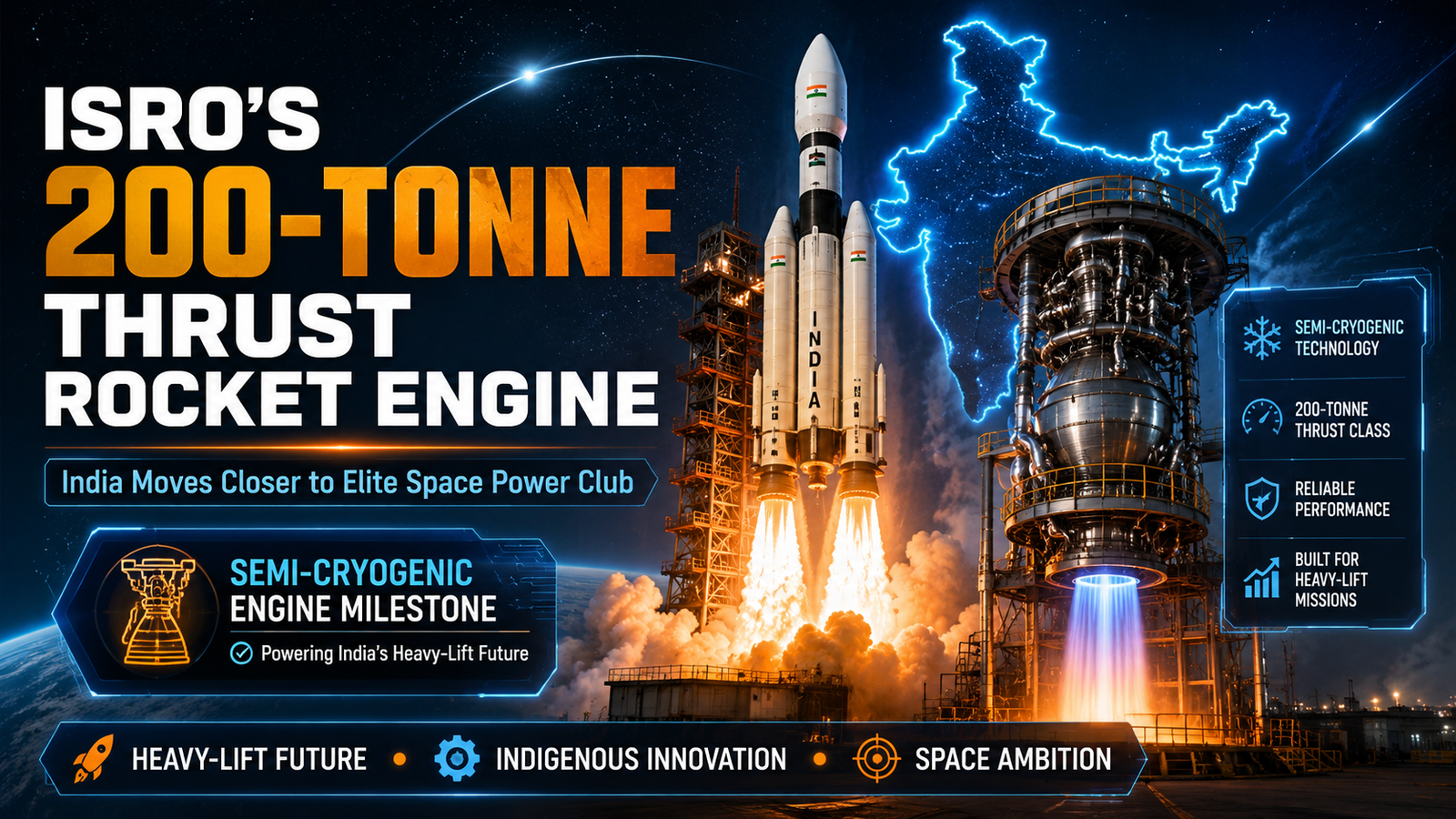

India’s space journey has taken another major leap. The Indian Space Research Organisation, or ISRO, has successfully conducted a high-thrust hot test of its Semi-Cryogenic Engine Power Head Test Article at the ISRO Propulsion Complex in Mahendragiri, Tamil Nadu.
The test reached a thrust level of 175 tonnes, which is about 88% of the target 200-tonne thrust level. This is a big milestone because it gives ISRO confidence to move toward the full 200-tonne thrust demonstration.
In simple words, India is getting closer to building a more powerful rocket engine that can carry heavier satellites, support bigger missions and strengthen the country’s position among advanced space powers.
Why This Test Matters
Rocket engines are among the most difficult technologies in the world. Only a few countries have mastered advanced high-thrust propulsion systems. These engines require extreme precision, powerful turbopumps, high-pressure fuel flow, heat resistance and stable combustion.
ISRO’s latest test is important because the power-head includes almost all major engine systems except the thrust chamber. During the test, the main turbopumps successfully operated at very high outlet pressures, showing that the engine system is moving in the right direction.
This is not just a laboratory success. It is a step toward a stronger Indian launch vehicle.
What Is a Semi-Cryogenic Engine?
A semi-cryogenic engine uses liquid oxygen and refined kerosene, known as isrosene. This combination is cleaner, more powerful and more efficient than older propulsion systems.
ISRO is developing the SC120 semi-cryogenic propulsion stage, powered by the 2000 kN-class SE2000 engine, to replace the current L110 core stage of the LVM3 rocket.
LVM3 is India’s heavy-lift launch vehicle. It has already played an important role in missions like Chandrayaan-3. With a semi-cryogenic upgrade, LVM3 can carry heavier payloads and become more competitive in the global launch market.
India’s Entry Into a Higher Technology League
This achievement shows that India is not only launching satellites but also mastering the deep technology behind powerful rockets.
Advanced propulsion is a strategic capability. It helps in satellite launches, space exploration, human spaceflight, commercial space missions and future deep-space programs.
A successful 200-tonne-class semi-cryogenic engine would strengthen India’s ability to launch heavier communication satellites, larger scientific payloads and more ambitious missions without depending heavily on foreign launch services.
Why It Is Important for Gaganyaan and Future Missions
India’s future space roadmap includes Gaganyaan, Chandrayaan missions, space station plans, heavier satellites and commercial launches. All of these need stronger, more reliable and more efficient rockets.
A more powerful LVM3 can give India greater flexibility. It can reduce launch dependence, improve payload capacity and support India’s dream of becoming a major space economy.
This also helps Indian private space companies because a stronger national launch ecosystem creates more confidence, more supply-chain growth and more global interest in India’s space sector.
Atmanirbhar Bharat in Space
The most powerful message from this test is self-reliance. India has faced technology denial in the past, especially in advanced space propulsion. But ISRO has repeatedly turned challenges into motivation.
From cryogenic engines to semi-cryogenic technology, India is gradually building its own capability.
This is the real meaning of Atmanirbhar Bharat in space: not just using technology, but creating it.
Final Thoughts
ISRO’s latest semi-cryogenic engine test is more than a technical update. It is a signal that India is preparing for a bigger role in the global space race.
The full 200-tonne thrust milestone is still ahead, but the successful 175-tonne test shows that India is moving strongly in that direction.
As the world enters a new era of space exploration, satellite internet, lunar missions and space-based technology, India is building the engines needed for the future.
The message is clear: India is not just reaching space. India is building the power to lead in space.
Disclaimer: This article is for informational and educational purposes only. It is based on publicly available updates from ISRO and media reports.