

















































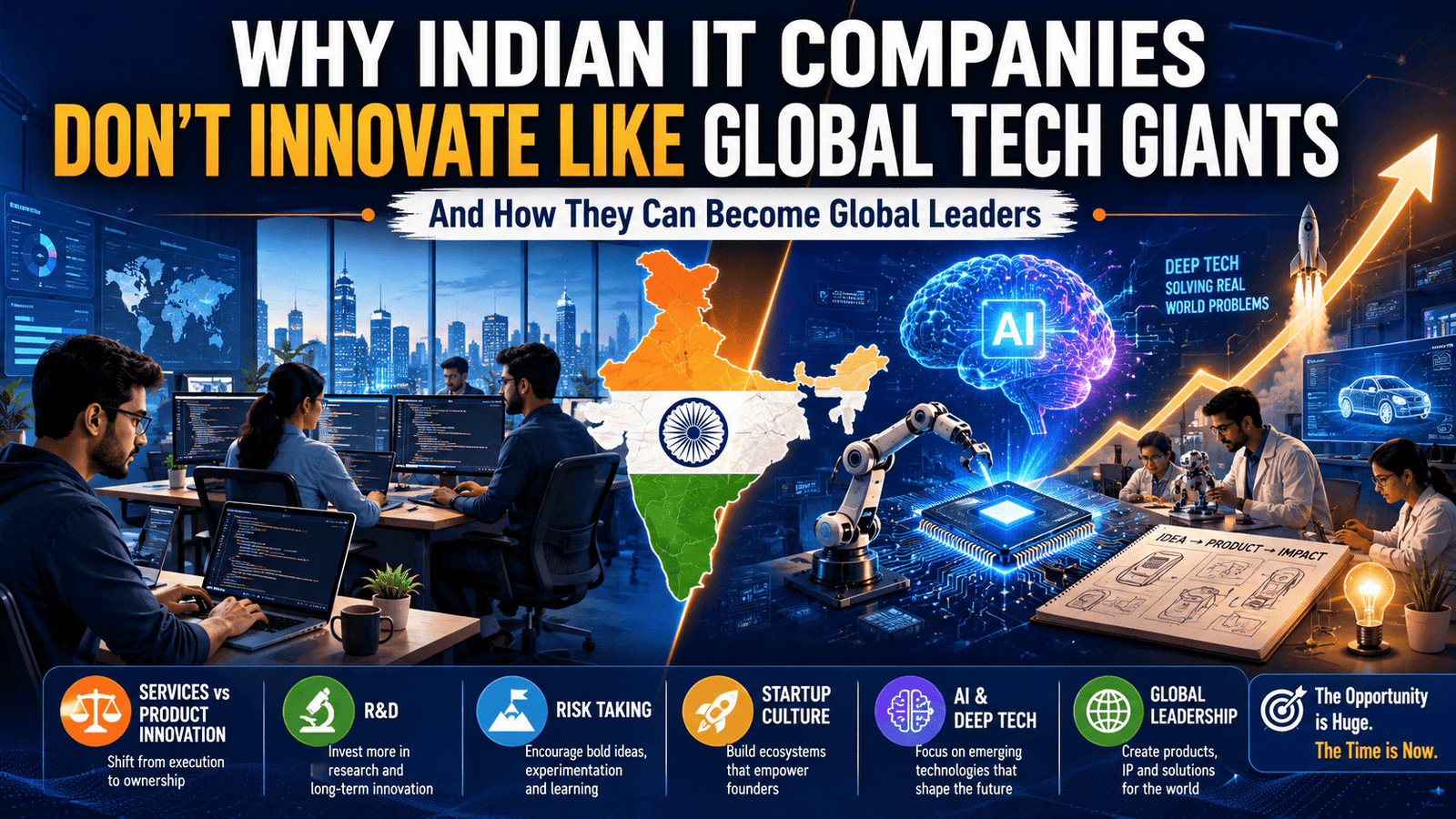
Why Indian IT Companies Don’t Innovate Like Google, OpenAI or Anthropic — And How They Can Become Global Leaders

India is one of the world’s biggest technology powerhouses. Indian engineers run global companies, build critical software systems and power the digital backbone of banks, airlines, hospitals, governments and Fortune 500 corporations. Yet one uncomfortable question remains: why have Indian IT companies not created the next Google, Facebook, OpenAI or Anthropic?
This question is not about talent. India has talent. It is not about hard work. Indian engineers are among the most hardworking in the world. The real issue is mindset, business model and risk appetite.
For decades, India’s biggest IT companies became successful by serving global clients. They mastered outsourcing, delivery excellence, cost efficiency, project management and enterprise transformation. This made India a global IT services leader. But the same model also created a limitation: Indian IT became excellent at executing other people’s visions, but weaker at building original global platforms.
India Built IT Services, Not Technology Empires
Companies like Google, Meta, OpenAI and Anthropic are not just service providers. They create products, platforms, models and ecosystems. Google built search, Android, YouTube and cloud. Meta built Facebook, Instagram, WhatsApp and AI infrastructure. OpenAI and Anthropic are building frontier AI models that may define the future of work, coding, research and business automation.
Indian IT giants, on the other hand, largely built their empires around client projects. Their revenue depends on solving problems for banks, retailers, governments, insurers and manufacturers. This is profitable and respectable, but it is not the same as building a world-changing product.
A services company asks: “What does the client need?”
A product company asks: “What will the world need next?”
That difference changes everything.
The Problem With the Servant Mindset
The biggest weakness of Indian IT is not skill. It is psychological.
Many Indian IT firms became comfortable being vendors, not visionaries. They became excellent at taking requirements, writing code, maintaining systems and reducing costs. But true innovation requires a different attitude. It requires asking bold questions, challenging the market, taking risks and building something before the customer asks for it.
This is where the “service mindset” becomes a trap. When companies are trained for decades to please clients, they may avoid risky product bets. They prefer predictable contracts over uncertain innovation. They optimize for billing hours, utilization, margins and delivery timelines instead of invention, patents, platforms and global consumer adoption.
That is why India has many software service giants but very few global software product giants.
Why Google and OpenAI Think Differently
Big technology companies invest heavily in research, talent and long-term bets. They do not wait for a client to fund every experiment. They spend billions on AI labs, data centers, chips, research papers, internal tools and future platforms.
Their best people are not only solving today’s client ticket. They are building tomorrow’s technology.
Indian IT companies often talk about innovation, but their structure is still deeply client-led. AI, cloud, cybersecurity and automation are often sold as services. That is useful, but not enough. The world’s most valuable tech companies own the platforms. They own the interface. They own the data layer. They own the product relationship with the user.
Indian IT companies usually sit behind the scenes.
Low R&D Risk Is Holding India Back
Indian IT firms do invest in research, patents and innovation labs. But compared with global technology giants, the scale and ambition are different. Frontier innovation requires patient capital. It may take years before a product becomes profitable.
Indian companies often prefer safe growth. They protect quarterly margins. They avoid large failed experiments. But innovation is messy. Google had failed products. Meta had expensive bets. OpenAI and Anthropic burn enormous capital to build advanced AI systems. Failure is part of the model.
Indian IT must accept that world-class innovation cannot happen without world-class risk.
The Talent Problem Is Not Talent — It Is Environment
India produces brilliant engineers. The proof is everywhere. Many top leaders at global tech companies are Indian-origin. Indian engineers contribute to AI, cloud, chips, cybersecurity and enterprise systems across the world.
But inside many Indian IT companies, talented engineers are often placed into maintenance work, support projects, migration tasks or repetitive client delivery. Their creativity is underused.
A brilliant engineer cannot invent the next AI model if the system rewards timesheets more than research.
To build global products, Indian companies must create environments where engineers can experiment, publish, fail, patent, build open-source tools and launch internal startups.
Why Startups Are Moving Faster Than IT Giants
India’s startup ecosystem is showing more product ambition than many traditional IT firms. Companies in fintech, SaaS, logistics, healthtech, AI and deeptech are trying to build platforms for India and the world.
AI startups like Sarvam AI show that India can build models for Indian languages and local use cases. SaaS companies have already proved that Indian product firms can sell globally.
This should be a wake-up call for large IT companies. If they do not move from services to products, smaller AI-native companies may capture the future.
What Indian IT Companies Must Do Now
Indian IT companies do not need to abandon services. Services gave India scale, trust and global reach. But the next phase must combine services with products, platforms and intellectual property.
First, they must increase serious R&D investment. Not just innovation centers for branding, but real labs with long-term budgets.
Second, they must build AI-first products for global markets. India should not only implement AI tools built by others. It must build its own models, agents, enterprise platforms and developer tools.
Third, they must reward invention. Engineers should be promoted not only for delivery, but also for patents, research, open-source contributions and product impact.
Fourth, they must create internal startup units. Large IT firms should allow small teams to build products independently, with startup-like freedom and funding.
Fifth, they must focus on Indian problems that can scale globally. India has massive use cases in healthcare, education, agriculture, logistics, payments, languages and public services. A solution built for India’s complexity can become powerful for the world.
India Must Build, Not Just Serve
The world is entering an AI era where countries that own technology will shape the future. Countries that only provide manpower may remain dependent.
India cannot be satisfied with being the world’s back office. It must become the world’s innovation office.
Indian IT companies have the cash, talent, client access and global credibility. What they need now is courage. They must stop thinking only like vendors and start thinking like builders of civilization-scale technology.
Final Thoughts
Indian IT companies are not failures. They are one of India’s greatest economic success stories. But the next question is whether they can evolve.
The first era of Indian IT was about outsourcing. The second era was about digital transformation. The third era must be about innovation, AI, products and global leadership.
India does not lack intelligence. It lacks enough institutions willing to bet big on original ideas.
If Indian IT companies want to compete with Google, Meta, OpenAI and Anthropic, they must stop asking only what clients want today. They must start building what the world will need tomorrow.
Disclaimer: This article is for informational and opinion-based business analysis only. It does not target any company or individual. It discusses industry trends, innovation models and strategic challenges based on publicly available information.