

















































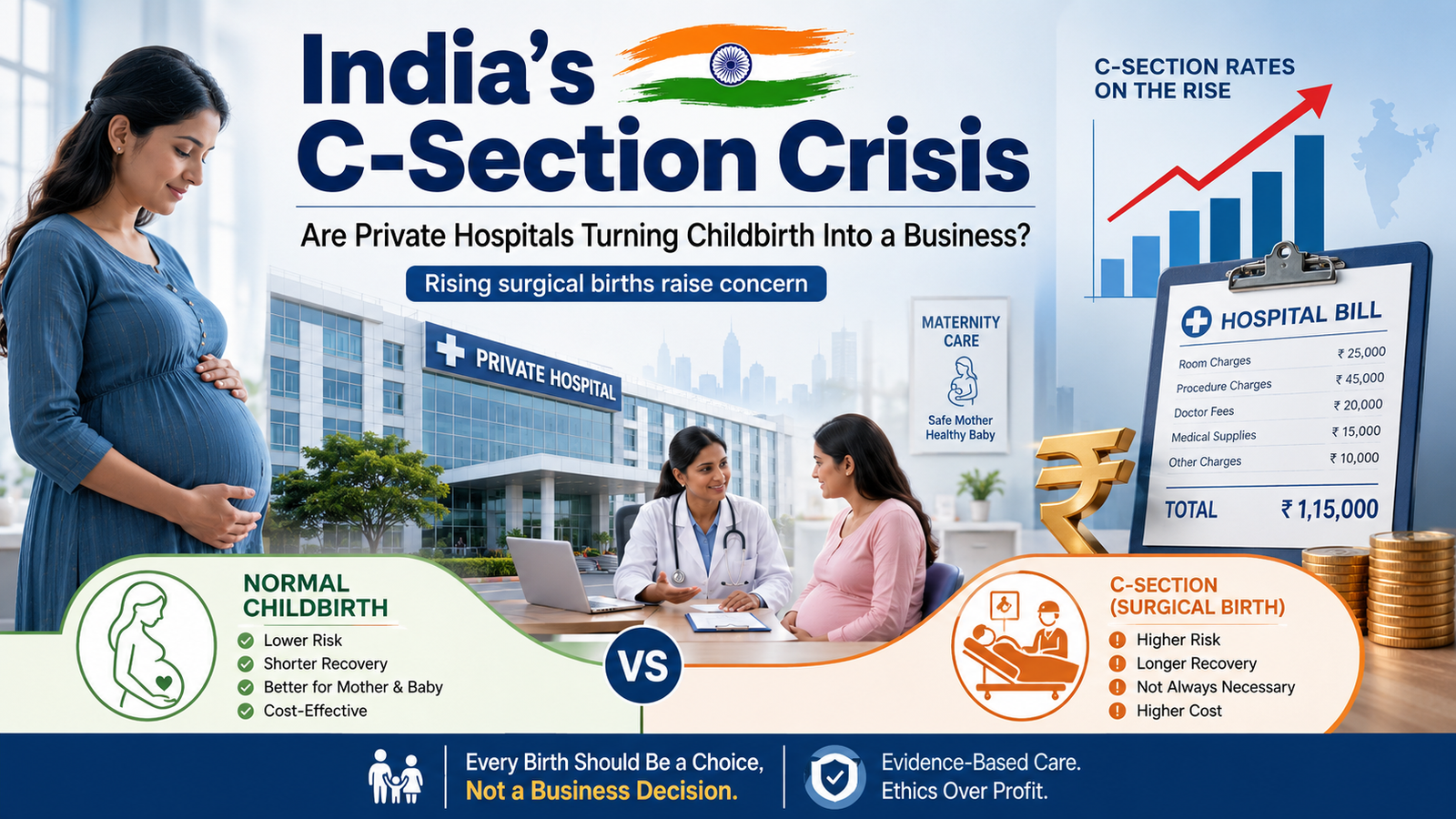
India’s C-Section Crisis: Are Private Hospitals Turning Childbirth Into a Business?

A Caesarean section can save the life of a mother and baby when there is a genuine medical emergency. No responsible discussion should demonize doctors or hospitals for performing a C-section when it is medically needed.
But India is now facing a different problem: C-sections are rising so fast, especially in private hospitals, that childbirth is increasingly looking like a business model rather than a medical decision.
The latest NFHS-6 data shows India’s C-section rate increased from 21.5% in 2019–21 to 27.2% in 2023–24. In urban India, the rate is even higher at 40.5%, compared with 22.8% in rural areas. Most alarming is the private-public gap: 54.1% of births in private health facilities are now C-sections, compared with 16.9% in public facilities.
This is not just a medical statistic. It is a public health warning.
What the WHO Says About C-Section Rates
The World Health Organization has long stated that, at a population level, C-section rates around 10–15% were considered ideal. WHO also notes that when C-section rates rise above 10%, there is no clear evidence that maternal and newborn mortality continues to improve.
This does not mean every country must mechanically stay at 10–15%. India is diverse, and some regions still need better access to emergency obstetric surgery. But when private hospitals in many states cross 50%, 60%, 80% or even higher, the question becomes unavoidable: are all these surgeries medically necessary?
Private Hospitals Are Driving the Surge
NFHS-6 numbers show the sharp divide clearly. C-sections in private facilities rose from 47.4% in NFHS-5 to 54.1% in NFHS-6, while public facility C-sections rose more slowly from 14.3% to 16.9%.
State-level figures are even more disturbing. Reports based on NFHS-6 data show private hospital C-section rates of 87.7% in West Bengal, 84% in Telangana, and 66% in Andhra Pradesh. Overall C-section rates were reported at more than 62% in Telangana, 52% in Andhra Pradesh, and 44.5% in West Bengal.
A medical system where more than half of private hospital deliveries become surgical births should trigger audits, transparency and public debate.
Why Are C-Sections Rising So Fast?
There are multiple reasons, and not all are unethical. Better hospital access, more high-risk pregnancies being detected, older maternal age in cities, IVF pregnancies, obesity, diabetes, hypertension and fetal distress can all increase the need for surgical delivery.
But the private hospital pattern raises deeper concerns.
A C-section is usually more expensive than a vaginal delivery. It is easier to schedule. It reduces long unpredictable labour hours. It can help hospitals manage beds, operation theatres and staff timing more efficiently. In some cases, fear of litigation may also push doctors toward surgery.
The problem begins when convenience, revenue and institutional pressure start influencing what should be a medical decision based on the mother and baby’s condition.
The Health Risks Families Are Not Always Told Clearly
A C-section is major abdominal surgery. When necessary, it is life-saving. When unnecessary, it can expose women and babies to avoidable risks.
WHO warns that rising C-section rates beyond a certain threshold may be associated with increased maternal and perinatal morbidity. WHO also notes that C-section birth carries short- and long-term risks that can affect the woman, child and future pregnancies, while also increasing healthcare costs.
Risks may include infection, bleeding, longer recovery, anaesthesia complications, breastfeeding delays, respiratory issues in newborns, and complications in future pregnancies. One serious future-pregnancy concern is placenta accreta spectrum, where the placenta attaches too deeply into the uterus; ACOG notes that risk rises sharply with repeated C-sections, especially when placenta previa is present.
This is why informed consent matters. A woman should not be rushed into surgery without being told the medical reason, alternatives, urgency level and possible risks.
The Other Side: Some Indian States Still Lack Access
India’s C-section crisis is not only about overuse. It is also about unequal access.
A 2025 analysis of NFHS-5 data found India’s national C-section rate of 21.5% hides huge inequalities. State rates ranged from 5.2% in Nagaland to 60.7% in Telangana, and private facilities had higher C-section rates than public facilities across wealth groups.
This means India has two problems at the same time. In some urban private hospitals, C-sections may be overused. In some poorer or rural regions, women may still lack timely access to emergency C-sections when they genuinely need them.
The goal should not be “fewer C-sections at any cost.” The goal should be the right birth method for the right patient at the right time.
What Government Must Do Now
India needs a serious national response. Awareness alone is not enough.
First, every hospital should publicly report C-section rates, separated by low-risk and high-risk pregnancies. Without transparency, families cannot compare hospitals properly.
Second, India should make the Robson Classification mandatory for public and private hospitals. WHO describes Robson as a global standard for assessing, monitoring and comparing C-section rates within and between healthcare facilities. It classifies women into 10 groups based on obstetric factors and helps identify where unnecessary C-sections may be happening.
Third, private hospitals with unusually high C-section rates should face clinical audits. Andhra Pradesh has already moved in this direction, with officials reviewing hospitals showing extremely high C-section patterns and checking whether Robson Classification was followed. The state also approved training of 1,264 midwives across government hospitals to promote safer natural births where medically appropriate.
Fourth, India must invest in midwife-led care. Government guidelines on midwifery services have already recognized that some areas suffer from over-medicalization of childbirth and that midwifery-led care can promote women-centric care, continuity and natural birth where safe.
What Families Should Ask Before Agreeing to a C-Section
During pregnancy, families should discuss birth plans early with their doctor. In an emergency, delay can be dangerous, so medical advice must be respected. But for planned or non-emergency C-sections, families can ask:
What is the exact medical reason for the C-section? Is it urgent or elective? Can labour be safely attempted? What are the risks of waiting? What are the risks of surgery? Can I get the indication written in the medical record? What happens if I want a second opinion?
These questions are not disrespectful. They are part of informed consent.
The Bottom Line
India should never shame women who had C-sections. Many mothers and babies are alive today because doctors made the right surgical decision at the right time.
But when private hospital C-section rates cross 50% nationally and reach extremely high levels in some states, society has the right to ask hard questions.
Childbirth should not become a revenue target. A mother’s fear should not become a business opportunity. India needs transparency, audits, patient education, midwife-led care and strict accountability so that C-sections are performed when they are medically necessary — not when they are financially convenient.
FAQs
Is C-section always bad?
No. A C-section can be life-saving when there is fetal distress, obstructed labour, placenta complications, abnormal baby position, severe maternal illness or other medical emergencies.
Why are C-sections higher in private hospitals?
Possible reasons include higher patient risk profiles, better access to surgery, scheduling convenience, fear of litigation, higher charges and hospital-level incentives. The unusually high private-sector rates in some states require transparent audits.
What is India’s latest C-section rate?
NFHS-6 data reported India’s C-section rate at 27.2% in 2023–24, up from 21.5% in 2019–21. Private health facilities reported 54.1%, while public facilities reported 16.9%.
What should the government do?
The government should mandate hospital-level reporting, Robson Classification audits, patient consent documentation, second-opinion rights for non-emergency cases, stronger midwifery services and penalties for hospitals showing suspicious patterns without clinical justification.
Disclaimer: This article is for public awareness and should not be treated as personal medical advice. Pregnant women should consult a qualified obstetrician or healthcare professional for decisions related to delivery.