

















































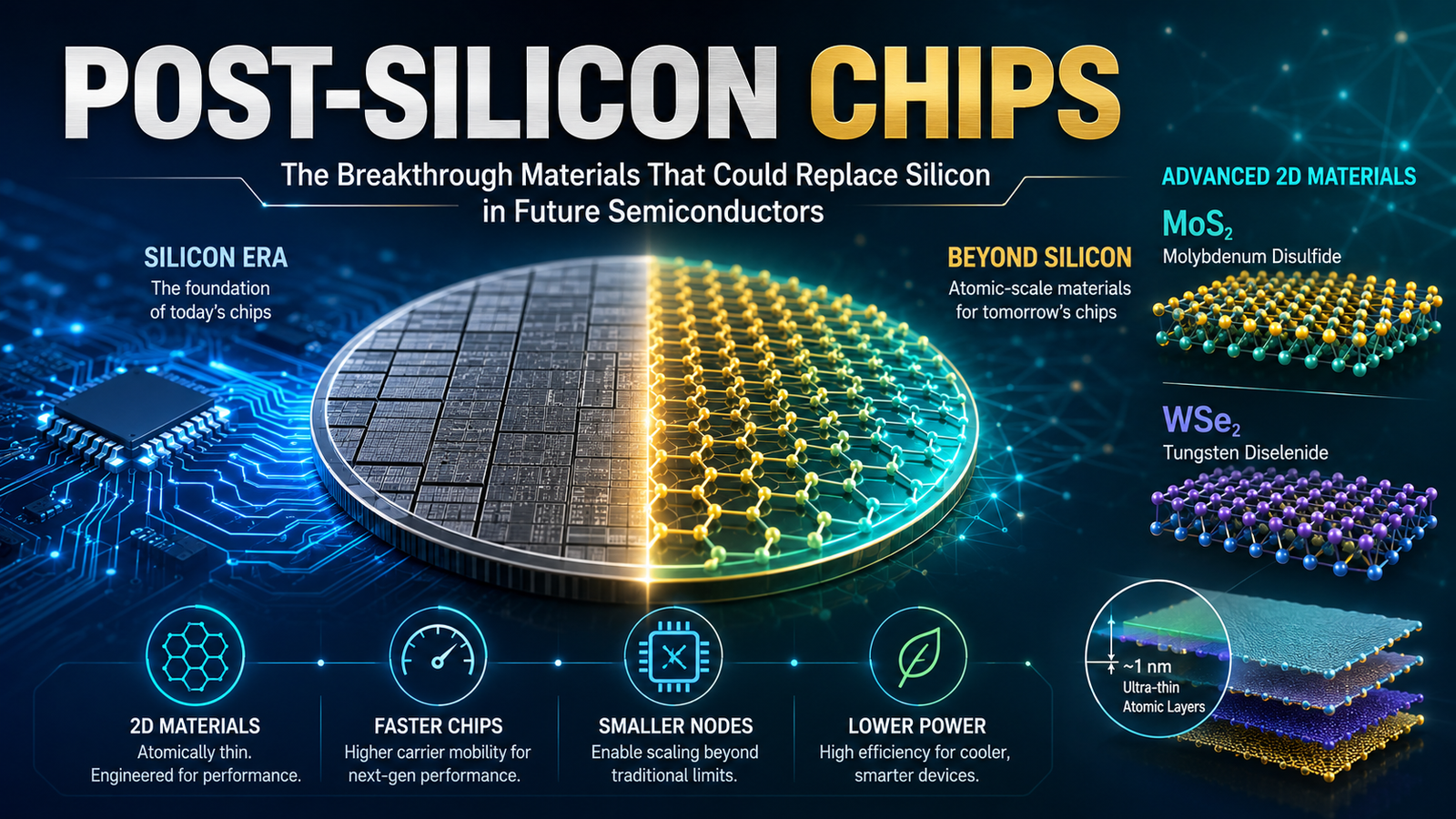
Post-Silicon Chips: The Breakthrough Material That Could Replace Silicon in Semiconductors

For decades, silicon has been the king of the semiconductor industry. Every smartphone, laptop, electric vehicle, data centre and AI chip depends on tiny silicon transistors.
But silicon is now reaching its physical limits.
As chipmakers try to make transistors smaller than ever, silicon starts facing problems such as heat, leakage, power loss and reduced control over electrons. This is why scientists around the world are searching for the next big material that can take chips beyond silicon.
The most exciting breakthrough today is coming from 2D semiconductors — ultra-thin materials that are only a few atoms thick.
What Are 2D Semiconductors?
2D semiconductors are materials so thin that they are almost flat at the atomic level.
The most important names in this race are:
- Molybdenum disulfide, also called MoS₂
- Tungsten diselenide, also called WSe₂
- Tungsten disulfide, also called WS₂
- Semiconducting graphene
- Bismuth-based 2D materials
Among these, molybdenum disulfide is currently one of the most promising candidates for future chips.
In simple language, MoS₂ is a material made of one layer of molybdenum placed between two layers of sulfur. It is only about three atoms thick, but it can behave like a semiconductor.
That is important because future chips need materials that can control electricity even at extremely tiny sizes.
Why Silicon Is Reaching Its Limit
Silicon became successful because it is cheap, stable and easy to manufacture at scale. But modern chips are now reaching the angstrom era, where features are close to atomic size.
At that level, silicon becomes harder to control.
Electrons can leak. Heat becomes difficult to manage. Making chips smaller becomes extremely expensive. This is why companies like TSMC, Samsung, Intel and IBM are moving toward new transistor designs such as gate-all-around, nanosheets, CFETs and 3D stacking.
But even those solutions may not be enough forever.
That is where 2D materials enter the picture.
The Big Breakthrough: Chips Made Without Silicon
Researchers have already built working chips using 2D materials.
A major breakthrough came when scientists developed a 32-bit RISC-V microprocessor using molybdenum disulfide instead of silicon. The chip used nearly 5,900 MoS₂ transistors and proved that a non-silicon semiconductor can run real computing instructions.
Another major step came from Penn State researchers, who built a working CMOS computer using 2D materials. They used molybdenum disulfide for one type of transistor and tungsten diselenide for the other. This is important because CMOS is the basic technology used in almost every modern chip.
More recently, researchers from Nanjing University, Suzhou Laboratory and Huawei developed a 2D molybdenum disulfide computer with more than 1,400 transistors on one chip. It used a 4-bit parallel processor and showed that 2D materials can move from simple lab devices toward real computing systems.
These are not commercial chips yet, but they are important milestones.
Why MoS₂ Could Be a Silicon Replacement
Molybdenum disulfide has one big advantage: it stays useful even when it becomes extremely thin.
Silicon loses performance when made too thin, but 2D materials can remain stable at atomic thickness. This makes them attractive for future ultra-small transistors.
MoS₂ can also reduce power consumption, improve transistor control and allow chips to become thinner and more energy efficient.
For AI chips, smartphones, edge devices and data centres, this matters a lot. The world needs more computing power, but it cannot afford unlimited electricity consumption.
A material that can improve energy efficiency could become extremely valuable.
Will Graphene Replace Silicon?
Graphene is often called a miracle material because it is strong, thin and highly conductive. But for normal computer chips, graphene has a problem: it does not naturally have a proper bandgap.
A bandgap is what allows a semiconductor to switch between “on” and “off.” Without this switching ability, making normal logic chips becomes difficult.
However, researchers have made progress in semiconducting graphene, especially using graphene on silicon carbide. This could help future high-speed electronics and quantum devices.
Still, for mainstream chip replacement, MoS₂ and other 2D semiconductors currently look more practical than ordinary graphene.
The Real Future: Not Replacing Silicon Overnight
It is important to be realistic.
Silicon will not disappear suddenly. The semiconductor industry has invested trillions of dollars in silicon manufacturing. Factories, tools, supply chains and designs are all built around silicon.
The first major use of 2D materials may not be a full replacement. Instead, they may be added on top of silicon chips.
This is called heterogeneous integration.
In simple words, silicon may remain the foundation, while 2D materials are added as extra layers to improve performance, memory, power efficiency or special functions.
This is why the future may not be “silicon versus 2D materials.” It may be “silicon plus 2D materials.”
Why This Matters for India
India wants to become a serious semiconductor power. Most countries are still focused on traditional silicon chip manufacturing, but the next wave of innovation may come from materials science.
For India, this is an opportunity.
India should not only focus on assembling chips or building older-node fabs. It should also invest in 2D materials, chip design, semiconductor research, packaging, AI chips and advanced manufacturing.
If India enters early in post-silicon research, it can build future advantage instead of only following global leaders.
Challenges Before Mass Production
The technology is exciting, but challenges remain.
Scientists still need to improve large-scale manufacturing, wafer quality, transistor speed, yield, reliability, contact resistance and integration with existing chip factories.
A chip with 1,400 or 5,900 transistors is impressive for research, but commercial processors contain billions or even hundreds of billions of transistors.
That gap is huge.
So the breakthrough is real, but mass production may still take years.
Final Thoughts
The semiconductor industry is entering a new era. Silicon is still powerful, but it is no longer the only answer.
2D semiconductors like molybdenum disulfide and tungsten diselenide are emerging as serious candidates for future chips. They are ultra-thin, energy-efficient and better suited for atomic-scale electronics.
The latest breakthroughs show that non-silicon chips are no longer science fiction. Researchers have already built working processors and computers using 2D materials.
But the smart view is this: silicon will not be replaced tomorrow. It will first be enhanced by 2D materials, and later some applications may move toward true post-silicon chips.
The next semiconductor revolution may not come only from smaller chips. It may come from a completely new material.
Disclaimer: This article is for informational and educational purposes only. Semiconductor technologies discussed here are mostly in research or early development stages. Commercial timelines may change depending on manufacturing, cost and industry adoption.