















































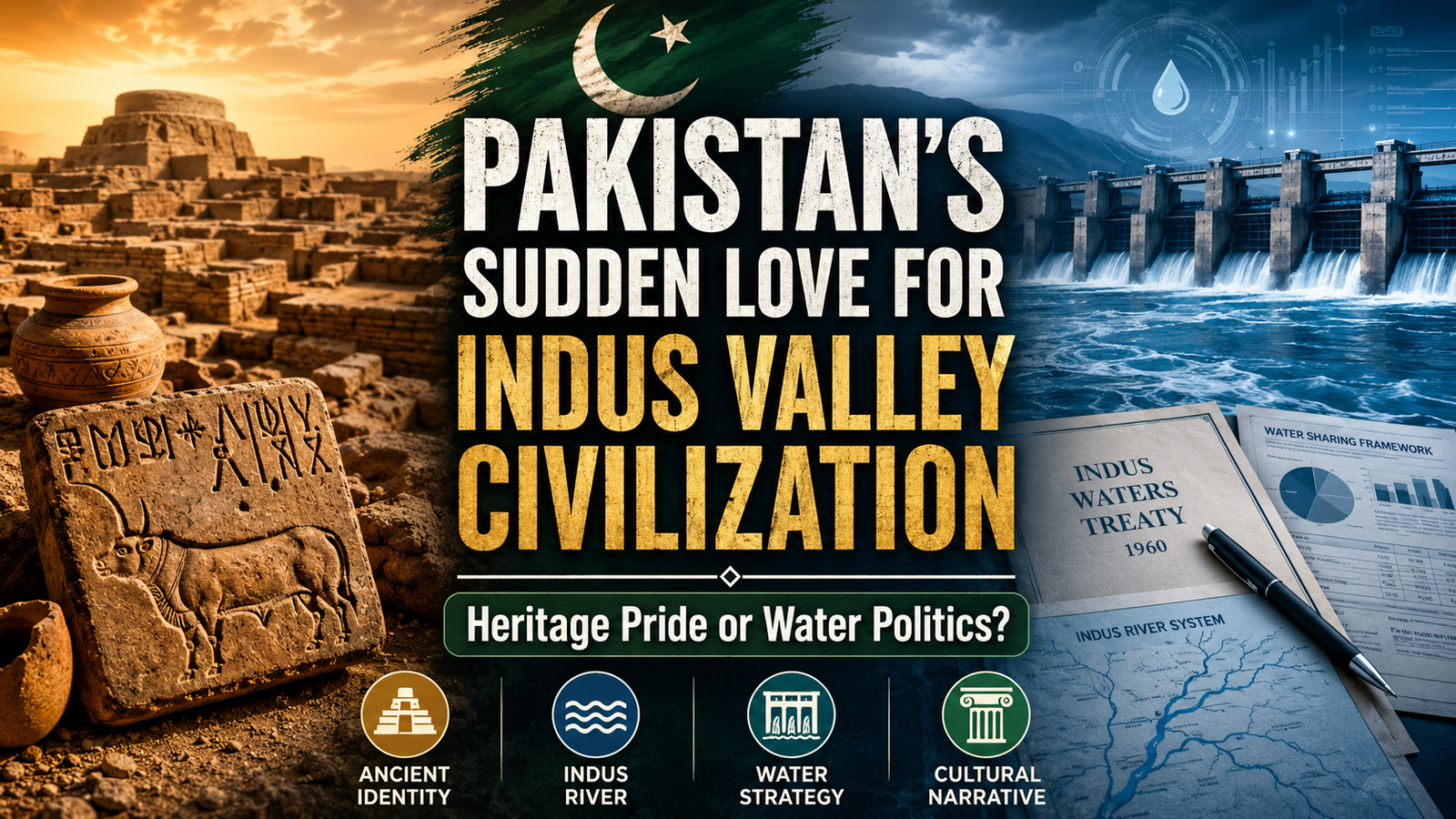

Pakistan has recently started speaking more loudly about the Indus Valley Civilization, Mohenjo-daro, Gandhara, Taxila and other ancient heritage sites. On the surface, this looks like a positive cultural shift. After all, the Indus Valley Civilization is one of the world’s oldest urban civilizations and deserves global respect.
But the timing raises a serious question.
Why is Pakistan suddenly highlighting its ancient pre-Islamic heritage at a time when India has put the Indus Waters Treaty in abeyance after the Pahalgam terror attack?
For many Indians, this looks less like genuine civilizational pride and more like a political narrative to strengthen Pakistan’s claim over the Indus river system.
Pakistan’s Identity Problem
Since 1947, Pakistan’s state identity has largely been built around religion and separation from India. Its national story often focused more on Islamic conquest, the two-nation theory and political hostility toward India than on the ancient civilizational roots of the land.
This created a strange contradiction.
The land of present-day Pakistan contains some of South Asia’s greatest ancient heritage sites — Mohenjo-daro, Harappa, Taxila and Gandhara. But for decades, these pre-Islamic roots were not central to Pakistan’s national imagination in the same way Islamic identity was.
Now Pakistan appears to be trying to rebrand itself as the heir of the Indus Valley Civilization.
There is nothing wrong with protecting ancient heritage. In fact, Pakistan should preserve these sites. The problem begins when heritage is used selectively for geopolitics.
Why the Indus Valley Narrative Matters Now
The Indus River is not only a river. It is Pakistan’s agricultural lifeline.
After the Pahalgam terror attack in April 2025, India put the Indus Waters Treaty in abeyance, saying Pakistan must credibly and permanently stop supporting cross-border terrorism.
This changed the entire regional conversation.
Pakistan suddenly started facing pressure over water security. Its politicians began accusing India of “weaponising water.” Some leaders even issued aggressive warnings. At the same time, the promotion of Indus Valley heritage became louder.
This is where the timing looks suspicious.
By projecting itself as the “true custodian” of the Indus civilization, Pakistan may be trying to create emotional and diplomatic pressure around the Indus river system.
In simple words: culture may be used as a cover for water politics.
India’s Argument Is Clear
India’s position is simple: normal water cooperation cannot continue while Pakistan-based terror networks attack Indian civilians.
The Pahalgam terror attack killed innocent people and triggered a major Indian response. India’s decision to hold the Indus Waters Treaty in abeyance was not about attacking ordinary people. It was a strategic message to Pakistan’s state and military establishment.
India has long argued that terrorism and normal relations cannot go together.
If Pakistan wants treaty normalcy, it must stop cross-border terrorism in a credible and irreversible way.
Pakistan’s Minority Problem Weakens Its Heritage Claim
Pakistan now wants to project itself as a protector of ancient civilization. But this claim looks weak when minorities inside Pakistan continue to face discrimination and insecurity.
Hindus, Sikhs, Christians, Ahmadis and other minorities have repeatedly raised concerns about forced conversions, blasphemy accusations, attacks on places of worship and weak legal protection.
Recently, reports of a 125-year-old Sikh gurdwara being demolished in Pakistan again raised questions about minority rights and heritage protection.
This creates a major contradiction.
How can a state claim to protect ancient civilizational heritage while minority communities connected to that heritage feel unsafe?
A country cannot use Mohenjo-daro for branding while allowing temples, gurdwaras and minority rights to remain vulnerable.
Radicalisation and Selective History
Over decades, extremist narratives have gained influence in parts of Pakistan’s society, politics and education. This does not mean every Pakistani citizen is radical or intolerant. Many Pakistanis support peace, minority rights and cultural preservation.
But the state has too often failed to stop extremist pressure.
When religious identity becomes a political weapon, ancient heritage becomes selective. A civilization is celebrated only when it helps the state narrative, not when it reminds people of pluralism, diversity and shared history.
The Indus Valley Civilization was not built on modern religious nationalism. It was a sophisticated urban culture known for planning, trade, drainage, water management and civic order.
That history belongs to humanity, not to one modern political project.
Pakistan’s War Threats Look Like Diversion
Pakistan’s aggressive rhetoric against India over water must also be seen in the context of its internal crisis.
Pakistan is under pressure from multiple directions. It is facing tensions with Afghanistan, violence linked to the TTP, unrest in Balochistan, economic stress and growing public frustration.
When a country faces internal failures, external confrontation becomes a political distraction.
This is why Pakistan’s repeated threats against India should be understood carefully. War rhetoric may be used to divert attention from governance failure, militant blowback, economic weakness and human-rights issues.
India should not fall into this trap. India’s response must remain firm, strategic and legally careful.
The Real Lesson of the Indus Civilization
The biggest irony is that the Indus Valley Civilization itself teaches the opposite of Pakistan’s current political behaviour.
Mohenjo-daro and Harappa were known for urban planning, drainage systems, trade networks and water management. Their success depended on order, civic discipline and respect for water systems.
Today, the Indus region needs cooperation, climate resilience, anti-terror accountability and sustainable water management.
Instead of using the Indus name for emotional diplomacy, Pakistan should first fix its internal contradictions: protect minorities, end support for extremist networks, stop cross-border terrorism and invest in real heritage conservation.
What India Should Do
India should continue to build its water infrastructure within its rights and national interests. The old approach of endless restraint has not changed Pakistan’s behaviour.
At the same time, India should communicate clearly to the world that its position is not anti-people. It is anti-terror.
India should also invest more in research, museums, documentaries and global cultural diplomacy around the Indus-Saraswati civilization, Harappan sites, ancient water systems and shared civilizational history.
Pakistan should not be allowed to monopolize a civilization that predates modern borders and belongs to the wider Indian subcontinent.
Final Thoughts
Pakistan’s sudden interest in the Indus Valley Civilization may look like cultural pride, but the timing makes it difficult to ignore the water-politics angle.
A state that spent decades building identity around separation from India is now trying to claim ancient civilizational continuity when the Indus Waters Treaty is under pressure.
Heritage protection is welcome. But selective heritage branding is not enough.
If Pakistan truly respects the Indus civilization, it must protect minorities, preserve temples and gurdwaras, stop extremist intimidation, respect plural history and end cross-border terrorism.
Until then, its sudden love for Indus heritage will look less like civilizational awakening and more like strategic rebranding.
India must stay firm: water cooperation cannot be separated from national security.
FAQs
Why is Pakistan suddenly promoting the Indus Valley Civilization?
Pakistan has recently increased focus on ancient heritage such as Mohenjo-daro, Gandhara and Taxila. Critics argue the timing is linked to the Indus Waters Treaty crisis and Pakistan’s need to strengthen its water narrative.
What is India’s position on the Indus Waters Treaty?
India has put the treaty in abeyance after the Pahalgam terror attack, saying Pakistan must credibly and permanently stop supporting cross-border terrorism.
Does the Indus Valley Civilization belong only to Pakistan?
No. The Indus Valley Civilization spread across areas of present-day India, Pakistan and the wider northwestern subcontinent. It predates modern borders.
Why is the minority issue important in this debate?
Pakistan’s claim of protecting ancient heritage looks weak when Hindus, Sikhs, Christians, Ahmadis and other minorities continue to face discrimination, forced-conversion concerns and attacks on religious sites.
What should India do next?
India should protect its national-security interests, build water infrastructure, expose Pakistan’s selective narrative and promote serious research on ancient Indian and Indus-Saraswati civilizational history.
Disclaimer: This article is an opinion-based geopolitical analysis using publicly available reports. It criticizes state policy, extremist narratives and strategic behaviour, not ordinary Pakistani citizens or any religion.