













































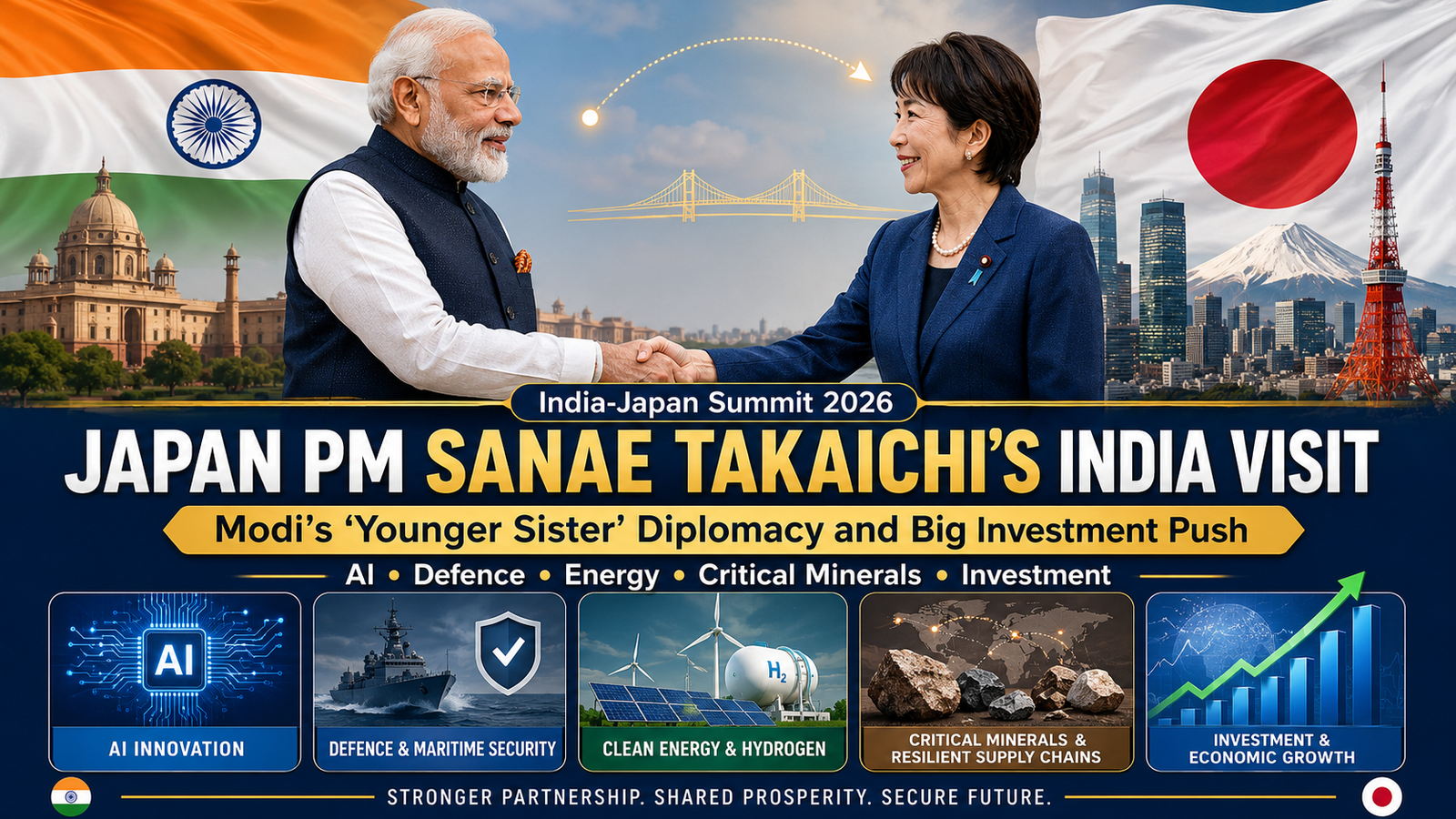
Japan PM Sanae Takaichi’s India Visit: Modi’s “Younger Sister” Diplomacy and Big Investment Push

Japanese Prime Minister Sanae Takaichi’s recent visit to India has opened a new chapter in India-Japan relations. The visit was not only about diplomatic meetings and formal agreements. It also carried a warm personal moment when Prime Minister Narendra Modi called PM Takaichi his “younger sister.”
That one phrase became the emotional highlight of the visit. But behind the warmth was a very serious strategic message: India and Japan are moving closer in technology, defence, energy security, supply chains and investment.
At a time when the world is facing unstable supply chains, rising geopolitical tensions and economic uncertainty, the India-Japan partnership is becoming more important than ever.
PM Modi Calls Japan PM His “Younger Sister”
During the joint press statement in New Delhi, PM Modi welcomed Japanese Prime Minister Sanae Takaichi by calling her “meri chhoti behen”, meaning “my younger sister.”
This was not just casual diplomacy. It reflected the personal comfort between the two leaders. Reports said PM Takaichi had earlier mentioned that she considered former Japanese PM Shinzo Abe like an elder brother and now saw PM Modi in a similar way. PM Modi responded warmly by calling her his younger sister.
This kind of personal chemistry matters in diplomacy. Strong relationships between leaders often help countries build trust faster.
Key Focus of the Visit
The visit focused on strengthening the India-Japan Special Strategic and Global Partnership.
Both leaders discussed trade, investment, defence, economic security, energy, artificial intelligence, critical minerals, technology, people-to-people ties and Indo-Pacific cooperation.
The message was clear: India and Japan are not just business partners. They are strategic partners shaping the future of Asia.
Major MoUs and Agreements Signed
India and Japan signed important agreements and adopted key documents during the visit.
The most important areas include:
- Artificial Intelligence cooperation
- Economic security roadmap
- Energy resilience
- Defence co-development
- Critical minerals and metals
- Semiconductors
- Shipbuilding
- Biogas and clean energy
- Supply-chain resilience
- Next-generation mobility
One of the biggest outcomes was the first-ever India-Japan defence co-development agreement. This is important because it shows Japan is now willing to work more closely with India in sensitive defence technology.
The two countries also agreed to strengthen cooperation in AI. PM Modi said Japan’s precision technology and India’s software strength can together give new energy to global AI development.
Big Japanese Investment Push in India
Investment was one of the biggest highlights of the summit.
PM Modi urged Japanese businesses to help ensure Japanese investment in India crosses 10 trillion yen over the next decade. He also called for doubling the number of Japanese companies operating in India.
This is a big opportunity for India.
Japan has strong technology, capital, manufacturing discipline and global business experience. India has a large market, young workforce, digital strength and fast-growing economy.
Together, the two countries can build strong supply chains in electric vehicles, semiconductors, green energy, advanced manufacturing, defence and infrastructure.
Reports also said many private-sector agreements were announced during the India-Japan Joint Economic Forum, with investment focus on clean energy, advanced technologies and semiconductors.
Maruti Suzuki’s New Plant: A Symbol of India-Japan Success
During the visit, PM Modi and PM Takaichi also jointly inaugurated Maruti Suzuki’s fourth manufacturing facility at Kharkhoda in Haryana through video conferencing.
This was symbolic.
Maruti Suzuki is one of the strongest examples of India-Japan economic cooperation. What began as a car partnership decades ago has now become a major manufacturing success story.
PM Modi also highlighted that a large share of Suzuki cars sold globally are now manufactured in India and exported to many countries.
This shows how Japan’s technology and India’s scale can create global impact.
Why This Visit Matters for India
This visit is important for India for five major reasons.
First, Japan can help India build stronger manufacturing and supply chains.
Second, Japan’s investment can support Make in India and Viksit Bharat 2047.
Third, defence cooperation with Japan strengthens India’s position in the Indo-Pacific.
Fourth, AI, semiconductors and critical minerals are key to the future economy.
Fifth, India and Japan together can offer a democratic, stable and trusted alternative in Asia.
Why Japan Needs India
This partnership is not one-sided. Japan also needs India.
Japan has advanced technology but faces an ageing population and slow domestic growth. India offers a young workforce, huge consumer market, digital talent and fast-growing manufacturing base.
Japanese companies are looking for trusted locations outside China to diversify production. India is becoming one of the most attractive options.
This is why India-Japan economic cooperation is no longer limited to cars and infrastructure. It is now expanding into AI, semiconductors, defence, green energy and space-age industries.
Strategic Importance in the Indo-Pacific
India and Japan are both members of the Quad, along with the United States and Australia. Both countries support a free, open and stable Indo-Pacific.
This matters because the Indo-Pacific is now the centre of global trade, technology and military competition.
A stronger India-Japan partnership helps balance regional power, protect sea routes and build secure supply chains.
In simple language, India and Japan are working together to make sure Asia’s future is not controlled by pressure, coercion or one-country dominance.
Final Thoughts
Japanese Prime Minister Sanae Takaichi’s India visit was a strong mix of warmth and strategy.
PM Modi calling her his “younger sister” showed personal trust. But the real importance of the visit lies in the agreements on AI, defence, energy, economic security, critical minerals, semiconductors and investment.
India needs technology, investment and reliable partners. Japan needs scale, talent and trusted growth markets. Together, both countries can build a powerful partnership for the next decade.
This visit shows that India-Japan ties are moving from friendship to future-building.
The message is simple: Japan brings precision, India brings scale — and together they can shape the future of Asia.
FAQs
Who is Sanae Takaichi?
Sanae Takaichi is Japan’s Prime Minister and the first woman to hold that position.
Why did PM Modi call her his younger sister?
PM Modi used the phrase to reflect personal warmth and trust between the two leaders during the India-Japan summit.
What were the key outcomes of the visit?
The visit focused on AI, defence co-development, energy security, critical minerals, supply chains, semiconductors and Japanese investment in India.
How much Japanese investment is India targeting?
PM Modi called for Japanese investment in India to cross 10 trillion yen over the next decade.
Why is Japan important for India?
Japan is important for India because of its technology, investment, manufacturing strength, infrastructure support and strategic role in the Indo-Pacific.
Disclaimer: This article is for informational and educational purposes only. Investment figures, MoUs and project timelines may evolve as official implementation progresses.