








































PM Modi Commissions Three Indian Navy Vessels: A Big Leap for India’s Indigenous Shipbuilding Power

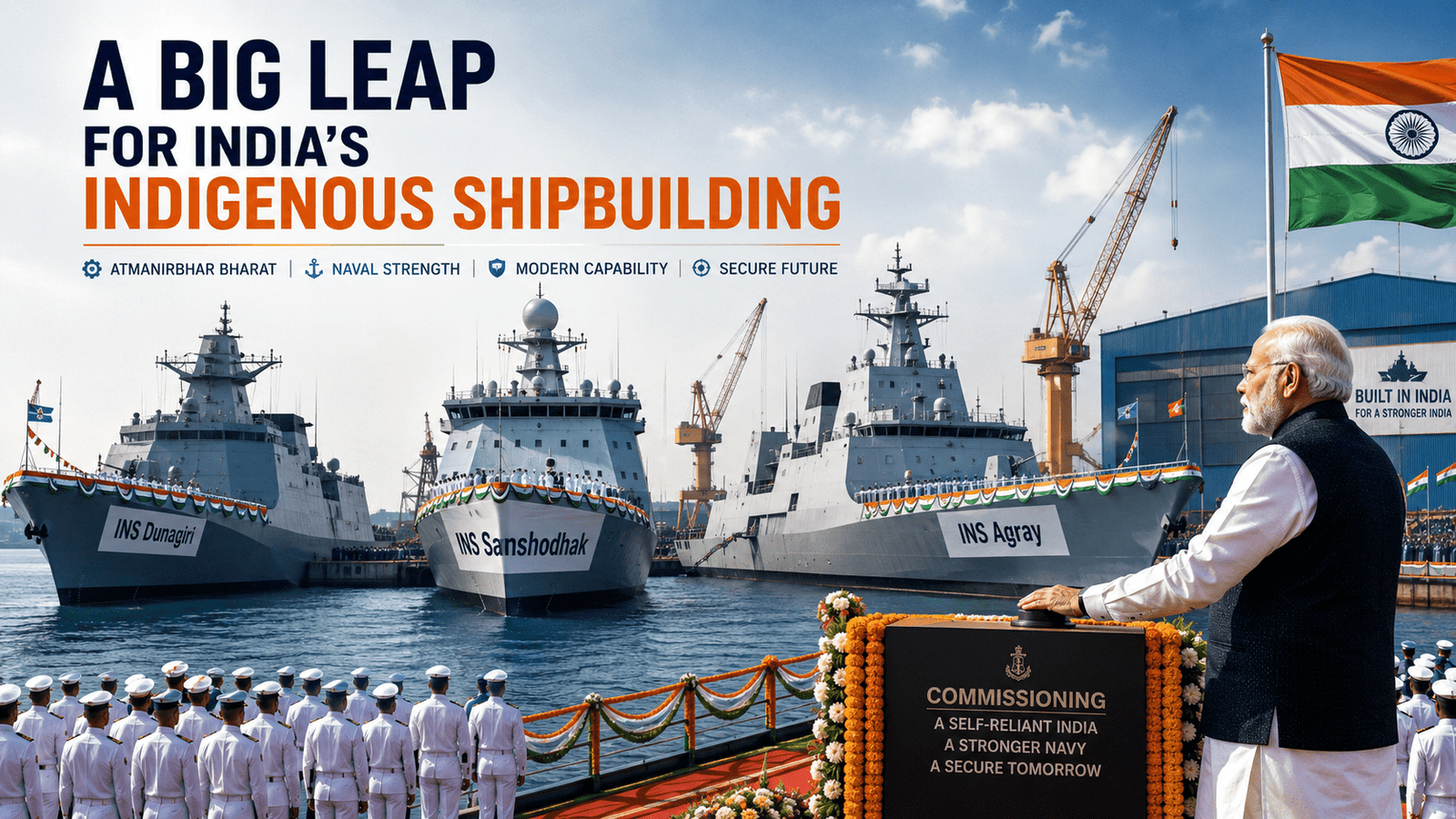
India’s maritime power has received a major boost after Prime Minister Narendra Modi commissioned three indigenously designed and built Indian Navy vessels — INS Dunagiri, INS Sanshodhak and INS Agray — at Syama Prasad Mookerjee Port in Kolkata.
This was not just a naval ceremony. It was a powerful message about India’s growing shipbuilding capability, defence self-reliance and rising confidence in indigenous technology.
For decades, India depended heavily on foreign defence platforms. Today, that story is changing. India is not only building ships for its Navy but also creating a wider industrial ecosystem involving public sector shipyards, private suppliers, engineers, designers and MSMEs.
Three Vessels, Three Different Capabilities
The commissioning of INS Dunagiri, INS Sanshodhak and INS Agray is important because each vessel adds a different layer to India’s maritime strength.
INS Dunagiri is an advanced stealth frigate and part of the Project 17A class. It is designed for high-end naval combat and is equipped with modern sensors and weapons, including BrahMos surface-to-surface missiles and medium-range surface-to-air missiles. This makes it a powerful frontline platform for blue-water operations.
INS Sanshodhak is a large survey vessel designed for hydrographic surveys, ocean mapping and collection of oceanographic data. This may sound technical, but it is extremely important. A Navy needs accurate seabed, coastal and underwater data for safe navigation, strategic planning, disaster response and maritime domain awareness.
INS Agray is an anti-submarine warfare shallow-water craft. Its role is to detect and engage underwater threats in coastal and littoral waters. In an age where submarines and underwater drones are becoming more important, anti-submarine capability is critical for coastal security.
Together, these vessels strengthen India’s combat power, underwater awareness, survey capability and coastal defence.
Why This Commissioning Matters
PM Modi’s message during the ceremony was clear: a country’s maritime strength is directly linked to its economic and strategic influence.
This is true because the sea is no longer just about ships and ports. Most global trade moves through sea routes. Undersea cables carry massive amounts of global data. Critical minerals, energy routes, shipping lanes and blue economy resources are all connected to maritime power.
For India, the Indian Ocean is not just geography. It is a strategic lifeline.
India’s energy imports, trade routes, coastal security, island territories and regional influence all depend on a strong Navy and a strong domestic maritime industry. That is why the commissioning of these vessels is a major step in strengthening India’s position in the Indian Ocean Region.
India’s Shipbuilding Ecosystem Is Maturing
One of the biggest highlights of this commissioning is that all three vessels were built in India by Garden Reach Shipbuilders & Engineers in Kolkata, with design support from the Indian Navy’s Warship Design Bureau.
This shows that India’s shipbuilding capability is no longer limited to basic platforms. India is now designing and building advanced stealth frigates, survey ships and anti-submarine warfare craft.
Even more importantly, the indigenous content in these ships is reported to be over 75 percent. More than 200 Indian MSMEs contributed to their construction. This means the benefits of naval shipbuilding are not limited to one shipyard. They spread across steel, electronics, sensors, engineering, software, machinery, weapons integration and component manufacturing.
Every Indian-made warship creates jobs, strengthens supply chains and builds technical knowledge inside the country.
From Buyer to Builder
India was once known as one of the world’s largest defence importers. That created strategic dependence. If a country depends too much on foreign suppliers, it can face delays, high costs and pressure during geopolitical crises.
Atmanirbhar Bharat is changing this mindset.
India does not want to remain only a buyer of defence equipment. It wants to become a producer, innovator and exporter. Naval shipbuilding is one of the strongest examples of this shift.
The journey from INS Vikrant to INS Dunagiri, INS Sanshodhak and INS Agray shows that India is gradually moving toward deeper indigenous capability. Each new platform adds experience. Each project improves design confidence. Each ship strengthens India’s industrial base.
Indigenous Technology Is Increasing Gradually
Defence self-reliance does not happen overnight. It is built step by step.
India’s naval platforms now include more indigenous design, Indian-made components, domestic sensors, local weapons integration and participation from Indian private companies and MSMEs. The goal is not only to assemble ships in India but to control the technology, design, supply chains and maintenance ecosystem.
This is important because modern warships are not just steel structures. They are floating technology platforms. They include radar, sonar, missiles, propulsion, electronic warfare systems, communication networks, navigation tools and combat management systems.
The more India develops these capabilities at home, the more independent and secure it becomes.
Impact on National Security
The Indian Ocean is becoming one of the world’s most important strategic regions. China’s growing naval presence, piracy threats, submarine activity, regional instability and competition over sea routes have increased the need for India to maintain strong maritime awareness.
INS Dunagiri will help India project power. INS Sanshodhak will help India understand and map the maritime environment. INS Agray will help protect coastal waters from underwater threats.
Together, they strengthen India’s ability to defend its coastline, secure trade routes and support regional stability.
Economic Benefits Beyond Defence
Shipbuilding is not only about national security. It is also an economic opportunity.
A modern shipbuilding ecosystem creates employment for engineers, welders, technicians, software developers, metal workers, electronics suppliers, logistics companies and thousands of skilled workers.
It also supports related industries such as ship repair, maintenance, port infrastructure and maritime logistics. PM Modi’s focus on shipbuilding, ship repair and MRO shows that India wants to turn maritime manufacturing into a major economic engine.
If India continues in this direction, it can become a global hub for shipbuilding and naval technology.
Final Thoughts
The commissioning of INS Dunagiri, INS Sanshodhak and INS Agray is a proud moment for India. It shows that the country’s defence manufacturing journey is moving from slogans to real platforms.
India is building more than ships. It is building confidence, capability and strategic independence.
The message is clear: India’s Navy is becoming stronger, India’s shipyards are becoming more capable, and India’s indigenous defence technology is gradually rising.
In the 21st century, nations that control the seas will shape trade, security and influence. With these new vessels, India has taken another important step toward becoming a confident maritime power.
Disclaimer: This article is for informational and educational purposes only. It is based on publicly available reports and should not be considered defence, financial, legal or investment advice.