






























PoK Unrest: Is This the Right Time for India to Raise the Demand for Pakistan-Occupied Kashmir?

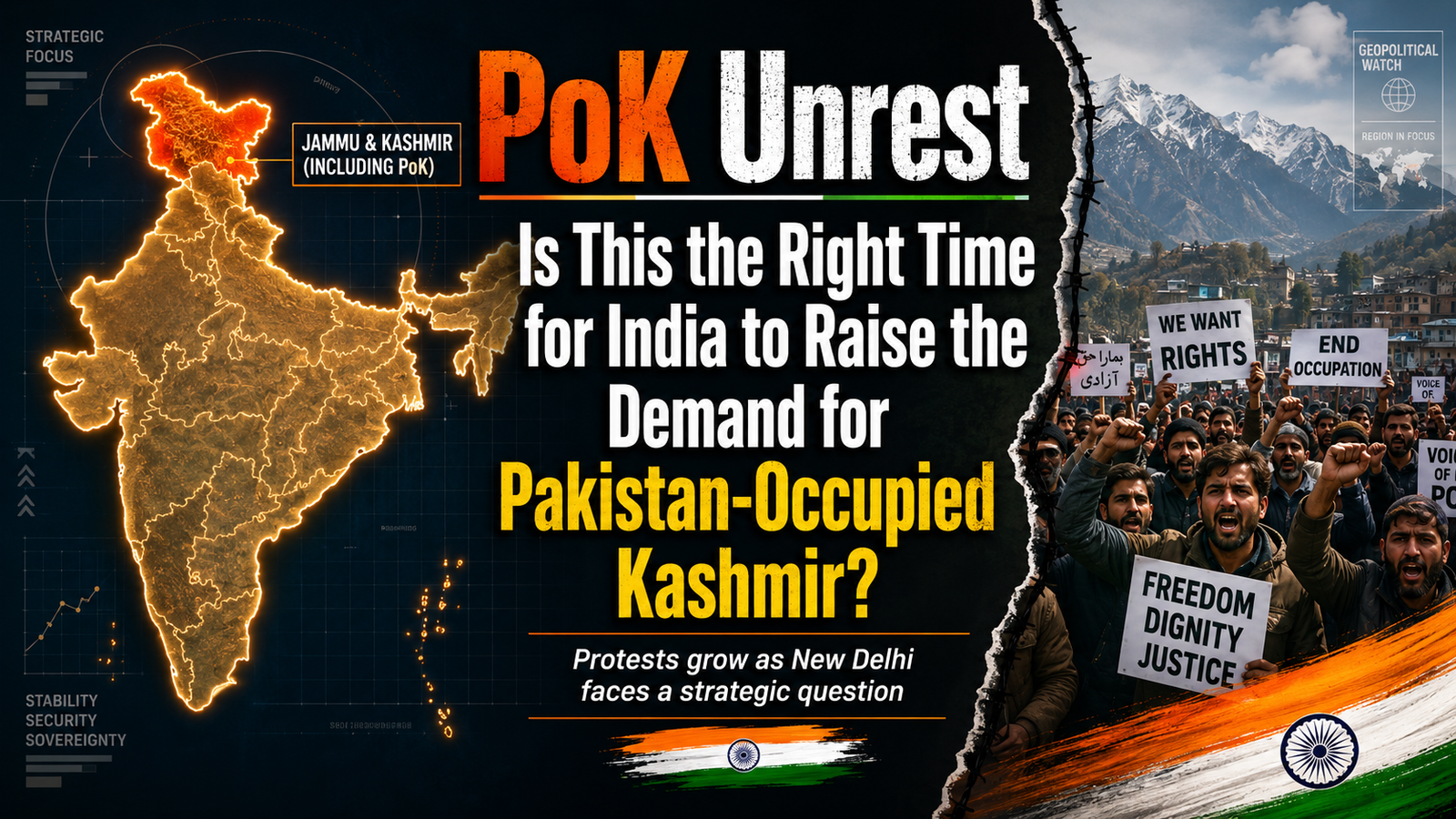
Pakistan-occupied Kashmir is again in turmoil. Protesters are raising slogans against Islamabad, local leaders are seeking support from people in Jammu and Kashmir, and anger against Pakistan’s control is growing louder.
The latest protests have turned deadly, with reports of police firing, arrests, food-supply disruption and a crackdown on civil-rights groups. What began as a movement over electricity prices, wheat subsidies and political representation has now become a deeper challenge to Pakistan’s authority.
For India, this is not just another protest across the Line of Control. It is a strategic moment.
What Is Happening in PoK?
Large protests have erupted across Pakistan-occupied Jammu and Kashmir after the arrest of senior leaders linked to the Jammu Kashmir Joint Awami Action Committee. Protesters have accused Pakistani authorities of repression, food restrictions and human-rights violations.
Reports say one person was killed after police opened fire on protesters. Earlier demonstrations in Rawalakot also saw strong anti-Pakistan slogans, with protesters declaring that PoK is not part of Pakistan.
Some leaders and protesters have reportedly appealed to people in India’s Jammu, Kashmir and Ladakh for support. This is important because it shows the movement is no longer only about local prices or subsidies. It is becoming a political rejection of Pakistan’s control.
Why People in PoK Are Angry
The people of PoK have long complained that Pakistan treats the region as a strategic possession, not as a place with real democratic rights.
Their anger is linked to several issues:
- high electricity prices despite local hydropower resources
- wheat and food-supply concerns
- lack of political representation
- crackdown on protest groups
- arrests of local leaders
- alleged human-rights violations
- resentment against Islamabad’s control
The reserved seats issue has also angered many locals. Protesters argue that seats reserved for refugees settled in Pakistan dilute the political voice of people actually living in PoK.
When people feel economically exploited and politically ignored, protest becomes inevitable.
India’s Official Position on PoK
India’s position has always been clear: the entire Union Territories of Jammu and Kashmir and Ladakh are an integral and inalienable part of India, and Pakistan is in illegal occupation of parts of Indian territory.
This is why PoK is not just a foreign-policy issue. It is an unfinished national question.
The latest unrest strengthens India’s argument that Pakistan’s control over PoK is neither stable nor accepted by many people living there.
Is This the Right Time to “Free PoK”?
Emotionally, many Indians will say yes. Strategically, India must be careful and smart.
This is the right time for India to intensify the diplomatic, legal and information campaign on PoK. India should raise human-rights violations, food restrictions, political repression and Pakistan’s illegal occupation at global forums.
But direct military action is a serious matter. India must avoid emotional decisions because Pakistan is a nuclear-armed state and any military escalation can affect millions of civilians.
The smarter approach is: build pressure, expose Pakistan’s failures, support the voices of PoK people diplomatically and keep India’s national-security options open.
India does not need to rush. Pakistan’s own internal contradictions are weakening its position.
Pakistan’s Internal Crisis Is Getting Worse
Pakistan is facing pressure from multiple sides.
In PoK, people are protesting against Islamabad’s control. In Balochistan, separatist voices continue to demand freedom or greater autonomy. Along the Afghanistan border, Pakistan is facing militant blowback and rising tensions with the Taliban-led government in Kabul.
Economically, Pakistan has also struggled with poverty, debt pressure, weak public services and past inflation shocks. The World Bank has warned that Pakistan’s poverty reduction progress has reversed, with poverty rising again after years of gains.
This is why Pakistan’s military and political establishment often uses India-focused rhetoric. External confrontation helps divert attention from internal failures.
Balochistan Also Shows the Same Pattern
Balochistan is another major challenge for Pakistan.
Baloch activists have repeatedly accused Pakistan’s state of exploitation, enforced disappearances, military operations and denial of political rights. Recent reports say Baloch activists are planning global campaigns to expose Pakistan’s role in the region, while separatist violence continues.
The situation in Balochistan shows that Pakistan’s problem is not only with India. Its own internal regions are questioning the state model.
A country cannot claim moral authority on Kashmir while suppressing voices in PoK and Balochistan.
The Failure of the Religion-First State Model
Pakistan was created through the two-nation theory, which argued that Hindus and Muslims were separate nations and needed separate political futures.
But after nearly eight decades, Pakistan’s experience raises a serious question: can a state built primarily around religious identity protect diversity, democracy and regional rights?
This is not a criticism of Islam as a faith. Millions of Muslims live peacefully in India and across the world. The problem is the political misuse of religion by a state.
Pakistan’s religion-first nationalism has often pushed minorities, regional identities and dissenting voices to the margins. Hindus, Sikhs, Christians, Ahmadis, Shias and other vulnerable communities have faced discrimination, blasphemy-law misuse, forced-conversion concerns and social pressure.
A strong country protects its minorities. A weak state uses identity politics to hide governance failure.
Why Gen Z Should Understand This
Many young people today see India-Pakistan issues only through social media clips. But the real story is deeper.
Pakistan’s crisis is not sudden. It comes from decades of military dominance, extremist influence, weak democratic institutions, poor education outcomes, corruption, minority insecurity and economic mismanagement.
Gen Z must understand that nations do not fail in one day. They fail when institutions are weakened, minorities are silenced, dissent is treated as treason and terrorism is used as a foreign-policy tool.
PoK is now showing the result of that failed model.
What India Should Do Now
India should take a five-step approach.
First, raise PoK human-rights violations globally.
Second, document testimonies, protests, arrests and food-supply allegations from the region.
Third, expose Pakistan’s illegal occupation and governance failures.
Fourth, engage the people of PoK through cultural, historical and humanitarian messaging.
Fifth, keep strategic patience while strengthening India’s military readiness and diplomatic pressure.
India must show confidence, not desperation.
Final Thoughts
The latest developments in PoK are a major warning sign for Pakistan. When people living under its control begin seeking support from India and openly rejecting Islamabad’s authority, the world should pay attention.
Pakistan’s problems are not only economic. They are structural. PoK, Balochistan, minority persecution, terrorism, poverty and political instability all point to a deeper crisis of state legitimacy.
For India, this is the right time to reclaim the PoK narrative strongly. But India must act with intelligence, not emotion.
The future of PoK will not be decided only by slogans or force. It will be decided by legitimacy, human rights, international pressure and the will of the people.
Pakistan’s grip is weakening. India must be ready — diplomatically, legally, morally and strategically.
FAQs
Are PoK leaders asking for India’s support?
Recent reports say PoK protest leaders and demonstrators have appealed to people in Jammu, Kashmir and Ladakh for support amid protests against Pakistan’s crackdown.
Is PoK legally part of India?
India’s official position is that the entire Union Territories of Jammu and Kashmir and Ladakh are integral and inalienable parts of India, and Pakistan is in illegal occupation of some parts.
Is this the right time for India to act on PoK?
It is the right time for India to intensify diplomatic, legal and information pressure. Any military decision must be carefully calibrated because of nuclear and civilian risks.
Why is Balochistan important in this debate?
Balochistan shows that Pakistan is facing internal legitimacy challenges beyond PoK, with activists demanding independence or greater autonomy.
Did the two-nation theory succeed?
Pakistan’s ongoing crises raise serious questions about a state model built primarily around religious nationalism. The issue is political misuse of religion, not religion itself.
Disclaimer: This article is an opinion-based geopolitical analysis using publicly available reports. It criticizes state policy, military control, extremist politics and governance failures, not ordinary citizens or any religion.