

















































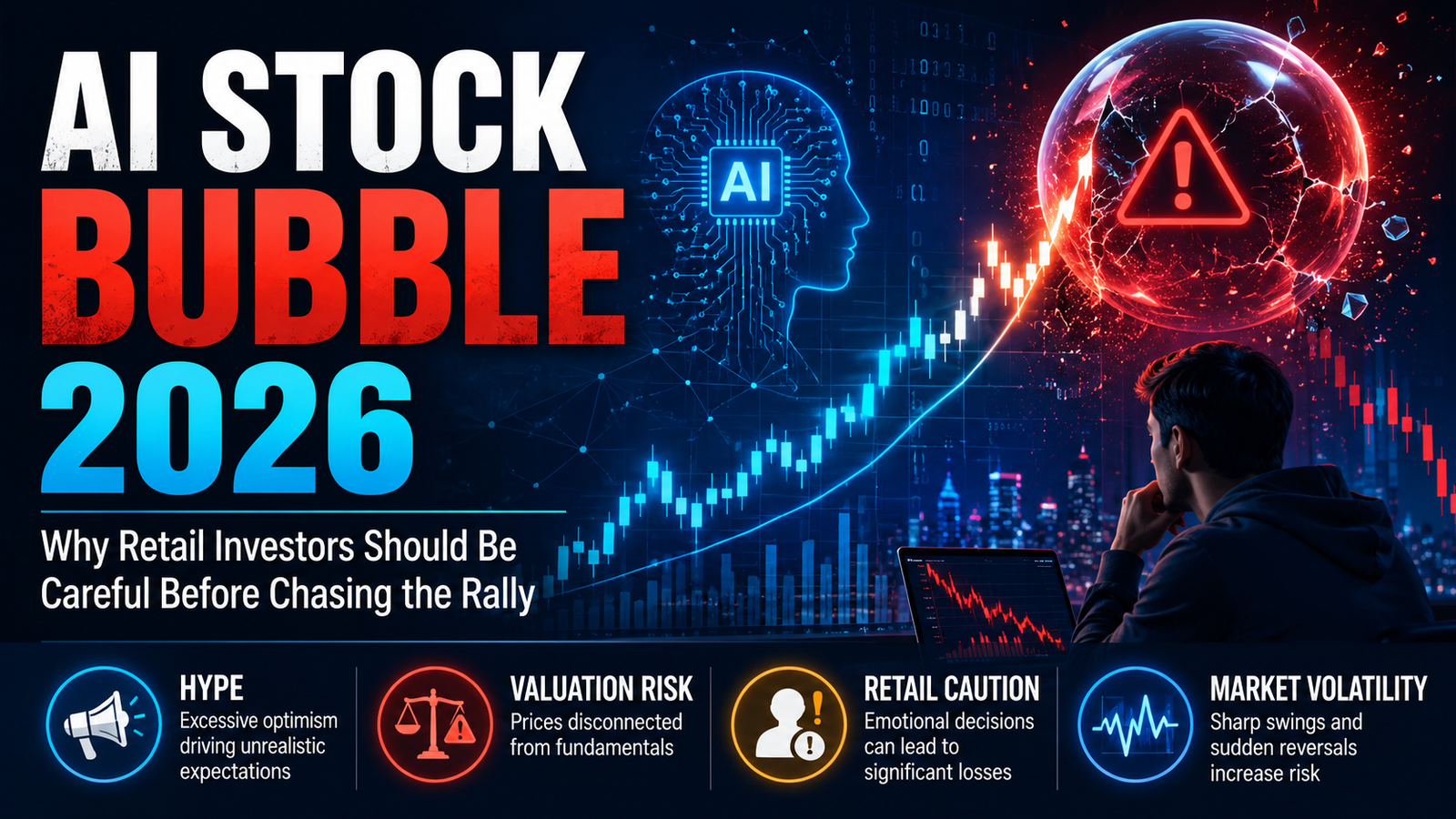
AI Stock Bubble 2026: Why Retail Investors Should Be Careful Before Chasing the Rally

Artificial intelligence has become the biggest investment story of 2026. From Nvidia and Microsoft to OpenAI, Anthropic, chipmakers and data-centre companies, AI-linked stocks are attracting massive investor attention.
Markets are hitting record highs. Tech stocks are leading the rally. IPO excitement is back. Retail investors are again asking the same question: is this the next big wealth creation opportunity or another bubble waiting to burst?
The answer is not simple. AI is real. The technology is powerful. Companies are spending billions on chips, data centres and software. But the stock market may already be pricing in a future that has not fully arrived yet.
That is where the danger begins.
Why AI Stocks Are Rising
AI stocks are rising because investors believe artificial intelligence will transform the global economy.
AI can improve coding, customer service, healthcare, finance, manufacturing, cybersecurity, logistics and education. Companies that control chips, cloud infrastructure, AI models and data centres are being treated like the new oil companies of the digital age.
This is why investors are paying high prices for AI-related companies. They believe today’s spending will become tomorrow’s profit.
But belief alone is not enough. At some point, revenue and profit must justify valuation.
The Bubble Warning
Several market indicators are now flashing caution.
U.S. stock valuations are extremely high. The S&P 500 price-to-sales ratio is far above its long-term average. The Buffett Indicator, which compares total stock-market value to GDP, is also near record levels.
Bank of America’s bubble-risk indicator has also shown elevated readings for semiconductor and technology stocks.
This does not guarantee a crash. But it does mean the market has become fragile.
When valuations are stretched, even a small disappointment can trigger a sharp correction.
AI Is Real, But Valuations May Be Too High
This is the most important point for retail investors.
AI is not fake. It is not just a social-media trend. It is a real technology wave.
But a real technology can still create a stock-market bubble.
The dot-com boom is the best example. The internet was real. It changed the world. But many internet stocks were overvalued, unprofitable and collapsed when expectations became unrealistic.
The same risk exists today.
Even if AI changes the world, not every AI stock will make investors rich.
The OpenAI and Anthropic IPO Hype
The IPO market is also adding fuel to the fire.
OpenAI has reportedly filed for a U.S. IPO, while Anthropic and other AI-linked companies are also moving toward public markets. Some reports suggest valuations could reach hundreds of billions or even trillion-dollar levels.
This creates excitement, but also risk.
When private companies come to the public market at huge valuations, retail investors must ask a basic question: are we buying early growth, or are we giving early investors an expensive exit?
A famous brand does not automatically mean a good investment.
Market Concentration Is a Hidden Risk
Many investors think they are diversified because they own an index fund. But today’s market is heavily concentrated in a few giant technology companies.
This means even passive investors may have large exposure to AI and megacap tech without realizing it.
If the biggest AI-linked stocks continue rising, index investors benefit. But if those same stocks fall together, the broader market can also decline quickly.
This is called concentration risk.
In simple language, the market may look diversified, but it is being pulled by a small group of powerful stocks.
What Retail Investors Should Avoid
Retail investors should avoid three common mistakes.
First, do not buy a stock only because it has “AI” in its name or story.
Second, do not invest based on social-media hype, influencer videos or fear of missing out.
Third, do not ignore valuation, debt, profitability and cash flow.
A company may have a great product but still be a bad investment at the wrong price.
How to Invest More Safely
A better strategy is to invest gradually.
Instead of putting all your money into AI stocks at once, use a phased approach. This reduces the risk of buying at the top.
Investors should also diversify across sectors such as healthcare, energy, consumer goods, banking, infrastructure and quality dividend companies.
AI can be part of a portfolio, but it should not become the entire portfolio.
For most retail investors, broad index funds, diversified mutual funds and disciplined SIPs are safer than chasing individual hype stocks.
What Indian Investors Should Learn
Indian investors are also exposed to the AI trend through U.S. stocks, Indian IT companies, semiconductor themes, mutual funds and global ETFs.
But Indian retail investors must be extra careful.
Many people enter global tech stocks after prices have already run up. They see headlines about Nvidia, OpenAI or AI chips and assume the rally will continue forever.
That is dangerous.
Before investing, Indian investors should check currency risk, taxation, fund expense ratios, company earnings and valuation.
Do not invest in AI because it is popular. Invest only if it fits your long-term financial plan.
Final Thoughts
The AI rally is one of the biggest investment stories of 2026. It may continue for years if companies convert AI spending into real profits.
But investors must remember one simple rule: good technology does not always mean good stock returns.
The market may be right that AI is the future. But it may also be overpaying for that future today.
For retail investors, the best approach is discipline. Avoid hype. Buy gradually. Diversify properly. Focus on profitable companies. And never invest money you cannot afford to lose.
AI may create the next generation of wealth. But if investors chase blindly, it can also create the next generation of losses.
FAQs
Are AI stocks in a bubble?
Some indicators suggest parts of the AI and semiconductor market are showing bubble-like behaviour, but this does not guarantee an immediate crash.
Should retail investors buy AI stocks now?
Retail investors should be cautious. Gradual investing and diversification are safer than chasing stocks after a huge rally.
Is AI a real investment theme?
Yes. AI is a real technology trend, but valuations may already be pricing in very high future growth.
Why are OpenAI and Anthropic IPOs important?
Their public listings could test whether investors are still willing to pay extremely high valuations for AI companies.
What is the safest way to invest in AI?
For many investors, diversified funds, SIPs and limited exposure may be safer than betting heavily on individual AI stocks.
Disclaimer: This article is for informational and educational purposes only. It is not financial or investment advice. Stock markets are risky and prices can change quickly. Please consult a qualified financial advisor before investing.