












































India-Indonesia Sabang Port Deal: How India Is Expanding Its Power in the Indian Ocean

India’s partnership with Indonesia on the development of Sabang Port is more than a normal infrastructure project. It is a strategic maritime move that can strengthen India’s position in the Indian Ocean and the wider Indo-Pacific region.
During Prime Minister Narendra Modi’s July 2026 visit to Indonesia, President Prabowo Subianto welcomed India’s interest in partnering on the integrated development of Sabang Port. The official joint statement said the project could include cruise and marine tourism facilities, ship-repair and shipbuilding industries, shore-based services for offshore energy activities, and stronger connectivity between India’s Andaman and Nicobar Islands and Indonesia’s Sumatra region.
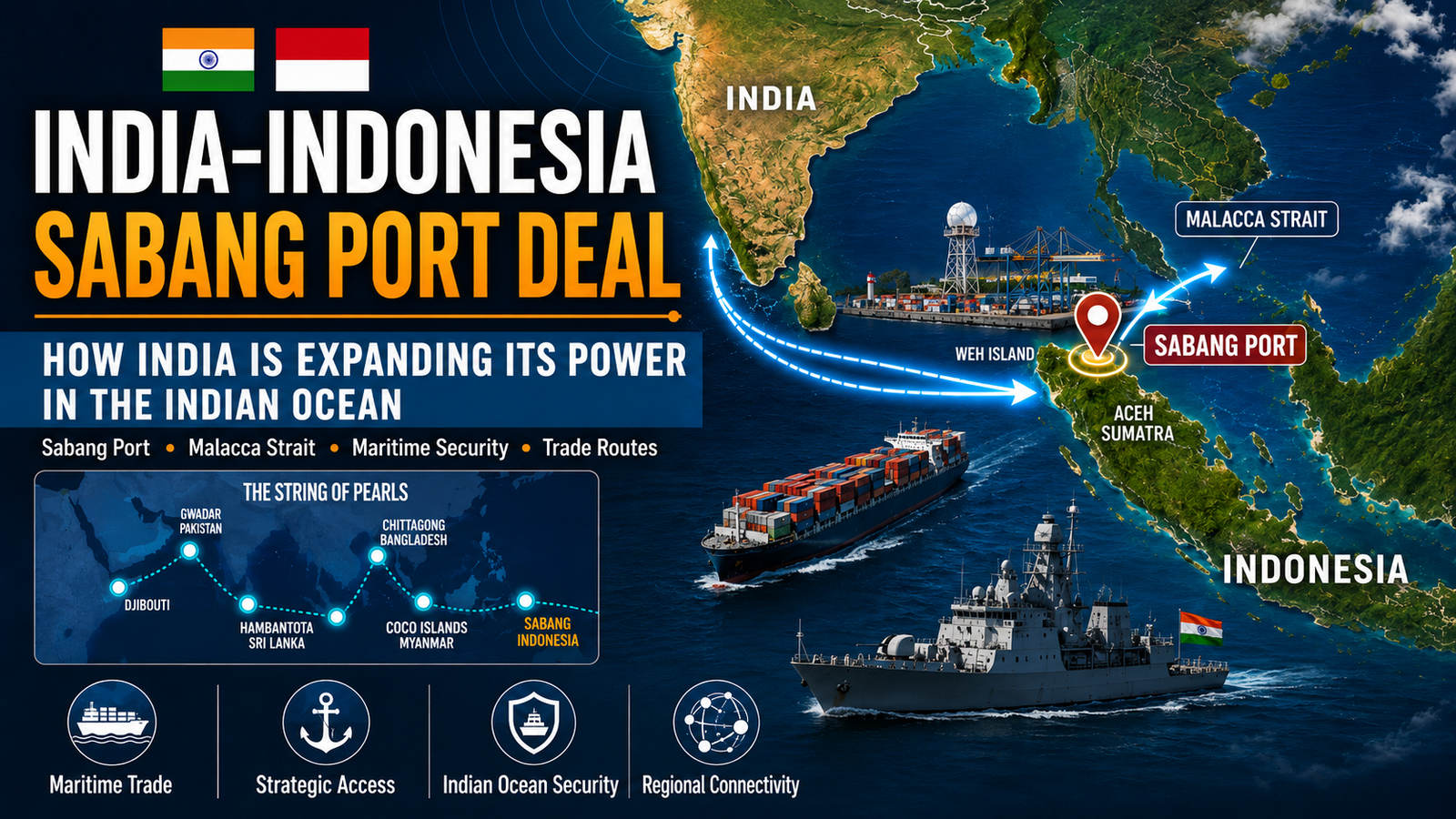
This matters because Sabang is located near one of the world’s most important sea routes — the Strait of Malacca.
Why Sabang Port Is So Important
The Strait of Malacca connects the Indian Ocean with the Pacific Ocean. It is one of the busiest and most sensitive maritime chokepoints in the world. A large share of global trade and energy supplies passes through this narrow route, making it critical for countries like India, China, Japan, South Korea and ASEAN economies. The Council on Foreign Relations has described the Strait of Malacca as a vital passage through which roughly a third of global trade and more than a quarter of seaborne oil passes.
Sabang Port, located in Aceh province of Indonesia, sits close to this route. For India, cooperation on Sabang strengthens maritime connectivity between Andaman and Nicobar Islands and Aceh-Sumatra. Indonesia’s President Prabowo also said that Sabang and India’s Andaman and Nicobar Islands can become a strategic maritime link to improve trade, logistics, investment and people-to-people connectivity.
In simple terms, Sabang gives India a stronger presence near the eastern gateway of the Indian Ocean.
A Counter to China’s String of Pearls Strategy?
For years, Indian analysts have discussed China’s “String of Pearls” strategy — a term used to describe China’s growing network of ports, infrastructure projects and strategic access points across the Indian Ocean, including locations such as Gwadar in Pakistan, Hambantota in Sri Lanka and Kyaukpyu in Myanmar. It is important to note that “String of Pearls” is an analyst term, not China’s official policy name. Still, many Indian strategic experts see these projects as part of Beijing’s long-term effort to expand influence in the Indian Ocean.
Sabang Port can become India’s answer to that pressure.
While China has built influence through port investments and maritime access, India is now building its own network through trusted partnerships — from Chabahar in Iran to Duqm in Oman, Agaléga in Mauritius, and now Sabang with Indonesia.
This is not about confrontation. It is about balance.
India’s Advantage: Geography and Partnership
India’s biggest strength is geography. The Andaman and Nicobar Islands sit near the entrance of the Malacca Strait. If India improves maritime cooperation with Indonesia, it can better monitor sea lanes, support trade movement, improve disaster response, and strengthen regional security.
The 2026 India-Indonesia joint statement also reaffirmed that both countries are maritime neighbours and strategic partners. The two sides agreed to strengthen defence and maritime cooperation through port calls, joint exercises, hydrography, information sharing, capacity building and defence industrial cooperation.
This means Sabang is not just about ships and cargo. It is part of a wider security and economic framework.
Boost for Trade, Tourism and Blue Economy
The Sabang project is also economically important. India and Indonesia are two large democracies, two major developing economies and two maritime powers. Better port-to-port connectivity can increase trade, tourism, shipping, logistics and investment between eastern India, Andaman and Nicobar, Aceh and Sumatra.
The official joint statement said the Sabang partnership can create investment, jobs, technology transfer and shared regional prosperity.
This is why Sabang should not be viewed only through a military lens. It is also a trade, connectivity and blue economy opportunity.
Why China Will Watch This Closely
China depends heavily on sea routes passing through the Indian Ocean and Malacca Strait. Any stronger Indian presence near this region naturally becomes strategically important.
India does not need to block anyone. But India must have the ability to protect its own trade routes, energy supplies and maritime interests. Sabang helps India move from a defensive posture to a more confident Indo-Pacific role.
With the Indian Navy, Andaman and Nicobar Command, and growing partnerships with ASEAN countries, India is slowly building a maritime network that can counterbalance China’s expanding footprint.
Final Thoughts
India’s role in developing Sabang Port with Indonesia is a major step in New Delhi’s Act East policy and Indo-Pacific strategy. It strengthens India’s presence near the Malacca Strait, improves connectivity with Southeast Asia, supports maritime security and gives India a stronger position in the Indian Ocean.
As China expands through its “String of Pearls,” India’s response is becoming clearer: build partnerships, strengthen ports, improve naval reach and protect the Indian Ocean through cooperation.
Sabang Port may look like a small dot on the map, but strategically, it could become one of India’s most important maritime gateways in the coming decade.
FAQs
What is Sabang Port?
Sabang Port is a strategically located port in Aceh, Indonesia, near the entrance of the Strait of Malacca.
Why is Sabang important for India?
Sabang gives India stronger maritime connectivity with Indonesia and improves India’s strategic presence near the Malacca Strait.
Is Sabang Port a military base for India?
No official statement says it is an Indian military base. The project is focused on integrated port development, maritime connectivity, tourism, ship-repair, shipbuilding and regional cooperation.
How does Sabang counter China’s String of Pearls?
Sabang helps India strengthen its own maritime network in the Indo-Pacific, balancing China’s growing port and infrastructure presence across the Indian Ocean.
Disclaimer: This article is for informational and educational purposes only. It is based on official statements, credible reports and strategic analysis available at the time of writing.