









































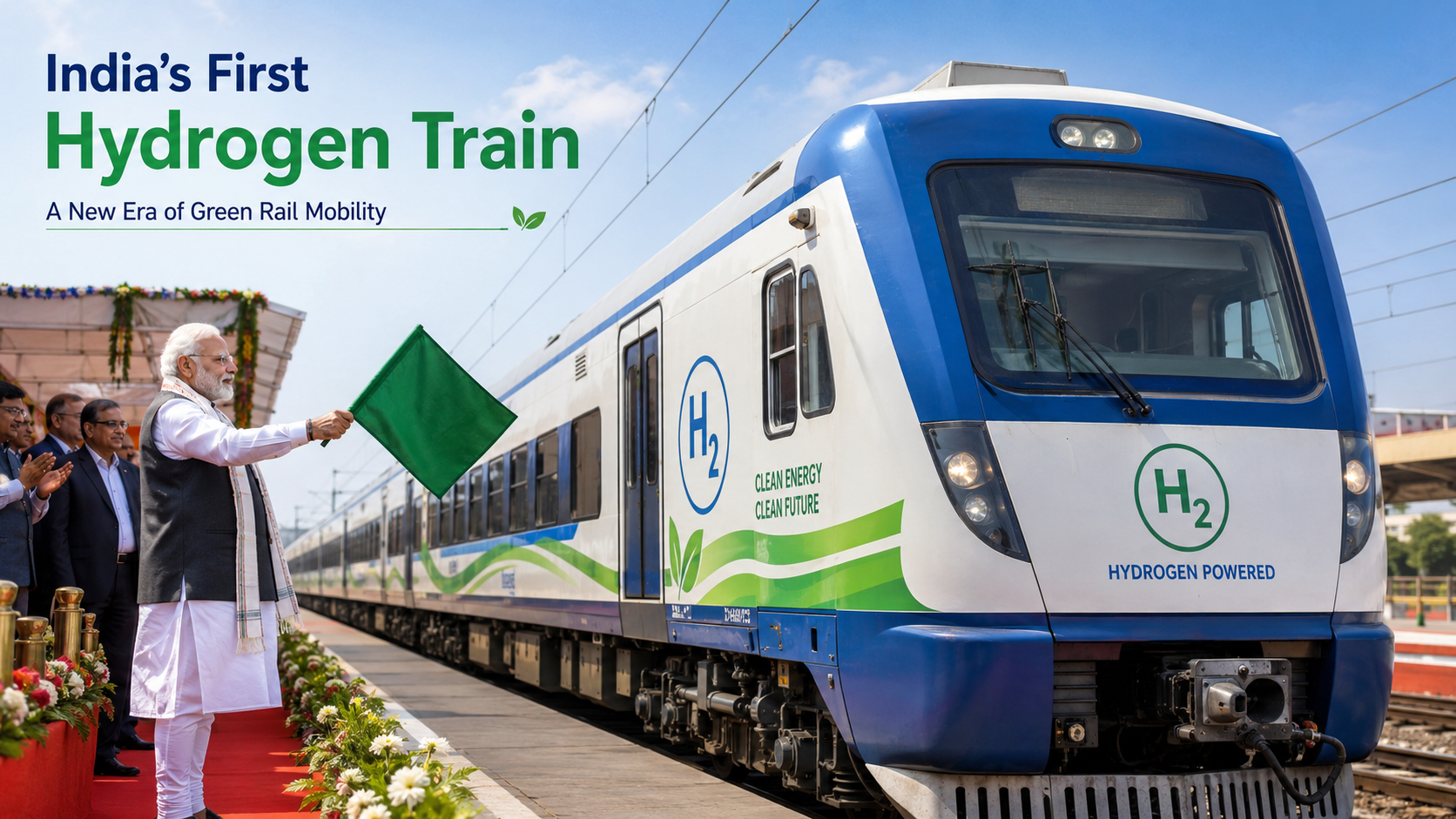
India’s First Hydrogen Train: PM Modi Flags Off a New Era of Green Rail Mobility

India has taken a major step in clean transportation after Prime Minister Narendra Modi flagged off the country’s first indigenous hydrogen-powered train between Jind and Sonipat in Haryana on July 17, 2026. Reuters reported that the launch makes India one of a small group of countries using hydrogen-powered rail technology.
The train, called NaMo Green Rail in media reports, is not just another railway launch. It represents a shift in how India is thinking about future mobility, clean energy and Atmanirbhar Bharat. The Prime Minister’s Office said PM Modi flagged off India’s first indigenous hydrogen-powered train and called it a proud symbol of cleaner, future-ready transportation.
What Makes This Train Special?
India’s first hydrogen train is a 10-car hydrogen fuel cell-based trainset designed and developed in India under specifications prepared by the Research, Design & Standards Organisation. PIB says it is powered by a 1200 kW hydrogen fuel cell propulsion system, has a design speed of 110 kmph, and is approved to operate at 75 kmph on the Jind-Sonipat section.
The train can carry around 2,600 passengers, making it a serious passenger mobility project rather than only a small demonstration vehicle. It will connect Jind Junction, Gohana Junction and Sonipat, along with several intermediate stations and proposed halts.
Reuters reported that the 10-coach train will run twice a day between Jind and Sonipat on a roughly 90-km route in Haryana.
How Does a Hydrogen Train Work?
A hydrogen train does not burn diesel like a traditional locomotive. It uses hydrogen fuel cells to generate electricity onboard.
According to PIB, the train uses Proton Exchange Membrane Fuel Cell technology, where hydrogen reacts with oxygen to produce electricity. The main byproducts are water vapour and heat, making it far cleaner at the point of use than diesel traction.
This is why hydrogen rail is seen as a possible solution for routes where full electrification is difficult, expensive or environmentally sensitive.
Indian Railways has also built a dedicated hydrogen ecosystem at Jind. PIB says India’s largest railway hydrogen storage and refuelling facility has been established there, with capacity to store nearly 3,000 kg of hydrogen at a time.
Why Is This Significant for India?
This train is significant for three major reasons.
First, it shows India can build advanced rail technology domestically. PIB says the project was designed and developed in India from design stage through prototype manufacturing, supporting the vision of Atmanirbhar Bharat.
Second, it gives Indian Railways practical operating experience with hydrogen fuel cell technology. Hydrogen trains are still at an early stage globally, so India’s pilot can help build knowledge around safety, refuelling, maintenance, cost and performance. PIB notes that the project will provide valuable operational experience for future hydrogen mobility applications.
Third, it supports India’s clean-energy goals. India has already electrified more than 99% of broad-gauge routes, but hydrogen can still be useful on heritage, hill, remote and branch routes where overhead electric lines may be difficult or visually disruptive. PIB says hydrogen trains are part of the next leap in clean rail mobility after India’s rapid electrification drive.
How Many Countries Have Hydrogen Trains?
India has now joined a select group of countries exploring or operating hydrogen rail technology. PIB names Germany, Japan, China and the United States as countries already in this group.
Reuters also reported that India joins countries including Germany, Japan, China and the United States in using hydrogen-powered rail technology.
Germany remains one of the most advanced examples. Alstom says its Coradia iLint became the world’s first hydrogen fuel cell passenger train to enter commercial service in Germany in 2018.
So the honest answer is: only a handful of countries have reached serious hydrogen rail deployment or testing, and India is now among them. But the technology is still new, and commercial success will depend on cost, hydrogen supply, safety and scale.
Future Projects: Hydrogen for Heritage
India’s hydrogen rail story does not end with Jind-Sonipat.
Indian Railways has planned 35 hydrogen trains under the Hydrogen for Heritage initiative. PIB earlier said these trains were planned for heritage and hill routes, with an estimated cost of ₹80 crore per train and ground infrastructure cost of ₹70 crore per route.
The Budget 2023-24 also included development of 35 hydrogen fuel cell-based trains for heritage and hill routes at a cost of ₹2,800 crore.
More recently, PIB said Indian Railways is exploring hydrogen technology for heritage railways including the Kalka-Shimla route, using experience from the Jind-Sonipat pilot.
This is important because hill and heritage routes often face environmental sensitivity, tourism pressure and engineering limitations. Hydrogen trains can reduce diesel smoke and noise while preserving the beauty of these routes.
Why Hydrogen Trains Matter Despite Electrification
Some people may ask: if Indian Railways is already mostly electrified, why does India need hydrogen trains?
The answer is simple: hydrogen is not meant to replace every electric train. It is meant to fill specific gaps.
Electric trains are ideal where overhead wires already exist. But in remote, heritage, hill or low-traffic routes, building and maintaining electrification infrastructure may not always be practical. Hydrogen trains can generate electricity onboard, making them useful where diesel currently remains the backup option.
This is why India’s first hydrogen train should be seen as a technology pilot, not as a replacement for the entire electrified railway system.
The Real Challenge Ahead
The biggest challenge will be hydrogen supply.
Hydrogen trains are clean at the point of use, but their total environmental impact depends on how the hydrogen is produced. If hydrogen is made using renewable energy, it becomes green hydrogen. If it is produced using fossil fuels, the climate benefit is lower.
India’s National Green Hydrogen Mission aims to make the country a global hub for green hydrogen production, use and export, with a target of 5 million metric tonnes per year by 2030.
That mission will be crucial if hydrogen trains, green steel, clean shipping, fertilizer and industrial decarbonization are to grow together.
Final Thoughts
PM Modi’s inauguration of India’s first hydrogen train is a major symbolic and technological milestone.
It shows that India is no longer just importing future mobility ideas. It is building, testing and operating them domestically.
The Jind-Sonipat hydrogen train may be only the beginning, but it gives India valuable experience in fuel cell propulsion, hydrogen storage, rail safety and clean mobility infrastructure.
If India can scale green hydrogen production, reduce costs and deploy hydrogen trains on the right routes, this could become a powerful part of the country’s clean transport future.
The message is clear: India’s railways are not only getting faster and more modern — they are also becoming greener.
FAQs
When was India’s first hydrogen train inaugurated?
India’s first indigenous hydrogen-powered train was flagged off by Prime Minister Narendra Modi on July 17, 2026.
Which route does India’s first hydrogen train run on?
It runs on the Jind-Sonipat section of Northern Railway in Haryana.
How many passengers can it carry?
The train has a capacity of around 2,600 passengers.
Which countries have hydrogen trains?
India has joined a select group that includes Germany, Japan, China and the United States. Germany has been one of the earliest commercial adopters.
What are India’s future hydrogen train plans?
Indian Railways has planned 35 hydrogen trains under the Hydrogen for Heritage initiative, mainly for heritage and hill routes.
Disclaimer: This article is for informational and educational purposes only. It is based on official statements and credible reports available at the time of writing. It should not be treated as investment, technical, policy or financial advice.