




































America’s Pressure Campaign Is Becoming a Strategic Risk for India: War, H-1B, Debt and the Dollar Question

For decades, the United States has told the world what responsible economic and political behaviour should look like.
Reduce debt.
Respect market forces.
Keep trade open.
Avoid destabilising wars.
Protect skilled immigration.
Maintain fiscal discipline.
But in 2026, Washington itself is confronting uncomfortable contradictions.
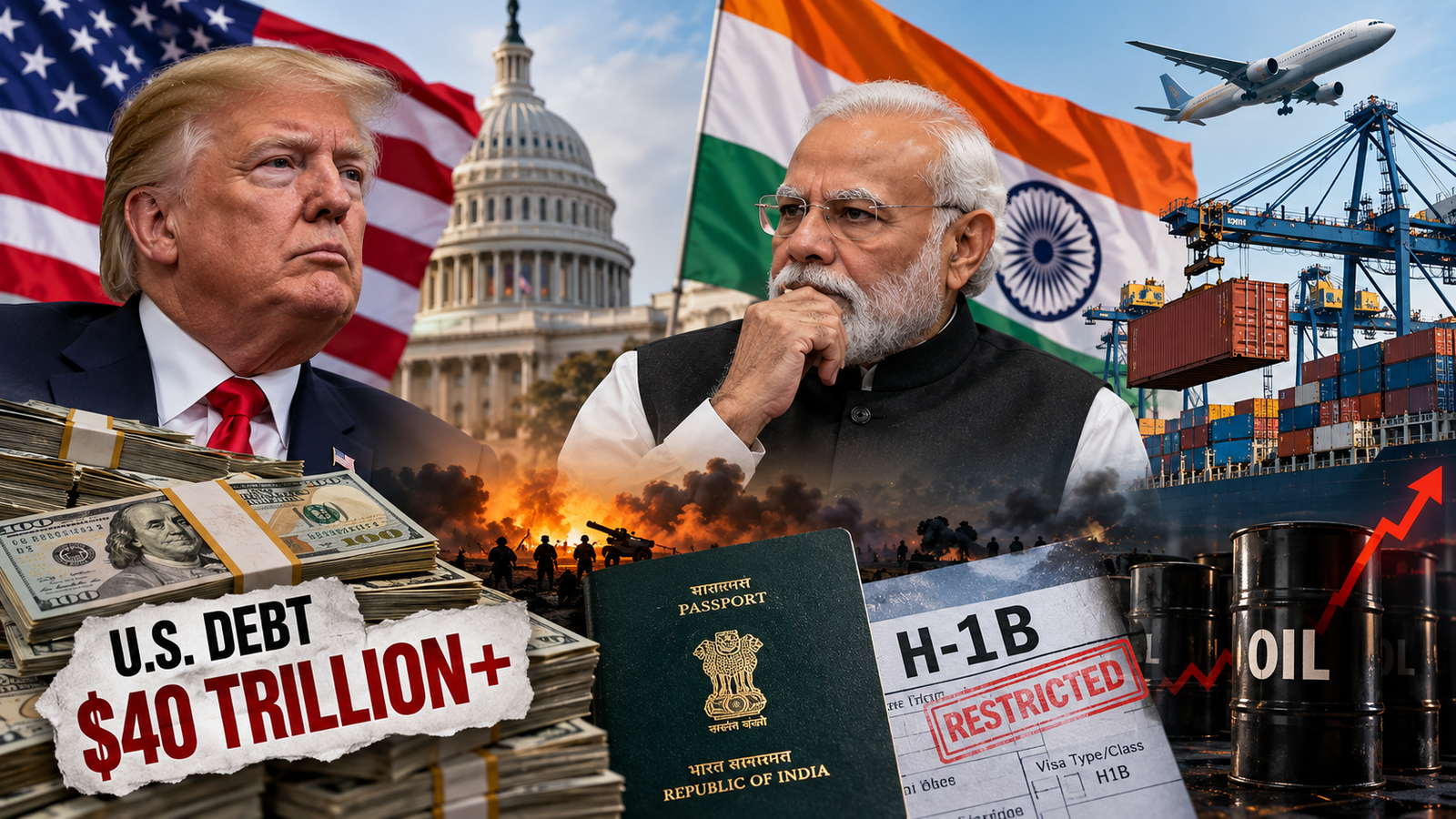
US federal debt has crossed $40 trillion.
Long-term government borrowing costs have risen to levels not seen in more than two decades.
Job creation has slowed dramatically.
American households remain deeply frustrated by the cost of living.
The Trump administration has tightened pathways used heavily by Indian skilled workers.
And the United States is now deeply involved in another Middle Eastern war that has helped drive global energy prices higher.
For India, the lesson should not be that America must become an enemy.
The lesson should be simpler:
India cannot afford to make its economic future dependent on American policy decisions.
America’s Debt Has Crossed $40 Trillion
The numbers are extraordinary.
US federal debt crossed $40 trillion in August 2026, according to Treasury data reported by Reuters.
Of that total, around $32.3 trillion was debt held by the public, with another $7.8 trillion held through intragovernmental accounts.
Washington is now spending roughly $1 trillion annually just on interest payments, with debt servicing consuming about one-fifth of federal tax revenue.
That should matter internationally.
The country issuing the world’s dominant reserve currency is borrowing at an enormous scale while simultaneously asking other governments to maintain fiscal discipline.
The danger is not that the United States suddenly becomes insolvent tomorrow.
It issues debt in its own currency and still has the world’s deepest capital markets.
The concern is what happens if global investors gradually demand higher returns to continue financing Washington.
That pressure is already visible.
US 10-year Treasury yields have climbed above 5%, reaching their highest levels in more than two decades.
The American Economy Is Stronger on Paper Than Many Households Feel
It would be inaccurate to say the United States is experiencing mass unemployment.
It isn’t.
The unemployment rate was 4.2% in September, while weekly unemployment claims remain historically low.
But another part of the labour market looks much weaker.
The US economy created only 29,000 jobs in September, far below the roughly 90,000 expected by economists. July and August payroll figures were also revised lower by a combined 60,000 jobs.
Hiring has slowed dramatically.
Workers are staying in existing jobs because finding another one has become harder.
Manufacturing employment has also failed to produce the revival repeatedly promised by Washington.
Reuters described the US economy heading into the midterm elections as a strange form of “low-hire, low-fire” full employment: layoffs remain limited, but opportunities for people entering or changing jobs have weakened.
That distinction matters.
America is not in a conventional employment collapse.
But millions of Americans can still feel economically insecure even while headline unemployment appears healthy.
Americans Themselves Are Feeling the Pressure
Political messaging cannot erase household expenses.
A Reuters/Ipsos poll published October 9 found 78% of Americans said Trump administration policies had contributed to rising living costs, including majorities across partisan lines.
Higher fuel prices have become particularly painful.
US diesel prices have risen around 70% since the US-Israeli war with Iran began, reaching approximately $6.28 per gallon.
Mortgage rates are high.
Borrowing costs have increased.
Inflation continues eating into wage gains.
So when politicians say the economy is strong, they may be describing GDP, corporate profits or unemployment.
When ordinary families say the economy feels difficult, they are describing rent, mortgages, groceries, fuel and debt payments.
Both realities can exist at the same time.
Then Came the War With Iran
On February 28, the United States and Israel launched major strikes against Iran, beginning a conflict that has since spread through the Gulf and affected global energy markets.
Washington argued that Iran’s nuclear and missile programmes represented a security threat.
Iran called the attacks unprovoked and illegal.
Whatever judgment history ultimately makes about the decision, the economic consequences are already visible.
The conflict has disrupted energy flows.
Shipping and insurance costs have increased.
The Strait of Hormuz has become a global economic pressure point.
Fuel prices have climbed.
And the fighting has expanded into Yemen and Saudi Arabia.
President Trump said on October 8 that the US would not conduct another major attack on Iran before the November 3 midterm elections while talks continued.
That statement itself illustrates how intertwined foreign policy, energy prices and domestic politics have become.
India Pays for Middle Eastern Instability Too
When Washington makes military decisions in the Gulf, the economic consequences do not remain inside America.
India imports most of its crude oil.
Higher oil prices increase India’s import bill.
A weaker rupee makes those imports more expensive.
Transportation costs rise.
Manufacturing becomes more expensive.
Inflation can follow.
So decisions made in Washington and Tel Aviv can eventually affect the grocery bill of a family in Mumbai, Delhi or Patna.
That is why India has a direct national interest in avoiding excessive dependence on a geopolitical system controlled by any single power.
And Now Indian Skilled Workers Are Under Pressure
The contradiction becomes even sharper with immigration.
India has supplied the United States with enormous quantities of technical talent.
According to official USCIS data, 71% of approved H-1B petitions in fiscal 2024 went to people born in India.
Indian engineers helped build Silicon Valley.
Indian professionals work across American healthcare, finance, cloud computing, consulting and artificial intelligence.
Yet Washington is now tightening that pathway.
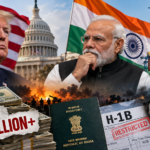
Trump has extended restrictions involving a proposed $100,000 fee on new H-1B applications, although the policy remains subject to court challenges.
And this week, the administration suspended several major companies—including Microsoft, Infosys, TCS and Wipro—from aspects of the PERM employment-based green-card process while investigations proceed.
India’s foreign ministry responded unusually directly, saying such measures “do not advance our shared ambitions.”
That is significant.
For years, Washington presented skilled migration as one of the foundations of the India-US relationship.
Now immigration itself is becoming another instrument of domestic American politics.
India Should Learn From This
The lesson is not that America is uniquely evil.
Major powers act in their own interests.
China does.
Russia does.
The European Union does.
India should too.
The mistake would be assuming geopolitical friendship automatically means permanent alignment.
The United States can be an important technology, defence and investment partner while simultaneously taking decisions that hurt Indian exporters, Indian professionals or Indian strategic interests.
A mature Indian strategy should therefore be built around redundancy.
More export markets.
More indigenous technology.
More domestic defence production.
More energy suppliers.
More settlement mechanisms.
More currencies used in bilateral trade.
And fewer strategic sectors where one foreign government can create a crisis simply by changing policy.
Is the World Really Dumping the Dollar?
Not yet.
This is where dramatic predictions need to meet the data.
The dollar’s share of disclosed global foreign-exchange reserves fell to 56.7% in the second quarter of 2026, according to the IMF.
That is much lower than the dollar’s dominance decades ago.
Countries have gradually diversified into:
the euro,
gold,
the Chinese renminbi,
and smaller reserve currencies.
But the dollar still remains by far the world’s most important reserve currency.
A sudden global abandonment of the dollar would also hurt the countries holding trillions of dollars in American assets.
So de-dollarisation is more likely to happen gradually than through one dramatic global sell-off.
But the Direction of Travel Matters
The more important question is why countries are diversifying.
Sanctions demonstrated that foreign-exchange reserves held within the Western financial system can become geopolitical tools.
Tariffs have shown that access to the American market can also become bargaining leverage.
Technology restrictions have demonstrated that semiconductors and software can be weaponised strategically.
Immigration restrictions affect foreign talent.
And dollar clearing gives Washington enormous reach over international financial transactions.
From the American perspective, these are tools of national power.
From everyone else’s perspective, they create an incentive to build alternatives.
That does not require an anti-American alliance.
It requires basic risk management.
India Should Accelerate Rupee-Based Trade
India has already begun experimenting with settlement mechanisms that reduce the need to use dollars for every transaction.
That strategy deserves expansion where economically practical.
Imagine India buying energy from one country using rupees or a mutually agreed settlement system.
Indian exporters receive payment without every transaction needing to pass through the dollar.
Companies reduce currency-conversion exposure.
The Reserve Bank gains greater flexibility.
None of this means replacing the dollar tomorrow.
It means creating alternatives so that India is never completely dependent on it.
BRICS Matters for the Same Reason
Much of the discussion surrounding BRICS payment systems is misunderstood.
The realistic objective is not necessarily creating one currency that suddenly replaces the dollar.
A more achievable goal is connecting national payment systems and central-bank digital infrastructure so countries can settle a larger share of trade without automatically routing transactions through dollar-based networks.
That could gradually create a multipolar monetary system.
Dollar.
Euro.
Rupee.
Renminbi.
Digital settlement networks.
Gold.
Regional currencies.
The world does not need one currency to replace the dollar for American financial dominance to weaken.
It merely needs more viable alternatives.
America’s Greatest Risk May Be Overusing Its Power
The United States gained enormous advantages from dollar dominance.
It can borrow more cheaply.
Its financial institutions sit at the centre of international finance.
American sanctions have extraordinary reach.
US companies gain easier access to global capital.
But those advantages depend partly on trust.
If Washington repeatedly uses economic access as political leverage, other countries have rational incentives to insure themselves against that power.
The paradox is striking:
The more aggressively America weaponises its financial dominance, the more reason other countries have to build systems that bypass it.
That process will not happen overnight.
But reserve currencies usually lose dominance gradually before the change becomes obvious.
India Does Not Need to Become Anti-American
India’s strongest position is not choosing between Washington, Moscow, Beijing or anyone else.
It is ensuring that no capital can force India to choose.
Buy American technology where it benefits India.
Buy Russian energy when economically and strategically justified.
Trade with Europe.
Expand exports to Africa.
Build stronger relationships with the Gulf.
Develop Indian technology.
Strengthen BRICS financial infrastructure.
Build domestic defence production.
International relations should be based on Indian interests—not emotional ideas of permanent friendship.
Conclusion
The United States remains the world’s most powerful financial and technological country.
That should not blind anyone to the pressures building underneath that strength.
Federal debt has crossed $40 trillion.
Interest costs are approaching $1 trillion annually.
Hiring has slowed dramatically even though layoffs remain low.
Households continue struggling with high living costs.
The Gulf conflict has pushed energy prices higher.
And Washington is tightening immigration pathways heavily used by Indian professionals.
Meanwhile, the dollar’s share of global reserves is slowly declining.
None of this means America collapses tomorrow.
None of it means the dollar disappears next year.
And none of it proves that every American policy is deliberately designed to damage India.
The more important conclusion is strategic.
India should stop building policies on the assumption that American access will always remain available on favourable terms.
Trade access can change.
Visas can change.
Technology access can change.
Sanctions can change.
Governments change.
Alliances change.
National interests remain.
India’s objective should therefore not be replacing dependence on America with dependence on China, Russia or anyone else.
It should be becoming powerful enough that no single country can seriously damage India’s economy simply by changing its rules.
That means stronger Indian companies.
More export markets.
Domestic technology.
Independent energy strategy.
Alternative payment systems.
And eventually a rupee that plays a much larger role in global commerce.
The future international system may not be a world without the dollar.
It may instead be something far more consequential:
a world where countries no longer need the dollar—or Washington’s permission—for everything.
Frequently Asked Questions
Has US federal debt really crossed $40 trillion?
Yes. Treasury data showed total US public debt exceeded $40 trillion for the first time in August 2026.
Is America experiencing massive unemployment?
No. Unemployment was 4.2% in September and layoffs remain historically low. However, new hiring has slowed sharply, with only 29,000 jobs added in September.
Are Indians disproportionately affected by H-1B policy changes?
Indian-born workers accounted for 71% of approved H-1B petitions in FY2024, making changes to the programme particularly significant for Indian professionals.
Is the dollar losing its reserve-currency status?
The dollar remains dominant, accounting for approximately 56.7% of allocated global foreign-exchange reserves in Q2 2026. Its share has declined over the long term, but current data do not indicate an imminent collapse.
Did the United States participate in starting the 2026 Iran war?
The US and Israel launched major attacks against Iran on February 28, 2026. Washington said the operation was intended to address Iranian nuclear and security threats; Iran described the attacks as unprovoked and illegal.
Should India abandon relations with the United States?
India and the United States have major economic, technology and defence relationships. The strategic question is less about ending that relationship and more about preventing excessive dependence on any single country.
Disclaimer: This article is geopolitical and economic analysis. Descriptions of US policies as coercive or strategically risky are analytical interpretations. Economic indicators cited are current as of October 9, 2026, and do not establish that the US economy is collapsing or that the dollar is about to lose reserve-currency status.
