
















































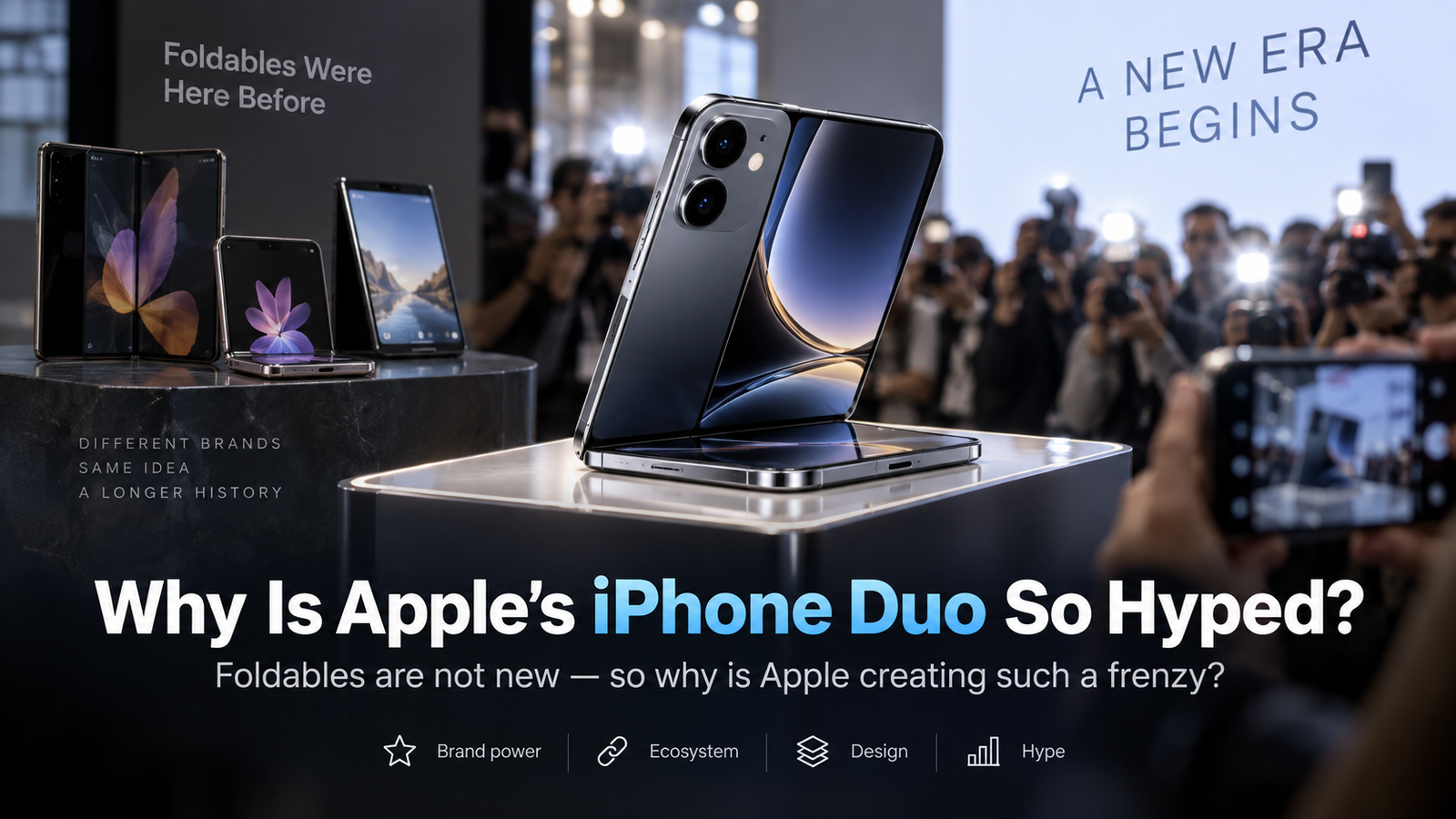

Apple’s first foldable smartphone, the iPhone Duo, has produced the familiar spectacle that accompanies almost every major iPhone launch: endless media coverage, social-media debates, preorder excitement and consumers discussing whether they should spend nearly $2,000 on a new device.
However, the basic technology is not new.
Samsung released the original Galaxy Fold in 2019. Huawei, Honor, Motorola, Google, Oppo and other manufacturers have since introduced different foldable and flip-style devices. Samsung has already completed several generations of its Galaxy Z Fold and Z Flip series.
Apple did not invent the foldable smartphone. It entered an existing category approximately seven years after Samsung.
So why does Apple’s arrival generate more excitement than many of the companies that developed the category first?
The iPhone Duo Is a Foldable, Not a Traditional Flip Phone
There is an important technical distinction.
The iPhone Duo is a book-style foldable phone. It has a regular external screen and opens to reveal a larger tablet-like display. A flip phone, such as Samsung’s Galaxy Z Flip or Motorola Razr, folds vertically into a smaller square-shaped device.
Apple unveiled the Duo with a 5.4-inch outer screen and a 7.6-inch internal display. It includes the A20 Pro processor, split-screen multitasking, Apple Pencil support and up to 2TB of storage. Its starting price is $1,999 in the United States.
These specifications may be impressive, but the underlying concept of combining a smartphone and tablet through a folding display has existed for years.
Samsung officially launched the Galaxy Fold in September 2019 after demonstrating flexible-display technology for several years.
Apple Does Not Need to Be First
Apple’s business strategy has rarely depended on introducing a technology before everyone else.
The company was not the first to produce:
- A smartphone
- A touchscreen mobile device
- A tablet computer
- A smartwatch
- Wireless earphones
- Mobile payments
- Facial recognition
- Satellite smartphone communication
- A foldable phone
Apple’s strength is taking an existing idea, simplifying how it works, integrating it into its ecosystem and presenting it to mainstream consumers.
Competitors often introduce experimental technology first. Apple frequently waits until suppliers, manufacturing processes and consumer expectations become more mature. It then markets its version as a polished product rather than a public experiment.
That does not make Apple the original inventor. It makes the company highly effective at commercialising and popularising technology.
The Apple Ecosystem Creates Powerful Loyalty
An iPhone owner may also use an Apple Watch, AirPods, a MacBook, an iPad, iCloud, Apple Music and other Apple services.
These products share photos, passwords, messages, files, calls and notifications. Features such as AirDrop, iMessage, FaceTime, Handoff and automatic device pairing make leaving the ecosystem inconvenient.
According to research cited by MacRumors, approximately 87% of American iPhone owners who purchased a new phone during the first quarter of 2026 remained with Apple.
Therefore, millions of consumers who wanted a foldable phone were not necessarily willing to move to Android. They were waiting for a foldable that preserved their existing Apple applications, purchases, accessories and services.
The iPhone Duo does not have to convince every Samsung customer to switch. It primarily needs to persuade existing iPhone owners to upgrade.
Apple Sells Trust, Not Only Specifications
Many consumers do not compare processor benchmarks, camera sensors or display technologies. They purchase the brand they already understand.
Apple has built a reputation for:
- Consistent software updates
- Reliable retail and customer support
- Strong resale value
- Familiar user interfaces
- Hardware-and-software integration
- Privacy-focused marketing
- Premium design and packaging
Early foldable phones faced legitimate concerns involving screen creases, hinge durability, dust protection and long-term reliability. Some consumers may trust Apple to enter the market only after it believes those problems can be managed.
Whether the iPhone Duo proves more durable than established competitors will require independent, long-term testing. But Apple benefits from consumer confidence before that testing is complete.
Apple Launches Have Become Cultural Events
Apple is exceptionally skilled at turning product announcements into global entertainment.
Its launch videos use carefully controlled lighting, dramatic music, polished animations and simple language. Complicated engineering is converted into a story that ordinary consumers can understand.
Technology websites, YouTube creators, investors and social-media users then amplify the event. Even criticism contributes to the attention.
This creates a cycle:
- Apple teases a product.
- Media outlets publish rumours and predictions.
- The launch generates global coverage.
- Supporters and critics debate the device.
- Social media creates fear of missing out.
- Preorders and limited initial supply increase desirability.
Few technology companies can generate this level of free publicity.
The iPhone Is Also a Status Symbol
For some buyers, an iPhone is more than a communication device. It represents fashion, social status and personal identity.
This effect is especially visible in markets where the cost of an iPhone represents several months of income. Owning the latest model can signal financial success, professional status or membership in a desirable social group.
The iPhone Duo increases this effect because it is visually distinctive and extremely expensive. When opened in public, people can immediately recognise that it is not an ordinary phone.
A high price can discourage practical buyers while simultaneously making the product more attractive to consumers seeking exclusivity.
Apple’s Entry Validates the Entire Foldable Market
Foldable devices have remained a relatively small part of global smartphone sales. Many consumers still see them as expensive or fragile niche products.
Apple’s entry tells customers, application developers and accessory manufacturers that foldables may be moving closer to the mainstream.
TrendForce estimated that the iPhone Duo could ship approximately five million units and capture nearly 25% of the 2026 foldable market despite launching late in the year. Counterpoint similarly expected Apple to become the second-largest foldable brand behind Samsung. These are forecasts, not confirmed sales.
This illustrates Apple’s market power. A category that other manufacturers spent years developing can receive a major commercial boost when Apple enters it.
Android Manufacturers Deserve More Credit
The excitement surrounding the Duo should not erase the contribution of Samsung and other manufacturers.
Samsung invested years in flexible displays, hinges, multitasking software and foldable manufacturing. Its early models faced criticism and technical failures, but those experiments helped the entire industry learn.
Huawei, Honor, Motorola, Google and Chinese manufacturers also introduced thinner designs, larger batteries, improved cameras and different folding formats before Apple entered the category.
Apple may deliver an excellent foldable experience, but it is building upon years of industry-wide experimentation.
Is the iPhone Duo Hype Justified?
Partially.
The iPhone Duo matters because Apple has a huge customer base, a powerful developer ecosystem and the ability to make foldables more mainstream. Its integration with iOS, Apple Pencil and other Apple products may create an attractive experience.
However, consumers should not confuse market impact with technological originality.
The folding concept is not revolutionary in 2026, and a $1,999 starting price makes the Duo unnecessary for most users. Buyers should also wait for independent reviews covering battery life, screen durability, repair costs, camera performance and the visibility of the display crease.
People who already own a recent iPhone or Android flagship are unlikely to need an immediate upgrade.
Conclusion
The excitement surrounding Apple is not based only on technical innovation.
Apple combines brand loyalty, ecosystem dependence, premium design, social status, excellent marketing and consumer trust. That combination allows the company to enter an established category and make it appear new to a much larger audience.
Samsung and other Android manufacturers created and improved the modern foldable-phone market. Apple’s achievement is not inventing it—it is convincing millions of existing iPhone users that the technology is finally ready for them.
That is the real source of the iPhone Duo hype.
Frequently Asked Questions
Did Apple invent the foldable smartphone?
No. Samsung launched the Galaxy Fold in 2019, while other companies subsequently introduced different foldable and flip-style devices.
Is the iPhone Duo a flip phone?
No. It is a book-style foldable that opens into a tablet-like display. A flip phone folds vertically into a more compact shape.
Why did Apple wait so long to release a foldable?
Apple often waits for technologies, components and manufacturing processes to mature before entering a new product category. This can reduce risk and allow greater hardware-software integration.
Why are iPhone users so loyal?
The Apple ecosystem connects devices and services closely. Moving to another platform may require replacing accessories, transferring data and leaving familiar services such as iMessage, FaceTime and iCloud.
Is the iPhone Duo worth $1,999?
That depends on the buyer. It may appeal to early adopters and users who want an iPhone and small tablet in one device, but most consumers can meet their needs with a significantly cheaper smartphone.
Disclaimer: This article is based on product announcements, industry forecasts and publicly available information as of September 22, 2026. Market-share and shipment estimates are projections and may differ from final sales. Product performance and durability should be evaluated through independent testing after wider consumer availability.
