

















































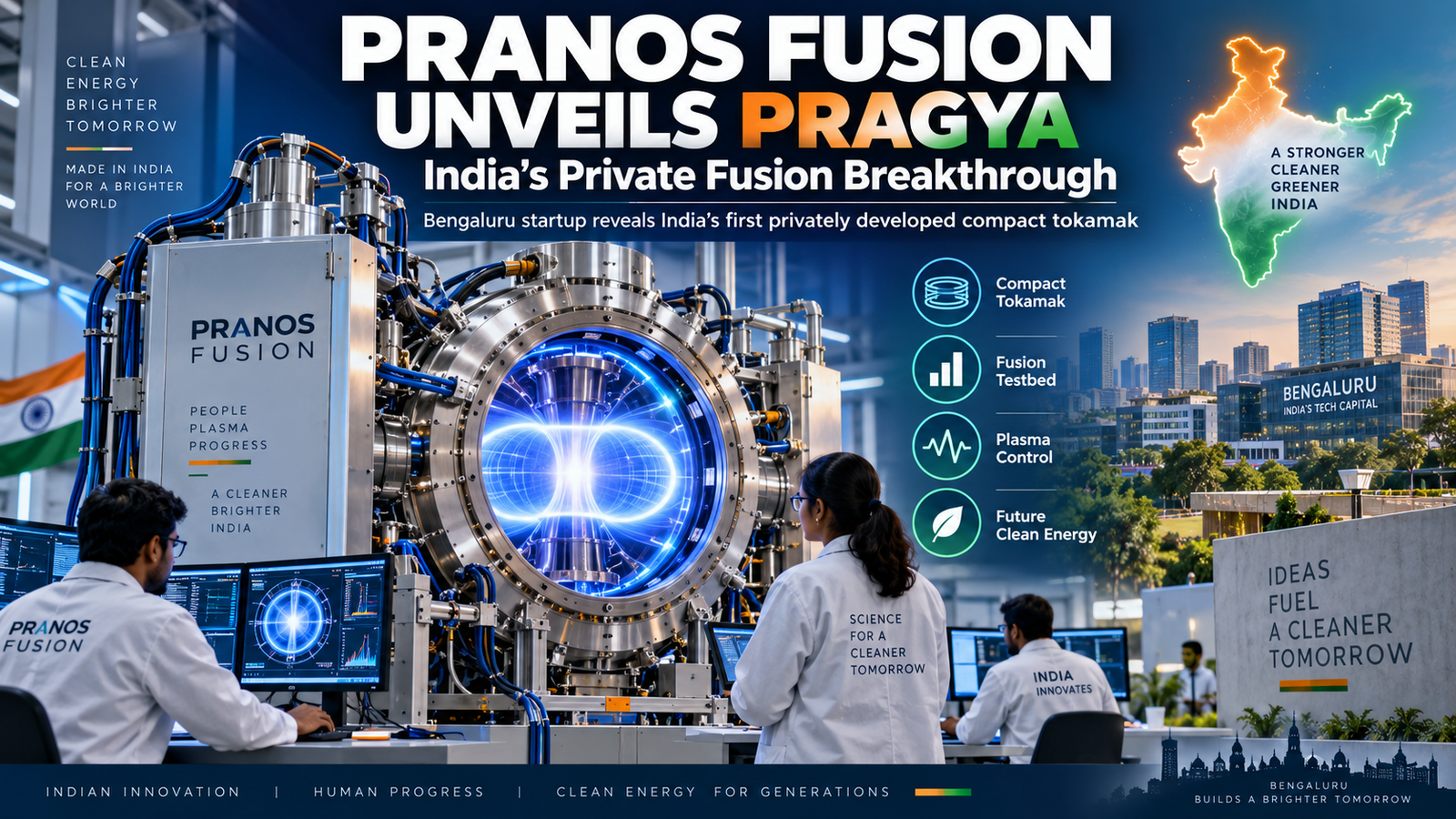

Pranos Fusion Unveils PRAGYA: Can This Indian Startup Build a Fusion Reactor?
A small team in Bengaluru is attempting one of humanity’s most difficult scientific challenges: recreating the energy process that powers the Sun.
Indian deep-technology startup Pranos Fusion has unveiled PRAGYA, which it describes as India’s first privately developed compact tokamak. The machine represents an important milestone for India’s emerging private fusion industry.
However, PRAGYA is not yet generating fusion energy or electricity. It is an experimental platform designed to help Pranos understand plasma behaviour, magnetic confinement and reactor-control technologies.
The company’s bigger ambition is Praniq, a proposed net-energy-gain fusion reactor targeted for around 2030.
What Is PRAGYA?
PRAGYA is a compact, low-aspect-ratio tokamak built to create, study and control plasma.
A tokamak is a machine that uses powerful magnetic fields to confine extremely hot plasma inside a doughnut-shaped chamber. Scientists eventually hope to heat this plasma sufficiently for light atomic nuclei to combine and release energy.
According to the official Pranos Fusion website, PRAGYA will operate as a control testbed and work with two other technologies being developed by the company:
- JENGA: Tokamak-design and plasma-control software
- MAGGA: High-temperature superconducting magnet technology
- PRAGYA: The physical tokamak used for plasma experiments
This integrated approach could allow Pranos to test its software, magnets and reactor hardware together.
Is PRAGYA Producing Nuclear Fusion?
No. This distinction is essential.
Although PRAGYA is frequently described as a compact fusion reactor, Pranos co-founder Shaurya Kaushal confirmed that the machine cannot yet conduct nuclear fusion. It is a testbed for developing the technologies required by a future reactor, according to ThePrint’s report from the Pranos laboratory.
PRAGYA must first demonstrate that it can reliably:
- Create plasma
- Shape and stabilise the plasma
- Control magnetic fields
- Test diagnostic instruments
- Evaluate reactor-control software
- Generate experimental data for a larger machine
Pranos reportedly plans to conduct between 10 and 12 experimental shots per day, potentially producing approximately 3,000 shots annually. This could provide its engineers with valuable data about plasma control and tokamak performance.
Who Founded Pranos Fusion?
Pranos Fusion was founded in 2024 by Shaurya Kaushal and Roshan George.
The Bengaluru startup operates with a multidisciplinary team covering plasma physics, simulation, engineering, magnet technology and control software. Its work has connections with Indian research institutions such as the Jawaharlal Nehru Centre for Advanced Scientific Research and the Institute for Plasma Research.
Pranos has also identified institutions including ITER, IISc, IIT Kharagpur and BITS Pilani as members of its wider research and talent ecosystem.
In March 2026, the startup raised $6.8 million—approximately ₹63 crore—in a round co-led by pi Ventures and Ankur Capital. Industrial47 and several strategic investors also participated, according to Ankur Capital.
The funding is intended to support research, testing infrastructure, recruitment and the development of its integrated fusion technology.
How Does Nuclear Fusion Work?
Fusion generates energy by combining light atomic nuclei into a heavier nucleus. It is fundamentally different from nuclear fission, which produces energy by splitting heavy atoms such as uranium.
To initiate fusion, fuel must be heated to extremely high temperatures, creating plasma. Tokamaks then use magnetic fields to prevent the plasma from touching the chamber walls.
The challenge is enormous. A practical reactor must create the required conditions, maintain stable plasma and ultimately produce more usable energy than the complete system consumes.
This is why building a tokamak does not automatically mean that commercial fusion power has been achieved.
What Is Praniq?
PRAGYA is the experimental starting point. Praniq is Pranos Fusion’s proposed next-generation machine.
The company wants Praniq to become a net-gain reactor, meaning it would produce more fusion energy than the energy delivered directly to the plasma. The project is reportedly expected to cost between $100 million and $200 million.
Pranos hopes to demonstrate Praniq around 2030. However, this remains a company target rather than a guaranteed completion date.
Engineering a net-gain reactor will require significantly stronger magnets, much higher temperatures, better plasma confinement, suitable materials and far greater funding.
Even achieving net fusion gain would not immediately produce commercial electricity. A power plant would also need to convert fusion energy into electricity reliably, safely and at a competitive cost.
Why PRAGYA Matters for India
India Gains a Private Fusion Programme
India already has decades of government-supported plasma research. The Institute for Plasma Research operates the ADITYA-U and SST-1 tokamaks, while India is also a major participant in the international ITER project in France.
PRAGYA is significant because it introduces a privately developed path alongside these public programmes. It does not replace India’s existing scientific achievements.
Development of Domestic Expertise
Fusion requires expertise in advanced materials, superconducting magnets, cryogenics, robotics, vacuum systems and artificial-intelligence-based plasma control.
A growing private fusion industry could train Indian scientists and engineers in technologies that may have applications beyond energy, including healthcare, aerospace, semiconductors and advanced manufacturing.
Greater Energy Security
India’s electricity demand is increasing as manufacturing, electric vehicles, data centres and cities expand.
If fusion eventually becomes commercially viable, it could provide reliable low-carbon electricity without depending heavily on imported fossil fuels. However, commercial fusion remains a long-term possibility—not an immediate solution to India’s energy requirements.
A New Deep-Tech Ecosystem
India’s startup ecosystem has traditionally been strongest in software, payments and consumer platforms. Pranos represents a different category: capital-intensive scientific engineering involving hardware, physics and long development periods.
Its progress could encourage more investment in Indian climate technology and advanced scientific research.
Is Fusion Completely Clean and Risk-Free?
Fusion has several potential advantages. It does not rely on a self-sustaining chain reaction like a conventional fission reactor, and it would not produce carbon emissions during normal electricity generation.
Nevertheless, fusion should not be described as entirely free of risk or radioactive material.
Future deuterium-tritium reactors would need to manage radioactive tritium, neutron damage and the activation of reactor components. Developers must also solve difficult questions involving fuel supply, maintenance, waste handling and cost.
Fusion may create less long-lived radioactive waste than conventional fission, but it does not eliminate every environmental and engineering challenge.
The Reality Behind the Breakthrough
PRAGYA is a meaningful Indian engineering achievement, but headlines claiming that India has already developed unlimited fusion electricity would be misleading.
The project has reached an important first stage: building a privately developed experimental tokamak. The more difficult stages—sustained fusion, net energy gain and commercial power generation—still lie ahead.
The startup’s technical paper on the PRAGYA vacuum-vessel design provides useful engineering details, but future plasma experiments and independently evaluated results will determine the machine’s scientific performance.
Conclusion
Pranos Fusion has not yet solved nuclear fusion, but PRAGYA places an Indian private company inside one of the world’s most important technology races.
Its immediate value lies in building domestic knowledge: controlling plasma, developing superconducting magnets, training engineers and testing the integrated systems required by more powerful machines.
The real milestone will be whether PRAGYA delivers reliable experimental results—and whether Pranos can turn those lessons into its proposed Praniq net-gain reactor.
India’s private fusion journey has begun. Turning that ambition into electricity will require years of scientific validation, significant investment and transparent testing.
Frequently Asked Questions
What is Pranos Fusion?
Pranos Fusion is a Bengaluru-based deep-technology startup developing tokamak hardware, plasma-control software and superconducting magnets for future fusion-energy systems.
What is PRAGYA?
PRAGYA is a compact, privately developed Indian tokamak designed for plasma-control experiments. It does not currently produce commercial fusion power.
Is PRAGYA India’s first tokamak?
No. Indian government research institutions have operated tokamaks for decades. PRAGYA is described as India’s first privately developed tokamak.
What is Praniq?
Praniq is Pranos Fusion’s proposed larger reactor intended to pursue net energy gain. The company is targeting approximately 2030, but the outcome and timeline are not guaranteed.
Has Pranos generated electricity from fusion?
No. Neither PRAGYA nor Pranos has demonstrated commercial electricity generation from nuclear fusion.
How much funding has Pranos raised?
The company raised $6.8 million, approximately ₹63 crore, in March 2026. Reports place its total funding at a little over $7 million.
Disclaimer: This article is based on information published by Pranos Fusion, its investors, scientific research and credible media reports available as of September 7, 2026. PRAGYA is an experimental tokamak and is not currently a commercial fusion-power reactor. Praniq’s proposed net-gain capability, cost and 2030 timeline are development targets that have not yet been independently demonstrated. This article is intended for news and educational purposes only.
