












































China Restricts Tunnel Boring Machines: Piyush Goyal Says India Will Build Its Own to Protect Mega Infrastructure Projects

China has announced new export restrictions on one of the most important machines used to build modern infrastructure.
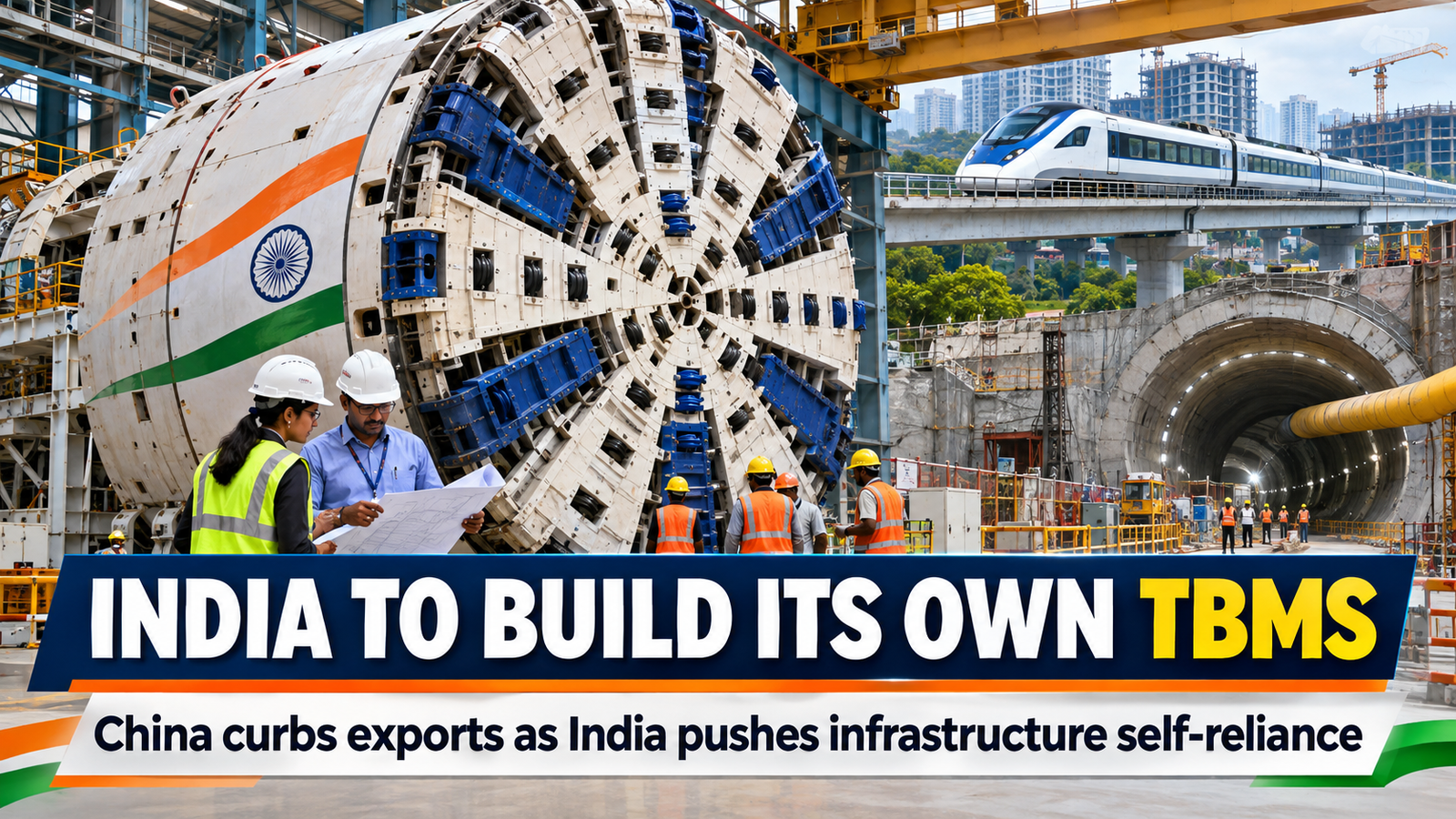
The equipment is called a Tunnel Boring Machine (TBM), and it plays a critical role in constructing underground metro networks, railway tunnels, highways and hydropower projects.
China’s restrictions, scheduled to take effect on November 18, 2026, have raised concerns about delays to major Indian infrastructure projects.
But India has delivered a clear response.
Commerce and Industry Minister Piyush Goyal announced that India would develop its own tunnel-boring machines rather than remain dependent on Chinese supplies.
The announcement highlights an important opportunity for India’s manufacturing industry.
What begins as a supply-chain challenge could accelerate India’s journey toward technological self-reliance.
1. Why Is China Restricting Tunnel Boring Machines?
On October 19, China’s Ministry of Commerce announced new export controls covering tunnel-boring machines and related equipment.
Under the rules, exporters must comply with licensing requirements designed to regulate the international sale of specified machinery.
Beijing says the equipment has both civilian and military applications, making it subject to national-security considerations.
The rules take effect on November 18.
These measures do not amount to a complete worldwide prohibition, but licensing requirements could complicate deliveries to some countries.
India is particularly concerned because it relies on foreign technology for several major infrastructure projects.
Source: Reuters — China Announces Export Controls on Tunnel Boring Machines
2. What Are Tunnel Boring Machines, and Why Are They So Important?
A tunnel-boring machine is an enormous piece of engineering equipment designed to excavate underground passages.
Some machines have cutting heads more than 10 metres in diameter.
As they advance through soil or rock, they can excavate tunnels and install supporting structures with much less disturbance at the surface than conventional open-cut construction.
These machines are especially useful in densely populated cities, where digging from the surface could disrupt roads, buildings and utilities.
India relies on TBMs for projects involving:
- Underground metro networks
- High-speed railway infrastructure
- Road and highway tunnels
- Hydropower and water-transfer tunnels
- Strategic transport connectivity in mountainous regions
Without reliable access to such machinery, construction schedules and project costs can become harder to control.
3. India’s Bullet Train and Metro Projects Could Be Affected
One of the major projects requiring sophisticated tunnelling equipment is the Mumbai–Ahmedabad High-Speed Rail Corridor.
The 508-kilometre bullet-train project includes a seven-kilometre undersea tunnel section.
Specialized TBMs are important for safely excavating portions of the route through difficult geological conditions and densely developed areas.
India’s expanding metro networks also require large numbers of underground tunnels.
The country has already experienced procurement difficulties.
In 2024, German manufacturer Herrenknecht reported delays involving machines manufactured at its Chinese facilities and intended for Indian projects.
Some shipments were eventually delivered in 2026.
China’s new licensing rules could create further uncertainty for contractors planning future work.
Source: The Indian Express — China’s TBM Export Restrictions and Their Impact on India
4. Piyush Goyal: India Will Manufacture Its Own Machines
Speaking at Delhi’s Kirori Mal College on November 3, Piyush Goyal addressed concerns over Chinese export restrictions.
He emphasized that India would strengthen domestic manufacturing rather than compromise its long-term interests to secure essential technology.
“If they don’t give tunnel boring machines, we will develop in India,” Goyal said.
His message was clear: India intends to reduce its dependence on overseas suppliers of strategic industrial equipment.
He also stressed that India wants constructive relations with China.
The objective is therefore not to end international trade, but to ensure that Indian infrastructure development cannot be easily disrupted by restrictions from one supplier.
Source: Business Standard — India to Develop Tunnel Boring Machines if China Imposes Curbs
5. The Good News: India Has Already Started Manufacturing TBMs
India is not beginning from zero.
Railway Minister Ashwini Vaishnaw recently stated that the country has developed manufacturing capabilities for TBMs with diameters of approximately 8 metres and 15 metres.
He also highlighted a manufacturing facility in Tamil Nadu and plans to produce machines exceeding 16 metres in diameter.
This is a significant development because large tunnel-boring machines require specialized engineering, precision manufacturing and complex mechanical systems.
India’s growing manufacturing base could help domestic contractors obtain machinery with shorter supply chains.
However, some machines manufactured or assembled in India still rely on foreign designs and imported critical components.
Achieving complete technological independence will require further localization.
Source: The Economic Times — India Expands Domestic Tunnel Boring Machine Manufacturing
6. How Domestic TBM Manufacturing Could Boost India’s Economy
Developing a competitive tunnel-boring machine industry could create opportunities beyond infrastructure construction.
New Manufacturing Jobs
Production requires mechanical engineers, welders, machinists, automation specialists, electrical engineers and skilled technicians.
Growth for Indian Suppliers
Large machines need motors, hydraulic systems, bearings, cutting tools, control systems and heavy steel components.
Domestic manufacturing could generate demand across several Indian industrial sectors.
Lower Supply-Chain Risks
Producing machinery and spare parts closer to Indian construction sites could reduce dependence on overseas shipments and unpredictable customs procedures.
Opportunities for Technology Development
Indian universities, engineering companies and research institutions could collaborate on improved cutting systems, automation and machine monitoring.
Future Export Potential
If India develops reliable and competitively priced TBMs, domestic manufacturers could eventually supply infrastructure projects in other developing countries.
The long-term opportunity is to turn India from a major buyer of advanced tunnelling machines into a competitive producer.
7. India Could Invest Billions in Advanced Construction Equipment
India is also considering financial incentives to strengthen domestic production.
In August 2026, Reuters reported that the government was preparing a proposed $1.2 billion incentive programme for advanced construction and infrastructure equipment.
The proposed seven-year plan would support manufacturing investments in equipment including TBMs, firefighting systems and specialized machinery.
Potential beneficiaries could include major Indian engineering and industrial companies.
The scheme was reported as a proposal, not an already completed investment programme.
Source: Reuters — India Considers $1.2 Billion Manufacturing Incentive Plan
If implemented successfully, such measures could accelerate domestic capacity development.
8. Spare Parts Are Just as Important as the Machines
Manufacturing new tunnel-boring machines is only part of the challenge.
Existing TBMs require regular maintenance and replacement components.
Cutting tools experience severe wear when excavating hard rock.
Hydraulic systems, bearings and electronic equipment also need servicing.
Experts have warned that restrictions affecting spare parts could disrupt machines already operating at construction sites.
This makes domestic component manufacturing particularly important.
India needs not only the ability to assemble large machines but also the capability to design, manufacture, repair and maintain their critical systems.
Building this complete industrial ecosystem will take time.
9. A Bigger Lesson for Atmanirbhar Bharat
China’s restrictions highlight a vulnerability shared by many industrial economies.
Modern infrastructure depends on highly specialized technologies produced by relatively few manufacturers.
When supply becomes restricted, countries may face higher costs and delayed projects.
India’s response demonstrates the importance of domestic engineering capabilities.
The same principle applies to semiconductors, rare-earth materials, industrial robotics and advanced electrical equipment.
International partnerships can remain valuable while India gradually develops more of the technology it needs.
True self-reliance means having the capability to produce and maintain critical equipment—not necessarily manufacturing every component entirely within national borders.
Conclusion: China’s Restrictions Could Accelerate India’s Manufacturing Ambitions
China’s upcoming restrictions on tunnel-boring machines create a genuine challenge for India’s infrastructure programme.
Major metro, railway and highway projects depend on reliable access to specialized excavation equipment.
But India is already expanding domestic manufacturing.
Piyush Goyal has pledged to develop indigenous capabilities.
Ashwini Vaishnaw has highlighted progress in producing large TBMs in India.
And proposed industrial incentives could support further investment.
There may be short-term difficulties involving procurement, imported components and technical expertise.
However, the longer-term opportunity is significant.
If India successfully develops its own advanced tunnelling technology, it could strengthen infrastructure delivery, create skilled employment and build a new high-value manufacturing industry.
The real achievement will come when Indian-made machines can reliably meet domestic construction requirements at competitive costs.
China’s export restrictions may create the immediate challenge—but India’s engineering and manufacturing capabilities will determine the long-term outcome.
Frequently Asked Questions
What is a Tunnel Boring Machine?
A TBM is a specialized machine used to excavate underground tunnels for metro railways, roads, railways, hydropower and other infrastructure projects.
Why has China restricted TBM exports?
China says the equipment has civilian and military applications and has introduced national-security-related export controls.
When will China’s new restrictions begin?
The export controls are scheduled to take effect on November 18, 2026.
Can India manufacture tunnel-boring machines?
Yes. India already has domestic manufacturing and assembly capabilities for certain TBM sizes, although some essential components and technologies remain imported.
Will India’s bullet train project be delayed?
There are potential supply-chain risks, but the new restrictions do not establish that the project will necessarily be delayed.
How will manufacturing TBMs in India help the economy?
It could create engineering jobs, strengthen domestic suppliers, reduce import dependence and support the timely execution of major infrastructure projects.
Editorial Note: China’s licensing requirements are scheduled to begin November 18, 2026. India’s domestic manufacturing capacity is expanding, but complete independence from imported designs and components has not yet been established.
