












































DUSU Election 2026: Why ABVP Won as NSUI and Left Alliance Failed

DUSU Election 2026: Why ABVP Won as NSUI and Left Alliance Failed
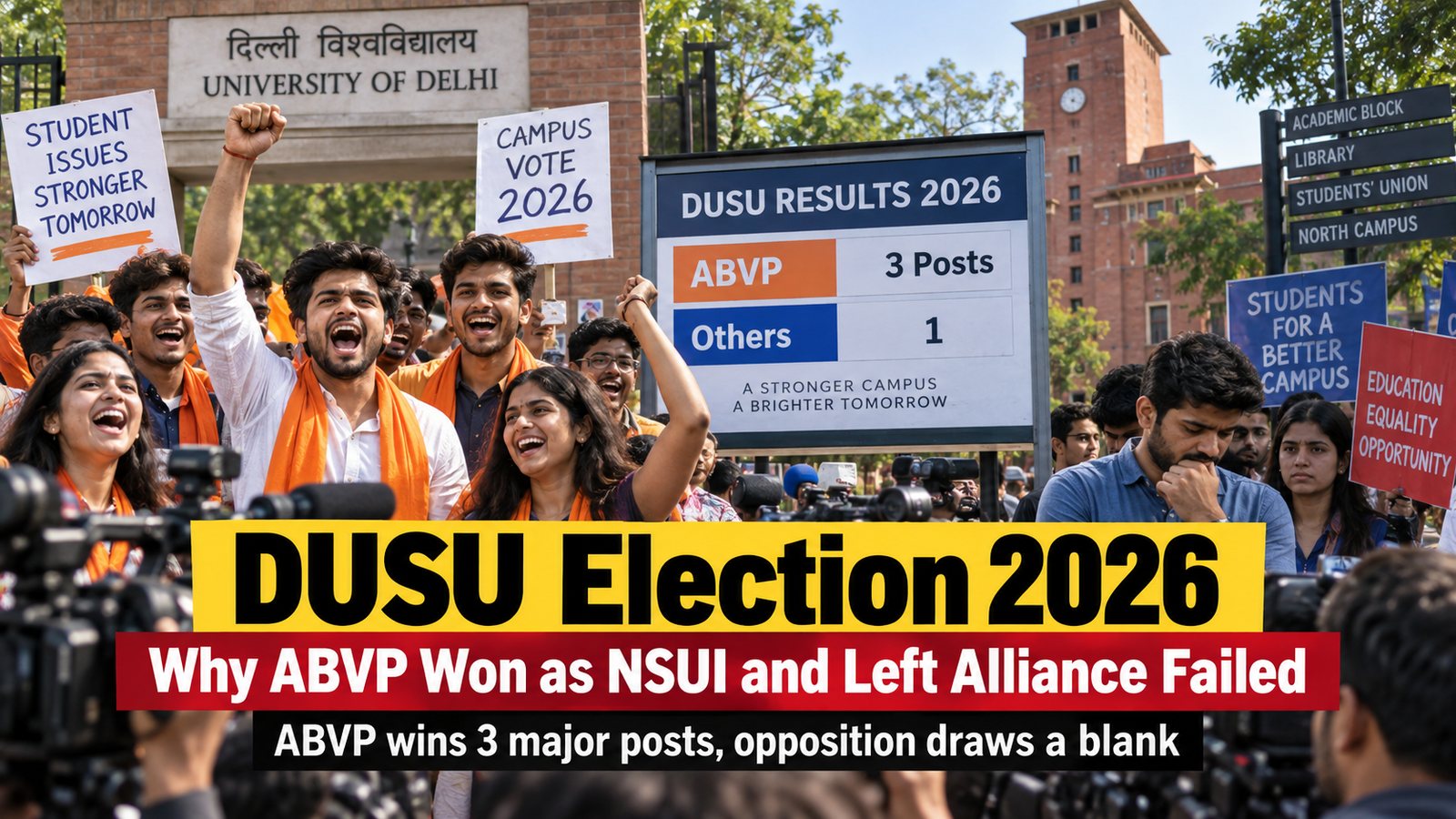
The Akhil Bharatiya Vidyarthi Parishad delivered another powerful performance in the 2026 Delhi University Students’ Union election, winning three of the four central-panel positions.
ABVP candidates captured the posts of president, secretary and joint secretary. The Congress-backed National Students’ Union of India failed to win a single position for the first time since 2015, while the AISA–SFI Left alliance also remained outside the central panel.
However, describing the result as a complete ABVP sweep would be inaccurate. Independent candidate Deepanshu Shokeen, a former NSUI member, won the vice-president’s post by more than 13,000 votes.
The result still represents a decisive political setback for both NSUI and the Left alliance. It also suggests that practical student concerns, candidate credibility and organisational strength mattered more than ideological slogans.
DUSU Election 2026 Results
The results were declared after 20 rounds of counting.
| Position | Winner | Organisation | Votes |
|---|---|---|---|
| President | Yash Dabas | ABVP | 24,576 |
| Vice-President | Deepanshu Shokeen | Independent | 30,615 |
| Secretary | Riya Chhawdi | ABVP | 21,650 |
| Joint Secretary | Lakshya Raj Singh | ABVP | 16,615 |
Yash Dabas defeated NSUI presidential candidate Vijay Shankar Meena by 2,053 votes. Left-alliance candidate Ananya Raturi received 5,377 votes.
Riya Chhawdi secured a more comfortable victory in the secretary contest, defeating NSUI’s Namrata Chaudhary by 6,781 votes. AISA–SFI candidate Stanzin Deskyong received 8,734 votes.
The vice-presidential result was the biggest surprise. Deepanshu Shokeen, who contested independently after reportedly not receiving an NSUI ticket, won 30,615 votes. ABVP’s Ishu Maurya secured 16,910, while NSUI’s Vir Chatrath received only 4,313.
The complete figures were reported by The Indian Express and NDTV’s DUSU results coverage.
ABVP’s Organisational Network Delivered Results
ABVP’s greatest advantage was its established ground-level organisation across Delhi University.
Student elections are not won only through speeches, social-media posts or support from national politicians. Campaigners must reach individual colleges, classes, hostels and student groups. They must also help students with everyday matters throughout the academic year.
ABVP demonstrated this organisational reach by winning complete panels in several colleges. The organisation reportedly won all contested positions at institutions including Shri Ram College of Commerce, Aditi Mahavidyalaya, Bharati College, Shivaji College and Sri Aurobindo College Morning.
It also secured important positions at Keshav Mahavidyalaya, Ramjas College and Shyama Prasad Mukherji College.
These college-level victories gave ABVP visible momentum before the central-panel results were announced.
NSUI’s Candidate Selection Became Its Biggest Failure
The vice-presidential result exposed serious weaknesses within NSUI.
Deepanshu Shokeen had previously been associated with the Congress-backed student organisation but contested independently after failing to receive its ticket. He then defeated the official NSUI candidate by more than 26,000 votes.
Shokeen’s victory suggests that a large section of students supported him personally, regardless of his lack of formal party backing.
For NSUI, this was more than an ordinary defeat. A former member demonstrated that he possessed significantly greater electoral appeal than the candidate selected by the organisation.
It raises questions about internal decision-making, candidate selection and whether the organisation properly understood student sentiment before distributing tickets.
Congress Failed to Convert Major Issues into Votes
The election took place against the background of serious concerns involving student accommodation, safety, alleged examination irregularities and campus infrastructure.
The collapse of a paying-guest accommodation building in Satya Niketan—which killed seven people, including five Delhi University students—placed housing safety at the centre of the campaign.
NSUI attempted to challenge ABVP using affordable accommodation, student safety and wider anti-establishment messaging. However, it failed to convert dissatisfaction over these issues into central-panel victories.
ABVP successfully presented itself as both the incumbent organisation and a group promising corrective action. Newly elected president Yash Dabas said that safety audits of hostels and paying-guest accommodations would be among his priorities.
The result indicates that identifying a genuine problem is not enough. An opposition organisation must also convince voters that it possesses a credible candidate, a functioning campus network and a realistic plan.
Why the Left Alliance Failed to Break Through
The AISA–SFI alliance attempted to establish itself as an alternative to both ABVP and NSUI. It received thousands of votes but could not win a central-panel position.
Its performance was not entirely insignificant. The alliance’s secretary candidate received 8,734 votes, and SFI candidates won positions in some college-level elections.
However, the Left alliance remained far behind ABVP and NSUI in the presidential contest. This suggests that its support, while present, was not broad enough across the university to win the most influential positions.
ABVP supporters have portrayed the result as a rejection of efforts to turn university politics towards extreme or confrontational ideological campaigns. The numbers support the narrower conclusion that Left organisations failed to persuade enough Delhi University students in this election.
The result should not be used to label all Left-leaning students as extremists or “urban Naxals.” Political disagreement inside a university is not proof of criminal or anti-national activity. The stronger argument is that the Left’s ideas and campaign failed to receive sufficient electoral support.
Students Appeared to Prioritise Practical Issues
Student elections are frequently described as contests between nationalism, Congress politics and the Left. Yet the 2026 result also reveals a more practical voting pattern.
Students were discussing:
- Safe and affordable hostels
- Paying-guest accommodation standards
- Campus security
- Transport and food costs
- Examination integrity
- College infrastructure
- Accessibility of elected representatives
ABVP’s campaign combined its broader nationalist identity with promises related to these campus issues.
The victory of an Independent vice-president also shows that students were willing to move beyond party labels when they found a candidate personally convincing. This was not simply a uniform vote for one ideology.
Higher Turnout Strengthened the Result
The election recorded a turnout of 40.46%, compared with 39.45% in 2025 and 29.7% in 2024.
Higher participation gives the result greater political significance. ABVP did not win because students stayed away in unusually large numbers. It maintained its position during an election in which participation increased.
At the same time, the presidential margin was only 2,053 votes. ABVP clearly dominated the panel, but NSUI still retained a substantial vote base. It would therefore be premature to claim that Congress-linked student politics has permanently disappeared from Delhi University.
What the Result Means for National Politics
DUSU elections are often treated as an early indicator of political attitudes among urban students. Many former student leaders have later entered state and national politics.
For the BJP and its wider ideological movement, ABVP’s victory offers evidence that its message continues to attract young voters on one of India’s most politically visible campuses.
For Congress, the result is particularly damaging because NSUI failed to win any central post despite having major safety and accommodation issues available for its campaign.
For the Left, the outcome shows that visibility in demonstrations and ideological debates does not automatically translate into votes. It needs a broader campus organisation and stronger connection with students’ everyday concerns.
However, a university election should not be treated as a scientific forecast of a national election. Delhi University represents an important but specific electorate with its own candidates, local issues and organisational dynamics.
ABVP Now Has to Deliver
Winning three posts gives ABVP political authority, but it also creates responsibility.
The newly elected representatives will be judged on whether they can improve hostel safety, campaign for affordable accommodation, address women’s security and remain accessible after the election celebrations end.
If promises are not converted into visible action, the same students who delivered this victory can vote differently in the next election.
Conclusion
The DUSU Election 2026 produced a clear ABVP victory, but not a complete four-seat sweep.
ABVP won the presidency, secretary and joint-secretary positions while demonstrating considerable strength across individual colleges. NSUI failed to win any central post, and its former member’s overwhelming independent victory exposed weaknesses in its candidate-selection process.
The AISA–SFI alliance secured a visible vote share but could not convert ideological mobilisation into representation on the central panel.
The larger message is straightforward: students responded to organisation, candidate credibility and practical campus concerns. Political labels alone were not enough.
ABVP won the election. Its next challenge is proving that it can govern the student union as effectively as it campaigned for it.
Frequently Asked Questions
How many posts did ABVP win in the DUSU Election 2026?
ABVP won three of the four central-panel posts: president, secretary and joint secretary.
Who won the DUSU vice-president election?
Independent candidate Deepanshu Shokeen won with 30,615 votes. He had previously been associated with NSUI.
Did NSUI win any DUSU position in 2026?
No. NSUI failed to win a central-panel position for the first time since 2015.
Did the Left alliance win any seat?
The AISA–SFI alliance did not win a central DUSU position, although SFI secured some posts in individual college elections.
Was the election a complete ABVP sweep?
No. ABVP won three of four central posts. The vice-president’s position went to an Independent candidate.
What was the voter turnout?
The reported turnout was 40.46%, higher than in both 2025 and 2024.
Disclaimer: This article combines verified election results with political analysis based on publicly available reports as of September 20, 2026. Explanations for why students voted a particular way are interpretations of campaign developments and results, not proven descriptions of every voter’s motivation. Allegations of electoral malpractice raised by NSUI and Congress representatives have not been established as fact. Political and ideological labels should not be interpreted as evidence of criminal or extremist activity. This article is intended for news, analysis and educational purposes.
