












































Why PB Fintech Shares Crashed 36%: IRDAI Insurance Rules Explained

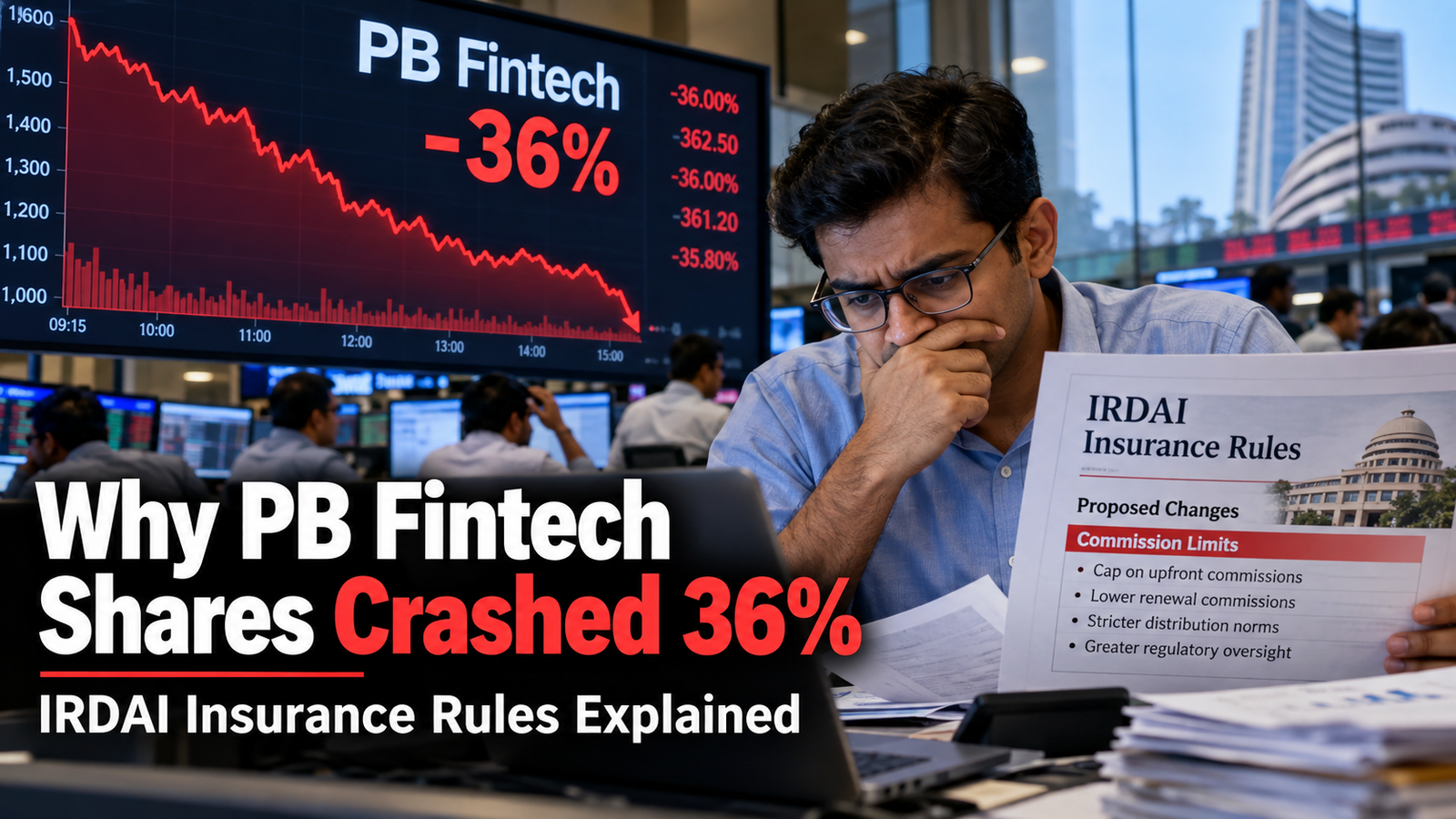
Shares of PB Fintech, the parent company of Policybazaar and Paisabazaar, plunged nearly 36% on September 24 after India’s insurance regulator proposed sweeping changes to how insurance policies are sold.
The Insurance Regulatory and Development Authority of India has proposed lower commission limits, tighter controls on insurers’ operating expenses and stronger protections against mis-selling.
The proposed rules could significantly reduce the commissions earned by online insurance platforms, banks, brokers and other distributors. This explains the sharp reaction in PB Fintech and other insurance-related stocks.
However, these measures are still proposals. They have not yet become final regulations.
What Has IRDAI Proposed?
IRDAI released a two-part consultation paper titled “Recalibrating Economics of Insurance Distribution” on September 23, 2026.
The regulator wants to change several parts of India’s insurance-distribution system:
- Introduce product-specific commission limits
- Reduce insurers’ expenses of management
- Prevent compulsory insurance bundling with loans
- Require clearer disclosure of commissions
- Restrict incentives linked only to sales volumes
- Introduce stronger action against insurance mis-selling
- Simplify the classification of insurance distributors
- Expand digital comparison and servicing platforms
The regulator said the objective is to create a more transparent and customer-focused insurance market. Public comments on the proposal can be submitted until October 25, 2026.
Why Is IRDAI Targeting Insurance Commissions?
Selling an insurance policy involves expenses such as employee salaries, advertising, technology, agent commissions and payments to banks or online aggregators.
IRDAI’s concern is that distributor payments have grown much faster than the premiums generated.
Between the financial years 2022–23 and 2024–25, new business premiums generated through a sample of corporate agents increased by approximately 28%. Distributor remuneration increased by around 125% during the same period.
Some additional payments—including promotional expenses, rewards and branding fees—have reportedly raised the effective cost of distribution well above the basic commission disclosed by insurers.
High commissions can create a conflict of interest. A distributor may have a financial incentive to recommend the policy paying the highest commission rather than the policy best suited to the customer.
What Are the Proposed Commission Limits?
The limits would depend on the insurance product, distribution channel, policy duration and effort required to sell or service the policy.
Some of the most significant proposed changes involve insurance sold with loans:
| Insurance product | Reported proposed commission limit |
|---|---|
| Credit-life insurance linked to loans | Around 2% |
| Loan-packaged motor third-party insurance | No commission |
| Motor own-damage insurance linked to loans | Around 5% |
| Loan-linked health insurance | Around 5% |
| Health-insurance renewals in certain categories | Lower than first-year commission |
Current effective commissions in some categories can be much higher. Reports analysing the consultation paper indicate that commissions on certain health products can reach approximately 40%, while some credit-life arrangements have produced payouts exceeding 20%.
IRDAI wants remuneration to reflect the actual effort and service involved rather than the distributor’s bargaining power.
Why Did PB Fintech Shares Crash?
PB Fintech earns a significant portion of its revenue by distributing insurance through Policybazaar.
When a customer purchases or renews a policy through the platform, the insurer pays Policybazaar a commission or distribution fee. Lower commission limits could therefore reduce PB Fintech’s revenue from every policy sold.
Investors are concerned about three possible effects:
Lower Revenue Per Policy
If insurers cannot pay existing commission rates, Policybazaar’s average revenue from policy sales could decline.
Pressure on Profit Margins
Digital advertising, call centres, customer acquisition and policy servicing remain expensive. If commission income declines without a similar reduction in operating costs, profitability could be affected.
Uncertainty Around the Business Model
Policybazaar has built a strong platform by allowing customers to compare policies from multiple insurers. However, its financial model still depends heavily on commissions and related payments from insurance companies.
PB Fintech shares fell nearly 36% to approximately ₹1,207 during trading following the release of the proposal. Shares of other insurance distributors also declined sharply.
The market reaction reflects uncertainty about future earnings. It does not mean PB Fintech’s business has collapsed.
Will Insurance Policies Become Cheaper?
Lower commissions could eventually reduce the cost of distributing insurance, but customers should not assume that premiums will fall immediately.
An insurance premium is influenced by several factors:
- Expected claims
- Policyholder age and health
- Medical inflation
- Reinsurance costs
- Administrative expenses
- Taxes
- Fraud and claim-management costs
- Distributor commissions
Reducing commissions addresses only one part of the total cost.
Insurers could use the savings to lower premiums, improve policy benefits, strengthen customer service or increase profitability. The final effect will depend on how IRDAI structures the rules and how individual insurers respond.
Could the Rules Reduce Mis-Selling?
This may be the most important benefit for customers.
High upfront commissions can encourage aggressive selling of unsuitable products. Customers may be pushed towards long-term savings plans when they need pure term insurance, or sold expensive policies without fully understanding exclusions and surrender conditions.
IRDAI has proposed:
- Identifying the individual responsible for each sale
- Recovering commissions in proven mis-selling cases
- Restricting sales-volume incentives for bank and NBFC employees
- Requiring simple disclosure of commission structures
- Strengthening suitability and accountability requirements
These measures could make it harder for distributors to prioritise commissions over customer needs.
Can Banks Still Force Customers to Buy Insurance With Loans?
IRDAI has proposed prohibiting the compulsory bundling of insurance with credit or loan products.
Banks and NBFCs may still offer suitable insurance alongside home, vehicle or personal loans. However, customers should not be forced to purchase a particular policy solely because they are borrowing money.
This could be especially important for home-loan customers who are sometimes encouraged to add a large single-premium insurance policy to the loan amount.
Customers should be allowed to understand:
- Whether insurance is legally required
- Whether they can select another insurer
- How much commission the lender receives
- Whether the premium is being financed through the loan
- How the policy affects the total interest payable
The proposal could give borrowers more freedom to compare policies before purchasing loan-protection insurance.
What Are the Risks of Lower Commission Limits?
The proposed reforms may also create unintended consequences.
Agents and distributors could become less interested in selling low-premium policies in rural or underserved areas. Smaller insurance intermediaries may struggle to cover their operating costs, while larger banks and online platforms could gain more market power.
There is also a risk that distributors may introduce separate advisory or service charges to replace lost commissions.
IRDAI will therefore need to balance lower distribution costs with the need to expand insurance access across India.
Are the New Rules Final?
No. This is a consultation paper, not a notified regulation.
IRDAI has invited feedback from insurers, banks, agents, brokers, digital platforms and members of the public until October 25, 2026.
The regulator may modify the commission limits, implementation schedule and other conditions after reviewing industry responses.
Investors and policyholders should avoid treating every number in the proposal as a final rule.
What Should Insurance Customers Do?
Customers do not need to cancel existing policies because of the consultation paper.
Instead, anyone purchasing a new policy should:
- Compare policies from multiple insurers
- Ask whether the seller receives a commission
- Check exclusions and waiting periods
- Review surrender conditions
- Avoid combining insurance and investment without understanding the costs
- Confirm whether loan-linked insurance is optional
- Read the benefit illustration before paying
The best policy is not always the one most aggressively recommended by an agent, bank employee or comparison platform.
Conclusion
PB Fintech’s 36% share-price fall shows how seriously investors are taking IRDAI’s proposed insurance reforms.
Lower commissions could pressure the earnings of Policybazaar, banks, brokers and other distributors. At the same time, the proposals could improve transparency, reduce forced bundling and discourage the sale of unsuitable policies.
Customers should not expect insurance premiums to become cheaper overnight. However, clearer commission disclosures and stronger action against mis-selling could make the insurance market fairer.
The proposal is significant—but the final rules may look different after the consultation ends.
Frequently Asked Questions
Why did PB Fintech shares fall?
Investors fear that IRDAI’s proposed commission limits could reduce the revenue Policybazaar earns from distributing insurance policies.
Has IRDAI banned insurance commissions?
No. IRDAI has proposed product-specific limits. Commissions would continue, but the amount could depend on the product, channel and effort required.
Will health and life insurance premiums decrease?
Not necessarily. Lower commissions may reduce distribution costs, but premiums also depend on claims, medical inflation, reinsurance and operating expenses.
Can a bank force me to purchase insurance with a loan?
IRDAI has proposed prohibiting compulsory insurance bundling. Banks may offer insurance with a loan, but customers should be given clear information and meaningful choice.
Are the new insurance rules already effective?
No. They remain proposals under public consultation. Feedback is open until October 25, 2026.
Should investors buy PB Fintech after the share-price fall?
This article does not provide investment recommendations. The effect will depend on the final regulations, PB Fintech’s response and its future financial performance.
Disclaimer: This article is based on IRDAI’s consultation paper and publicly available reports as of September 24, 2026. The proposals are not final regulations and may change following public consultation. Share prices are volatile and may change after publication. This article is intended for news and educational purposes only and does not constitute insurance, legal or investment advice.
