





































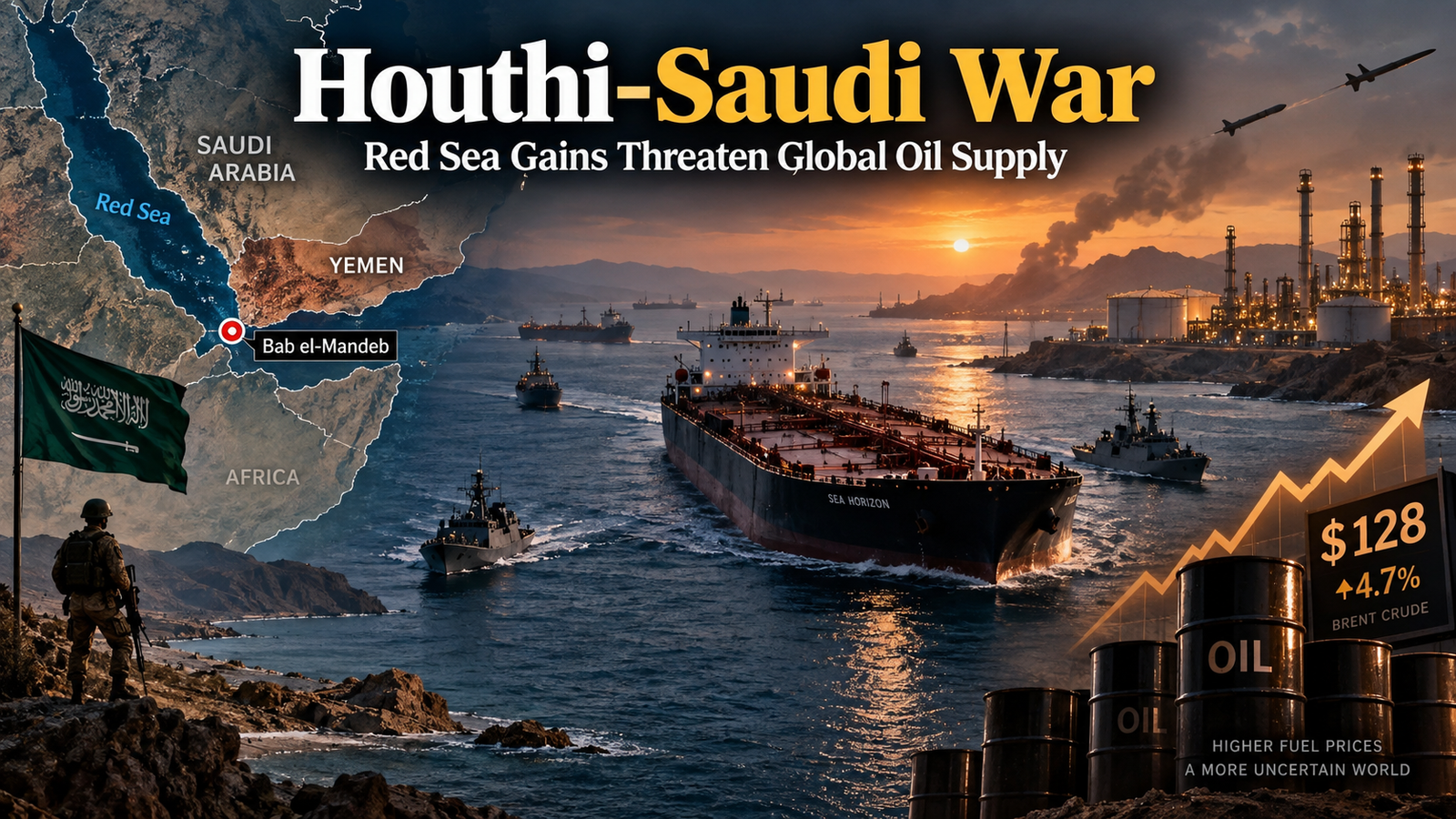
Houthi-Saudi War: Red Sea Gains Threaten Global Oil Supply

Houthi-Saudi War: Strategic Red Sea Gains Raise Fears of a Global Oil Crisis
The renewed Houthi-Saudi conflict is becoming much more than another battle inside Yemen. It now threatens some of the world’s most important oil and shipping routes.
Houthi forces have advanced along Yemen’s Red Sea coast and reportedly captured the port city of Mocha, Mayun Island—also known as Perim—and the Greater and Lesser Hanish Islands.
These locations are close to the Bab el-Mandeb Strait, the narrow waterway connecting the Red Sea with the Gulf of Aden and the Indian Ocean. Their capture gives the Houthis greater ability to monitor or disrupt ships moving between Asia, the Middle East and Europe.
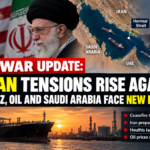
The timing is especially dangerous for Saudi Arabia. With the Strait of Hormuz already severely restricted, the kingdom has relied heavily on its Red Sea route to export oil. That alternative is now under growing pressure.
Why the Captured Ports and Islands Matter
Mayun Island sits inside the Bab el-Mandeb Strait, while the Hanish Islands lie farther north in the southern Red Sea. Mocha provides an important coastal position overlooking nearby shipping lanes.
According to the Associated Press, these territorial gains strengthen the Houthis’ ability to threaten maritime traffic and Saudi oil shipments.
However, capturing these positions does not mean that the Houthis have completely closed the Bab el-Mandeb. International naval forces and commercial vessels can still operate in the region.
The real danger is that missiles, drones or naval attacks could make the route too risky for shipping companies. Even without a complete blockade, higher insurance premiums and security concerns can force vessels to take longer and more expensive routes.
Data from the U.S. Energy Information Administration shows that approximately 8.1 million barrels per day of oil and petroleum products passed through the Bab el-Mandeb during the second quarter of 2026.
Any serious disruption would therefore affect energy markets far beyond Yemen and Saudi Arabia.
Is Saudi Arabia Being Cut Off?
Saudi Arabia has not been completely cut off, but its oil-export options are being squeezed.
The kingdom traditionally sends large quantities of oil through the Strait of Hormuz. When that route became severely restricted, Saudi Arabia redirected more crude through its 1,200-kilometre East-West Pipeline to Yanbu on the Red Sea coast.
That pipeline was recently damaged in a drone attack that Saudi Arabia attributed to Iran-backed militias operating from Iraq—not directly to the Houthis.
Officials said repairs could take between three and five weeks. Before the attack, the pipeline was reportedly moving between 2.6 million and 4 million barrels of oil per day.
At the same time, Houthi gains near the Bab el-Mandeb have placed additional pressure on tankers sailing south from Yanbu toward Asian markets.
Saudi oil can still travel north through the Suez Canal, but reaching Asia through that route would require a much longer journey. This would increase freight costs, fuel consumption and delivery times.
Why Fuel Prices Are Increasing
Brent crude climbed to around $109 per barrel as markets reacted to the damaged Saudi pipeline, Houthi advances and fears of further regional escalation.
Fuel prices can rise even before a physical shortage appears because traders anticipate future supply problems.
The crisis is increasing costs in several ways:
- Less Saudi oil may reach international markets.
- Tankers may require longer routes around Africa.
- Insurance companies can charge more for ships entering conflict zones.
- Diesel, jet fuel and LPG supplies may become more expensive.
- Import-dependent countries may face weaker currencies and larger energy bills.
The International Energy Agency has warned that global oil inventories have already fallen substantially while Middle Eastern exports remain disrupted. This leaves the market with less protection against another major shock.
Higher oil prices eventually affect petrol stations, airlines, trucking companies, factories and farms. As transport and production costs increase, consumers may pay more for food and everyday goods.
Could the Global Economy Crash?
A global economic crash is possible under a severe escalation, but it is not yet inevitable.
The more immediate risk is stagflation—a combination of weak economic growth and persistent inflation.
A major worldwide downturn would become more likely if:
- The Saudi pipeline remained unavailable for months.
- Houthi attacks stopped most Bab el-Mandeb shipping.
- The Strait of Hormuz remained largely closed.
- More Gulf oil facilities were damaged.
- Diesel and aviation-fuel shortages intensified.
- Central banks raised interest rates to control inflation.
The International Monetary Fund has warned that renewed conflict could increase commodity prices, tighten financial conditions and worsen food insecurity.
India and other Asian oil importers would be particularly exposed. Higher crude prices could increase the cost of petrol, diesel, LPG, fertiliser, transport and food. Europe would also face higher shipping costs if more vessels were forced to avoid the Red Sea.
For poorer countries, the situation could be even more serious because governments may not have enough financial capacity to subsidise fuel or essential food supplies.
Yemen Faces the Greatest Human Cost
While markets focus on oil prices, Yemeni civilians continue to suffer the most.
The latest fighting has displaced tens of thousands of people, with families facing shortages of food, water, shelter and medical care. Schools have reportedly been converted into temporary shelters.
A lasting solution therefore requires more than protecting oil tankers. Saudi Arabia, the Houthis, Iran and international powers must support negotiations that address Yemen’s political divisions and humanitarian emergency.
Conclusion
The Houthi capture of Mocha, Mayun and the Hanish Islands has changed the balance of power around the Red Sea.
Saudi Arabia is not completely isolated, and the Houthis have not fully closed the Bab el-Mandeb. Nevertheless, the combination of territorial gains, pipeline damage and restricted shipping routes has placed global oil supplies under serious pressure.
A worldwide economic crash is not guaranteed. But if the conflict spreads and multiple energy routes remain disrupted, the result could be higher fuel prices, rising inflation and slower global growth.
What began as a civil war inside Yemen now carries consequences for households, businesses and economies around the world.
Frequently Asked Questions
Which strategic locations have the Houthis captured?
Recent reports indicate that Houthi forces captured Mocha, Mayun Island and the Greater and Lesser Hanish Islands.
Have the Houthis closed the Bab el-Mandeb?
No. Their gains increase their ability to threaten shipping, but the waterway has not been completely closed.
Is Saudi Arabia completely cut off from exporting oil?
No. Saudi Arabia retains alternative routes and facilities, although its available export options have become more limited and expensive.
Will this conflict cause a global recession?
It could contribute to a recession if oil disruptions continue or expand. However, a global economic crash remains a risk scenario rather than a confirmed outcome.
Disclaimer: This article is based on credible media reports and publicly available energy-market information as of September 15, 2026. Military claims, territorial control, oil prices and infrastructure-repair estimates may change. References to a possible recession or economic crash describe potential scenarios and should not be treated as guaranteed forecasts or financial advice. This article is intended for news and educational purposes only.
