






















U.S. Tariff Double Standards: Why India and China Are Rejecting Washington’s Russia Pressure

U.S. Tariff Double Standards: Is Washington Losing Its Global Influence?
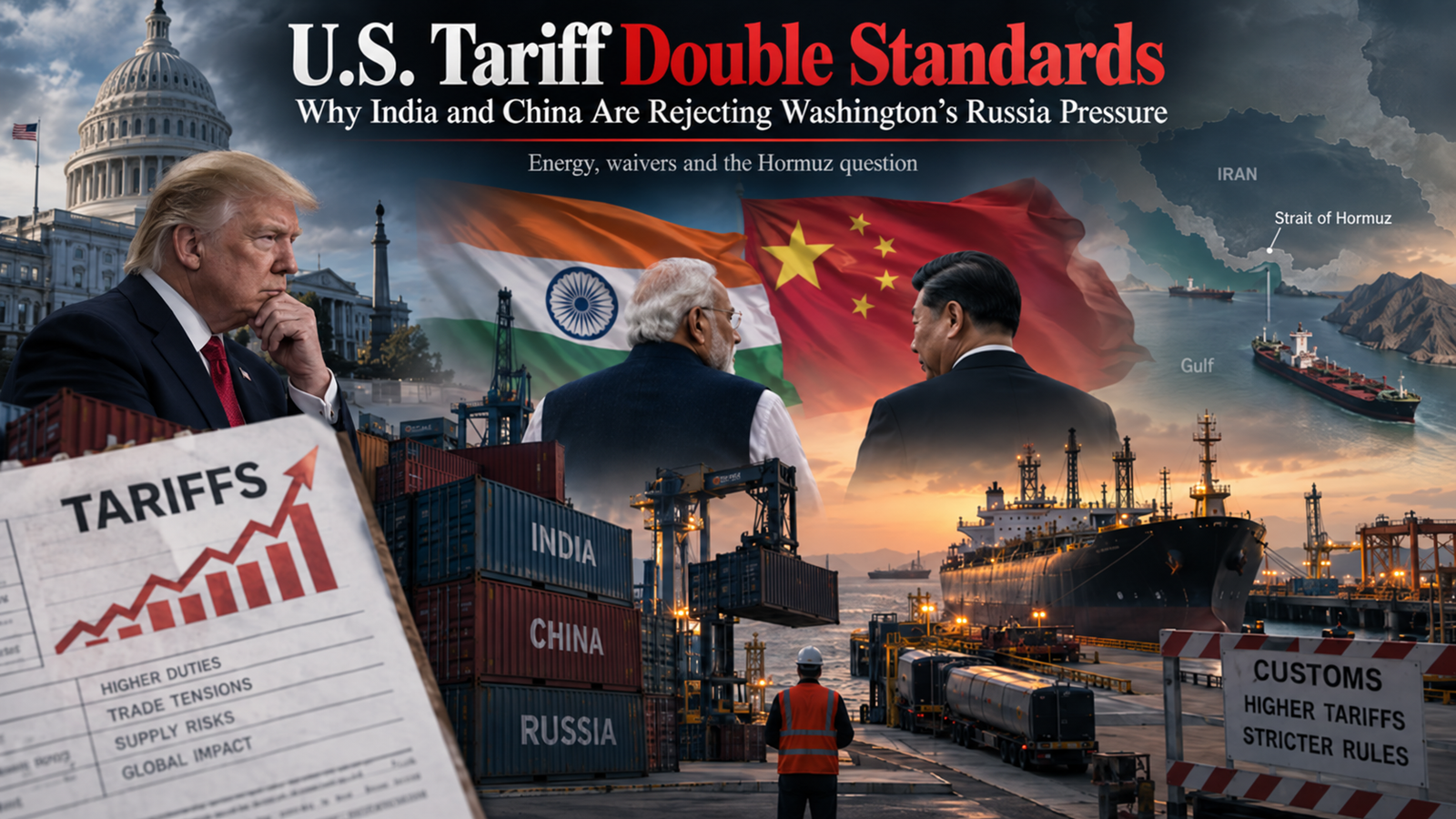
The United States wants other countries to stop buying Russian energy. Its latest weapon is a new sanctions law that could expose major Russian oil and gas buyers—including India and China—to tariffs of up to 100%.
Washington presents the measure as an attempt to reduce the revenue funding Russia’s war in Ukraine. However, critics see something else: a powerful country demanding sacrifices from others while preserving flexibility for itself and its allies.
The accusation of hypocrisy has gained strength because the law gives the U.S. president considerable authority to decide which countries are targeted, how high the tariffs will be and which nations receive national-security waivers.
At the same time, the United States continues to permit temporary waivers for certain Russian-enriched uranium imports, while parts of Europe remain connected to Russian energy.
This does not mean that America has no economic power left. But it does suggest that tariff threats are becoming less effective as countries search for alternatives to a U.S.-dominated system.
What Does the New U.S. Sanctions Law Actually Do?
The Lindsey O. Graham Sanctioning Russia and Iran Act gives the U.S. president authority to impose tariffs of up to 100% on goods imported from major buyers of Russian oil and gas.
According to Reuters’ analysis of the legislation, it targets the five largest importers of Russian energy, countries making new purchases after the law takes effect and major facilitators of sanctions evasion.
However, the legislation does not provide a fixed public list of targeted countries or clearly explain how the rankings will be calculated. It also grants the president broad waiver authority on national-security grounds.
India and China are obvious potential targets because both purchase large amounts of Russian energy. However, experts have warned that Brazil, Japan and individual European Union members could also be affected.
Therefore, claims that Europe has received a complete formal exemption are not currently supported by the published details. The more accurate criticism is that Washington retains enough discretion to apply the law selectively.
Why the Accusation of Hypocrisy Resonates
The United States has restricted imports of Russian-enriched uranium, but American companies can still obtain temporary waivers to prevent nuclear-fuel shortages. The waiver system is scheduled to remain available until the beginning of 2028, according to Reuters.
Washington can argue that these exceptions are necessary to protect its energy security. India can make a remarkably similar argument about Russian crude oil.
India imports most of the oil it consumes and must secure affordable energy for approximately 1.4 billion people. Russian oil currently accounts for more than 40% of its supplies, according to Reuters’ report on the potential tariffs.
If the United States can use waivers when immediate alternatives are unavailable, New Delhi will naturally ask why India should face punishment for protecting its own consumers.
Europe’s position also complicates Washington’s moral argument. Although the European Union has significantly reduced Russian energy imports, Russia still supplied 16% of EU liquefied natural gas imports in 2025 and remained the bloc’s second-largest LNG supplier. EU imports of Russian LNG totalled approximately 13.8 million tonnes that year, according to Reuters.
Europe is gradually phasing out this dependence, but its continuing purchases demonstrate that energy transitions cannot always happen immediately.
Why India Is Refusing to Accept U.S. Pressure
India has said it remains committed to protecting the energy security of its population and will take the measures necessary to defend its economic interests.
Stopping Russian oil purchases suddenly could force Indian refiners to buy more expensive supplies from other countries. That could increase fuel prices, transportation expenses and inflation while placing additional pressure on government finances.
A 100% tariff would also harm Indian exporters selling products in the American market. But the costs would not fall on India alone. American importers and consumers could face higher prices, while global supply chains would encounter further disruption.
Washington’s approach therefore risks turning a strategic partner into a more distrustful one. India has traditionally maintained relationships with the United States, Russia, Europe and the developing world instead of becoming completely dependent on any single geopolitical bloc.
Attempting to force India to choose sides could push New Delhi towards even greater strategic autonomy.
Are Countries No Longer Taking U.S. Tariffs Seriously?
It would be inaccurate to say that no country takes American tariffs seriously. The United States remains one of the world’s largest consumer markets, and losing access to it could severely affect exporters.
However, excessive use of tariffs can gradually weaken their effectiveness.
Countries may respond by diversifying export markets, negotiating new trade agreements, expanding local-currency payments and strengthening organisations such as BRICS. Businesses may also redesign supply chains to reduce exposure to American trade policy.
Tariffs remain powerful, but their repeated use as a diplomatic weapon creates an incentive for other countries to build alternatives. A tool used too frequently can eventually encourage the world to reduce its dependence on that tool.
The Strait of Hormuz Reveals the Limits of Military Power
The continuing disruption in the Strait of Hormuz has strengthened the argument that even overwhelming military power cannot guarantee immediate political or economic control.
Only four commodity vessels crossed the strait on September 17, compared with a ten-day average of approximately 16. Before the conflict, the waterway carried around one-fifth of the world’s oil and gas, according to Reuters shipping data.
Despite months of military operations, normal commercial traffic has not been fully restored. Regional countries are now discussing pipelines, terminals and other infrastructure that could bypass Hormuz.
This does not prove that the United States has been militarily defeated by Iran. It does show that bombing military targets and securing a strategically important shipping route are two different challenges.
Modern conflicts involve missiles, drones, mines, dispersed armed groups and vulnerable commercial shipping. A country can possess the world’s strongest military and still struggle to produce a quick or politically sustainable outcome.
Is the United States a Declining Power?
The United States is not powerless. It retains enormous military capabilities, the world’s most influential financial system, major technology companies and extensive diplomatic alliances.
What is declining is Washington’s ability to expect automatic compliance.
India, China, Türkiye, Gulf countries and other emerging powers increasingly make decisions according to their own economic and security interests. Even traditional U.S. partners are reluctant to join conflicts or accept policies that could raise domestic energy prices.
This is the defining feature of a multipolar world: the United States remains powerful, but it is no longer the only country capable of shaping global outcomes.
Conclusion
The new Russian-energy sanctions law may place genuine economic pressure on India, China and other countries. But its broad waiver provisions and selective implementation risk reinforcing perceptions of American double standards.
Washington cannot demand that developing economies abandon affordable energy immediately while retaining exceptions whenever American supply security is threatened.
The disruption in the Strait of Hormuz delivers a related lesson. Military and economic strength remain important, but neither guarantees control in an increasingly fragmented world.
If the United States wants lasting cooperation, it will need more than tariffs and threats. It will need consistent rules, diplomatic credibility and recognition that other countries also have legitimate national interests.
Frequently Asked Questions
Has the United States imposed a 100% tariff on India and China?
The law authorises tariffs of up to 100%, but the final rate and implementation can depend on presidential decisions, country classifications and possible waivers.
Did the law completely exempt Europe?
No universal European exemption has been confirmed. Some EU members could potentially be affected, although the president has broad authority to issue national-security waivers.
Does the United States still import anything connected to Russian energy?
Russian-enriched uranium imports are restricted, but temporary waivers remain available to prevent fuel shortages. These waivers are scheduled to expire in 2028.
Has the United States reopened the Strait of Hormuz?
Traffic continues at significantly reduced levels. Some vessels are crossing, but the waterway has not returned to its normal pre-conflict operating conditions.
Are U.S. tariffs still powerful?
Yes. Access to the American market remains extremely valuable. However, repeated tariff threats may encourage countries to diversify trade and reduce their long-term dependence on the United States.
Disclaimer: This article contains news analysis and opinion based on publicly available reports as of September 18, 2026. The legislation gives the U.S. president significant discretion over tariff rates, country designations and national-security waivers; implementation may therefore change. References to hypocrisy or declining influence represent geopolitical analysis rather than established legal findings. This content is provided for informational purposes and does not constitute financial, legal or investment advice.
