










































UPI Charges From October 15 Explained: Who Pays and Who Is Exempt?

UPI Charges From October 15: Who Will Pay and Which Transactions Remain Free?
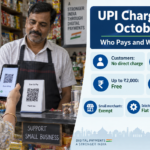
India is introducing charges on certain high-value UPI merchant payments from October 15, 2026. The announcement has created confusion, with many users wondering whether sending money to friends, paying shopkeepers or scanning a QR code will now cost extra.
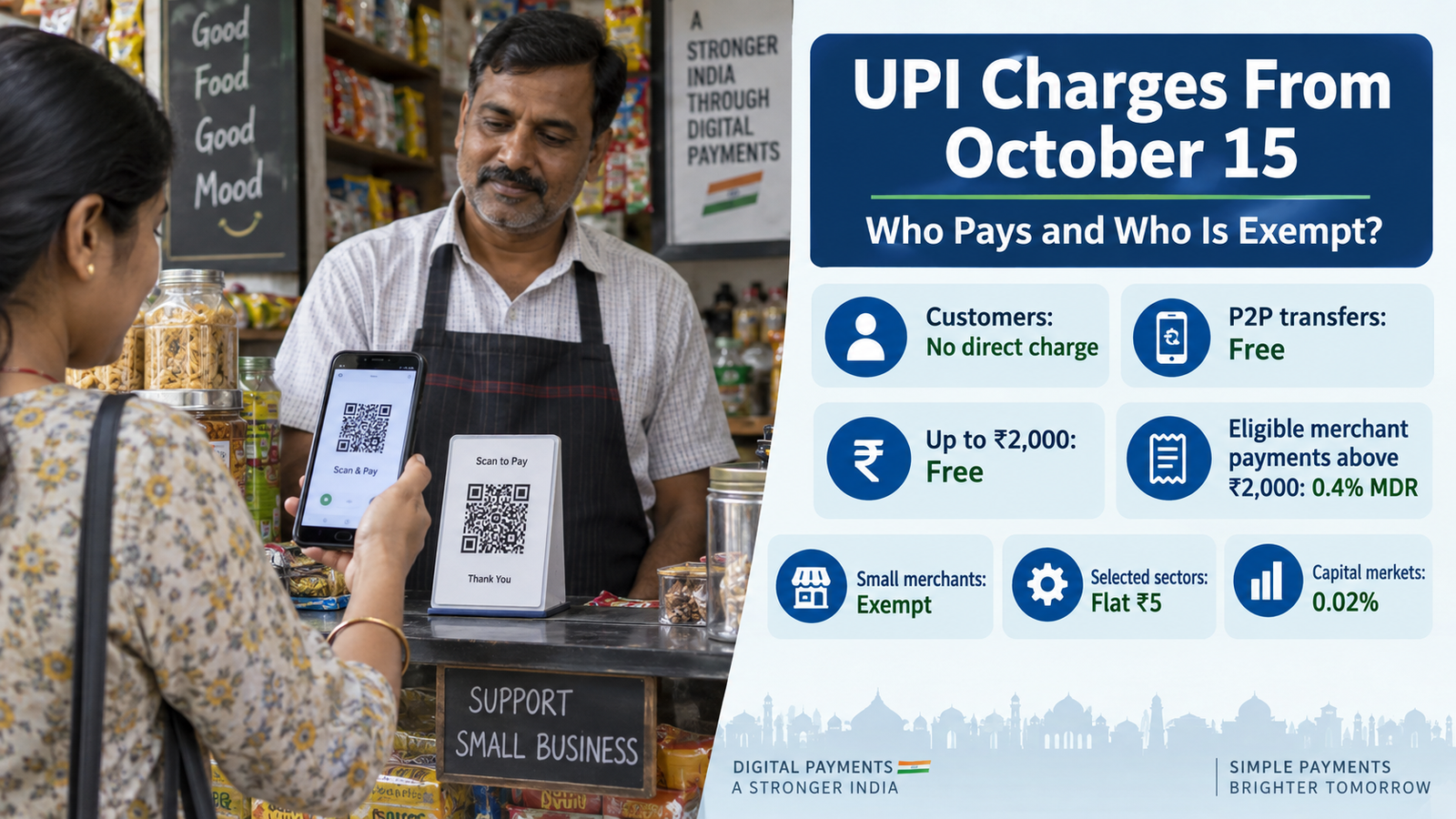
The most important clarification is simple: ordinary UPI users will not be directly charged.
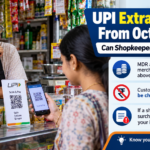
Person-to-person transfers will remain free regardless of the amount. The new charge is a Merchant Discount Rate, or MDR, applied mainly to eligible businesses receiving UPI payments above ₹2,000.
Here is what will change—and what will remain free.
What Is the New UPI Charge?
The National Payments Corporation of India has introduced an MDR of up to 0.4% on eligible person-to-merchant transactions exceeding ₹2,000.
The new framework will take effect on October 15, 2026.
MDR is a payment-processing fee usually paid by a merchant. It is distributed among banks, payment applications and other companies that operate the digital-payment system.
It is not a fee automatically deducted from the customer’s bank account.
According to The Indian Express, the government has advised banks to ensure that merchants do not pass the charge on to customers.
Will Customers Pay for UPI Transactions?
Customers will continue to enjoy free UPI payments under the new framework.
The following transactions will remain free:
- Sending money to friends or family
- Transferring money between personal bank accounts
- Paying a merchant ₹2,000 or less
- Payments made to eligible small merchants
- SIP payments made through UPI
- Eligible recurring UPI AutoPay transactions
- Payments made using RuPay debit cards
Person-to-person transactions will remain free regardless of the amount transferred. There are no monthly quotas or paid transaction tiers for individual users.
Existing daily UPI limits imposed by banks or NPCI are security and risk-management limits—not fee thresholds.
How Much Will Merchants Pay?
Eligible merchants receiving payments above ₹2,000 can be charged an MDR of 0.4% of the transaction value.
For example:
- On a ₹3,000 merchant payment, the MDR could be ₹12.
- On a ₹10,000 merchant payment, the MDR could be ₹40.
- On a ₹50,000 merchant payment, the MDR could be ₹200.
- On payments of ₹75,000 or more, the MDR will be capped at ₹300.
The customer should still pay only the original bill amount. The processing charge is intended to be deducted from the merchant’s settlement.
An 18% GST will also apply to the MDR service fee—not to the full purchase amount. For example, if the MDR is ₹40, GST would apply to that ₹40 rather than the ₹10,000 transaction.
GST-registered businesses may be able to claim input tax credit, subject to applicable tax rules and proper documentation.
Are Small Shopkeepers Exempt?
Small merchants receiving up to ₹1 lakh per month through UPI QR codes will continue to receive zero-MDR protection.
These businesses will operate under NPCI’s person-to-person merchant, or P2PM, category.
If a merchant receives more than ₹1 lakh per month through UPI for three consecutive months, the account can be moved into the regular P2M merchant category. Eligible payments above ₹2,000 could then attract MDR.
NPCI and the Finance Ministry said approximately 96% of merchant UPI transactions will remain unaffected because their value is ₹2,000 or less.
Special Charges for Fuel, Railways and Utility Payments
Some essential or low-margin sectors will not pay the standard 0.4% rate.
Instead, a flat MDR of ₹5 will apply to eligible transactions above ₹2,000 in categories including:
- Fuel
- Railway tickets
- Agricultural inputs
- Insurance premiums
- Telecom and utility bills
- Credit-card bill payments
- Tax payments
The flat fee is intended to prevent the cost from rising with the transaction value in sectors where margins may be regulated or relatively small.
What About Mutual Funds and Stockbrokers?
UPI payments to stockbrokers, mutual funds and securities dealers will attract a lower MDR of 0.02%, capped at ₹300.
However, SIP payments made through UPI will remain exempt. Eligible recurring AutoPay instructions, including some utility and subscription payments, will also remain free.
Stockbrokers have raised concerns that even the lower charge could create significant expenses because customers may transfer money without necessarily completing a trade.
Why Is India Introducing UPI MDR?
UPI has operated without MDR since January 2020. This policy played a major role in making it India’s most widely used digital-payment system.
However, banks and payment companies still incur expenses for processing transactions, preventing fraud, maintaining servers and expanding payment infrastructure.
The payment industry has estimated that operating and settling UPI transactions costs approximately ₹20,000 crore annually.
NPCI argues that MDR revenue will support:
- Cybersecurity improvements
- Fraud-detection systems
- Server and network capacity
- Payment infrastructure in rural areas
- Competition among UPI applications
- Long-term reliability of the UPI network
Five percent of the collected MDR is expected to support a dedicated fund for expanding UPI acceptance among small merchants.
Why Are Retailers Opposing the Decision?
Retail organisations fear that merchants with narrow profit margins may encourage customers to pay in cash when purchases exceed ₹2,000.
The Retailers Association of India has argued that the ₹1 lakh monthly exemption threshold is too low for many small businesses, especially during the festival season.
Petrol-pump dealers have also requested a complete exemption, saying that even a flat ₹5 charge could become expensive when applied across thousands of transactions.
A petition has been filed in the Supreme Court challenging the framework. However, filing a petition does not automatically suspend the policy. Unless a court or the government changes the rules, the October 15 implementation date remains in place. Reuters has reported widespread retailer and broker opposition to the decision.
Could Merchants Charge Customers Extra?
The government has advised banks to ensure that merchants do not pass MDR on to customers. UPI application providers are also prohibited from imposing platform fees or hidden charges on ordinary users.
Customers should check the final bill if a merchant asks for an additional “UPI fee.” They can choose another payment method and report unexplained charges to the merchant’s payment provider or bank.
However, businesses may eventually adjust their general prices to cover operating expenses. Monitoring will therefore be important to ensure that the new system does not indirectly penalise consumers.
Conclusion
The new UPI policy does not mean that every digital payment will become chargeable.
Personal transfers will remain free, merchant payments of ₹2,000 or less will remain protected, and eligible small merchants will continue receiving zero-MDR benefits.
The main change affects larger businesses receiving high-value merchant payments. From October 15, eligible payments above ₹2,000 can attract a 0.4% MDR, capped at ₹300.
For most consumers, using UPI should feel exactly the same. The real debate is whether merchants will absorb the cost—or begin encouraging customers to return to cash.
Frequently Asked Questions
Will I be charged for sending ₹5,000 to a friend?
No. Person-to-person UPI transfers will remain free regardless of the amount, subject to normal bank transaction limits.
Will a ₹5,000 shop payment attract a fee?
The merchant may pay MDR on an eligible transaction, but the customer should not be directly charged.
Are UPI payments below ₹2,000 free?
Yes. UPI merchant payments of ₹2,000 or less remain under the zero-charge framework.
When will the new UPI charges begin?
The revised MDR framework is scheduled to take effect on October 15, 2026.
Is 18% GST charged on the entire UPI payment?
No. GST applies to the MDR service fee, not to the full transaction value.
Will Google Pay, PhonePe or Paytm charge users?
UPI application providers are not permitted to impose platform fees or hidden charges on ordinary users under the announced framework.
Disclaimer: This article is based on government statements, NPCI announcements and credible media reports available as of September 16, 2026. The framework may be modified following regulatory reviews, legal proceedings or additional official clarifications. Tax treatment can depend on a merchant’s circumstances. This article is intended for news and educational purposes and does not constitute financial, tax or legal advice.

Comments are closed.
[…] 17, 2026 Latest Technology News: Gemini 3.8, India’s Chip Push and European Robotaxis September 16, 2026 UPI Charges From October 15 Explained: Who Pays and Who Is Exempt? […]