
































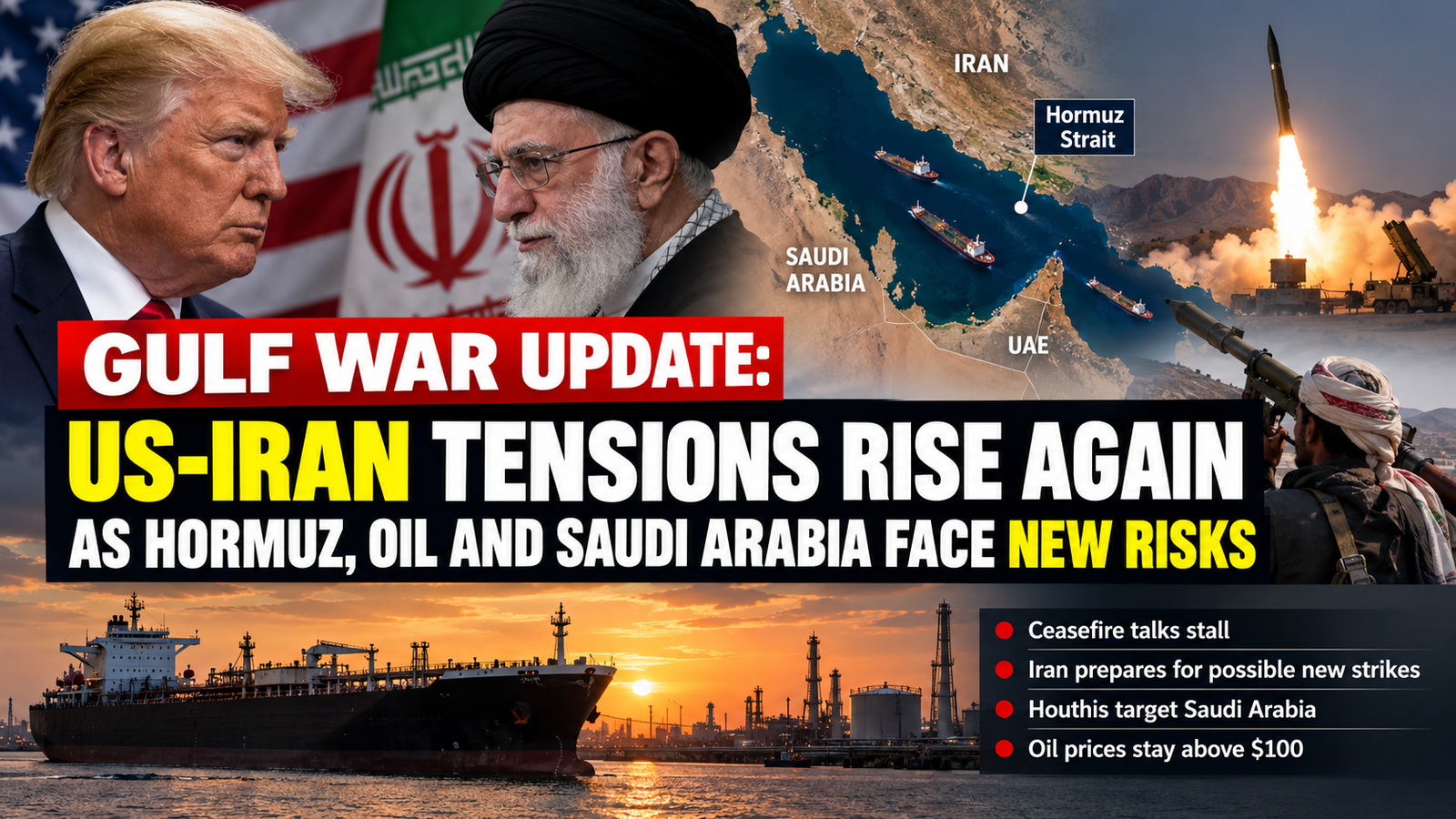
Gulf War Update: US-Iran Tensions Rise Again as Hormuz, Oil and Saudi Arabia Face New Risks

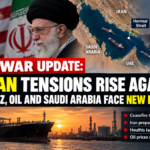
The war surrounding Iran and the Gulf has entered another dangerous phase.
More than seven months after the United States and Israel launched strikes against Iran on February 28, 2026, the conflict has still not reached a durable settlement.
A brief ceasefire reduced the intensity of direct fighting earlier this year, but sporadic hostilities, restrictions in the Strait of Hormuz and attacks across the region have continued.
Now several developments are happening simultaneously:
US-Iran negotiations remain stalled, Washington is strengthening its military presence in the region, Tehran is preparing for a potentially larger retaliation if attacked again, Houthi forces have claimed another strike on Saudi energy infrastructure, and global oil markets are once again feeling the pressure.
So where does the Gulf conflict stand today?
US-Iran Peace Talks Are Struggling
Qatar has been attempting to mediate between Washington and Tehran.
Iran recently presented proposals aimed at ending hostilities and reopening the Strait of Hormuz, while seeking sanctions relief and other guarantees.
So far, however, the negotiations have failed to produce a comprehensive settlement.
Iranian President Masoud Pezeshkian has publicly said Tehran remains willing to negotiate, but Iranian officials have also indicated privately that they see the chances of a breakthrough as limited.
The central disputes remain familiar: Iran’s nuclear programme, sanctions, regional security and control of shipping through the Gulf.
Without compromise on those issues, another escalation remains possible.
Iran Is Preparing for a Bigger Response
Perhaps the most concerning development is Iran’s military preparation.
Reuters reported that Iranian commanders are planning a broader and more forceful response if the United States resumes large-scale attacks.
Iranian officials said potential responses could extend beyond direct attacks on US military assets and could involve countries that assist American military operations.
Tehran has also reportedly told aligned groups in Yemen, Lebanon and Iraq to prepare in the event of renewed major US strikes.
No final Iranian decision has been announced.
But the message appears clear: Tehran does not want its next response to be merely symbolic if another major attack occurs.
That raises the possibility that another US-Iran confrontation could spread more widely across the Middle East.
US Military Presence Remains Heavy
The United States already maintains significant forces in and around the Gulf.
The aircraft carrier USS George Washington is currently supporting operations connected to the conflict near the Strait of Hormuz after replacing the USS Abraham Lincoln.
Reuters reported on October 3 that the carrier’s deployment has no defined end date. US forces in the region continue operating under the threat of Iranian missiles and drones.
Reports have also indicated that Washington is considering additional forces and another aircraft carrier as it evaluates its next steps toward Iran.
That military buildup does not necessarily mean another large offensive is certain.
But it gives Washington greater capacity to launch one if diplomacy fails.
Houthis Claim Attack on Saudi Aramco Facility
The conflict is also widening beyond Iran itself.
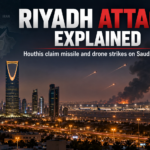
On October 3, Yemen’s Iran-aligned Houthi movement said it had attacked a Saudi Aramco facility in Riyadh using ballistic missiles and drones.
A Reuters witness reported seeing smoke and fire near an Aramco facility, although Saudi authorities and Aramco had not immediately confirmed that the facility itself was successfully struck.
The Houthis said the operation was retaliation for Saudi military action in Yemen.
Only days earlier, the group claimed another attack against Aramco installations near Yanbu. Saudi Arabia said it intercepted six ballistic missiles and did not report damage to the facilities.
Attacks on Saudi energy infrastructure matter far beyond the Gulf.
Saudi Arabia is one of the world’s most important oil exporters. Any serious disruption could quickly affect global fuel prices.
The Strait of Hormuz Is Still the World’s Biggest Flashpoint
The Strait of Hormuz remains at the centre of the conflict.
Before the war, roughly one-fifth of global crude oil and LNG supplies passed through the waterway.
Shipping has not stopped entirely.
In fact, September saw the highest number of LNG shipments through Hormuz since the war began. Data cited by Reuters showed between 19 and 21 LNG cargoes exited the strait during the month.
But that was still far below normal pre-war activity.
Some vessels have been conducting so-called “dark transits,” switching off tracking systems while passing through the area because of security concerns.
US naval escorts are also helping protect some shipping.
The important point is that Hormuz is functioning—but it is far from normal.
Oil Is Back Above $100
Energy markets are already reflecting that risk.
Brent crude settled at around $102.31 per barrel on October 1, after jumping more than 4% in a single session.
The Gulf war is not the only reason.
Fuel supplies have also been affected by developments involving China and Russia.
But uncertainty surrounding Iran and the Strait of Hormuz remains one of the largest geopolitical risks facing energy markets.
The situation has become serious enough that G7 countries agreed to release crude oil and diesel from emergency reserves to help ease pressure on fuel markets.
That tells us something important.
The Gulf conflict is no longer only a military story.
It has become an inflation story.
Why India Should Be Watching Closely
For India, a prolonged Gulf conflict creates several risks.
India imports the overwhelming majority of the crude oil it consumes.
If oil remains above $100 for an extended period, India’s import bill can rise sharply.
Higher energy prices can eventually affect:
Petrol and diesel prices → transportation costs → food and manufacturing costs → inflation.
A prolonged disruption in Hormuz could also affect LNG shipments from Qatar, an important energy supplier to India.
There is some encouraging news: several recent Qatar-linked LNG cargoes successfully passed through Hormuz and reached waters near India, including a vessel unloading at Hazira.
But the sustainability of those shipments remains uncertain if military tensions escalate again.
Are We Heading Toward a Larger Gulf War?
That remains impossible to know.
There are currently two opposing forces operating at the same time.
Diplomacy is still alive.
Qatar continues trying to establish common ground between Washington and Tehran.
But military preparation is also increasing.
Iran is preparing retaliation.
US naval forces remain heavily deployed.
Houthi attacks are putting Saudi Arabia under pressure.
And the Strait of Hormuz remains partially disrupted.
The danger is that a single military miscalculation—an attack on a US warship, a major strike on Saudi energy infrastructure, or renewed US attacks inside Iran—could trigger another cycle of retaliation.
Conclusion
The Gulf conflict is currently in an uneasy position between negotiation and renewed escalation.
There is no full peace agreement.
There is no complete closure of the Strait of Hormuz either.
Oil and LNG are moving again, but under extraordinary security conditions.
Meanwhile, the United States is maintaining substantial military forces in the region, Iran is preparing for a stronger response if attacked, and Houthi strikes are once again threatening Saudi Arabia.
For the global economy, the most immediate danger may not even be the battlefield itself.
It is energy.
If the Strait of Hormuz faces another serious disruption or Saudi energy infrastructure suffers major damage, oil prices could rise further—feeding inflation from India and Europe to the United States.
For now, diplomacy has not collapsed.
But neither has the war ended.
And the next few weeks may determine whether the Gulf slowly moves toward a settlement—or enters another much more dangerous phase.
Frequently Asked Questions
Is the US-Iran war over?
No. Direct fighting has fluctuated in intensity, but the broader conflict that began with US-Israeli strikes on Iran on February 28 remains unresolved.
Is the Strait of Hormuz open?
Partially. Oil and LNG vessels are passing through, but traffic remains disrupted and security risks are high. September LNG shipments increased but were still far below normal pre-war volumes.
Has Saudi Arabia been attacked?
The Houthis claimed an October 3 missile-and-drone attack targeting an Aramco facility in Riyadh. Smoke was observed nearby, but Saudi authorities had not immediately confirmed a successful strike on the facility.
Are the United States and Iran negotiating?
Indirect negotiations are continuing through Qatar, but no comprehensive peace agreement has been reached.
Why is the Gulf conflict affecting oil prices?
The Gulf contains some of the world’s largest oil and gas exporters, while the Strait of Hormuz is one of the world’s most important energy shipping routes. Any disruption can reduce supply and increase transportation and insurance costs.
Disclaimer: This article reflects publicly available information as of October 3, 2026. The conflict is rapidly evolving, and battlefield claims from governments and armed groups may not always be independently verified.
