



















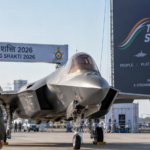






















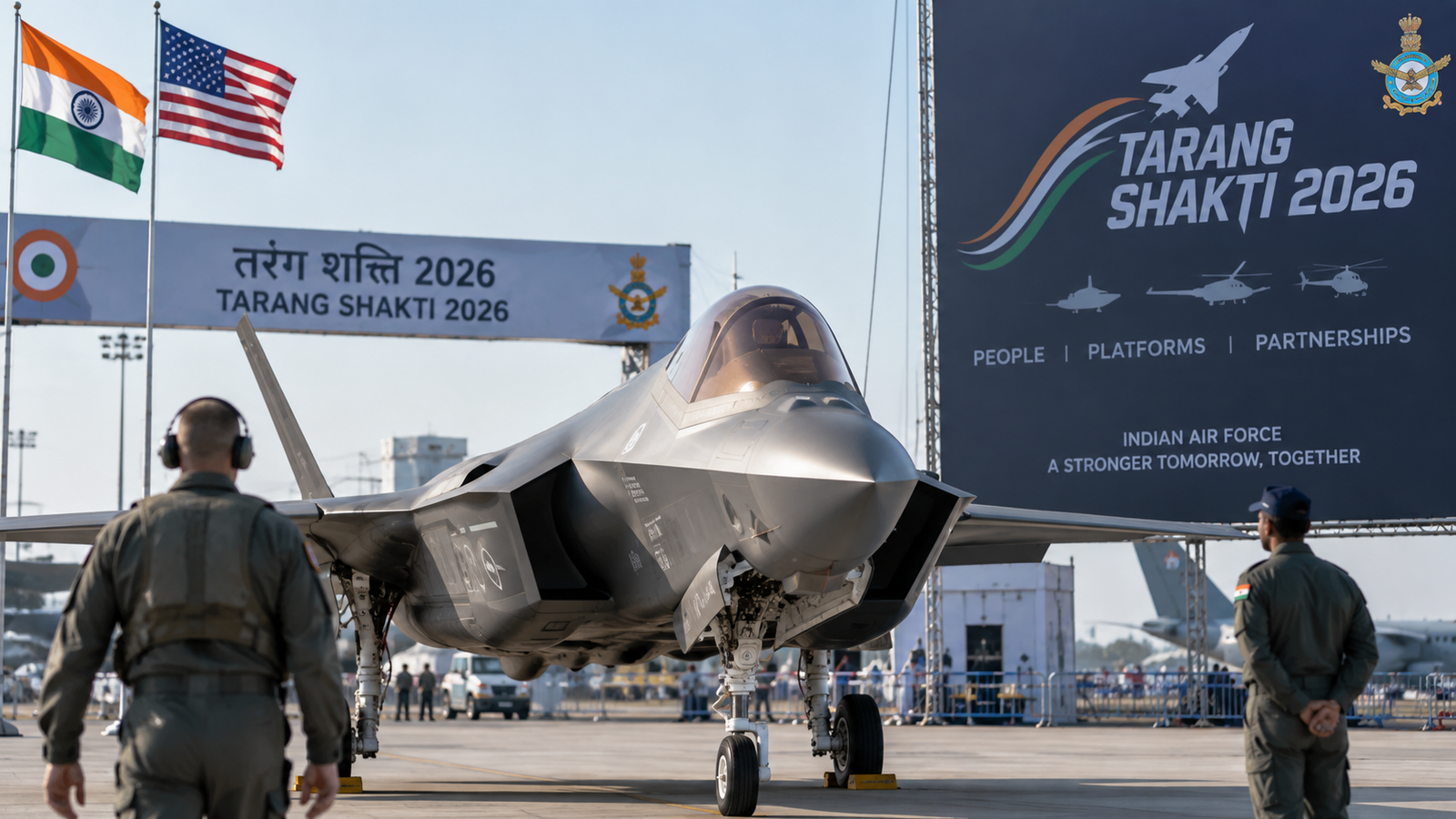

The United States is sending its advanced F-35 stealth fighters to participate in the Indian Air Force’s Tarang Shakti 2026 multinational exercise in Jodhpur.
Scheduled from September 26 to October 12, the exercise will mark the first time the Indian Air Force trains with the F-35 during a military exercise on Indian soil.
The aircraft has appeared in India before. US Air Force F-35s participated in Aero India 2023, while both the American F-35 and Russian Su-57 appeared at Aero India 2025. Those were primarily aerospace exhibitions and flying demonstrations—not joint operational exercises.
Tarang Shakti will therefore give Indian pilots, planners and ground crews a more practical opportunity to operate alongside one of the world’s leading fifth-generation combat aircraft.
However, its participation does not mean that India has agreed to purchase the F-35.
What Is Exercise Tarang Shakti 2026?
Tarang Shakti is the Indian Air Force’s largest multinational air exercise. Its first edition was organised in 2024 in two phases at Sulur and Jodhpur.
The second edition will bring together combat aircraft, transport planes, aerial-refuelling tankers and support personnel from several countries.
Eight foreign countries—the United States, France, the United Arab Emirates, Germany, Australia, Greece, Bangladesh and Sri Lanka—are expected to participate with aircraft or personnel. Other countries will attend as observers and delegates.
The participating aircraft are expected to include:
- US Air Force F-35 stealth fighters
- French Rafale fighters
- UAE F-16 fighters
- Indian Rafale and Su-30MKI aircraft
- Tejas light combat aircraft
- Mirage 2000, MiG-29 and Jaguar fighters
- C-130 transport aircraft
- Aerial-refuelling and surveillance platforms
Reports indicate that the American contingent could include six F-35s supported by two KC-135 aerial-refuelling aircraft. Final aircraft numbers may change before the exercise begins.
Why Is the F-35’s Participation Important?
The F-35 is not simply another fighter jet. Its greatest strength comes from combining stealth, advanced sensors, electronic warfare and secure data sharing.
Unlike older combat aircraft that depend heavily on their pilots interpreting information from separate systems, the F-35 is designed to collect and combine data from multiple sensors. It can then present the pilot with a more complete picture of the surrounding airspace.
During a multinational exercise, the IAF can study how a fifth-generation aircraft works alongside conventional fighters, surveillance platforms and aerial tankers.
The experience could help India improve:
- Joint mission planning
- Beyond-visual-range combat tactics
- Electronic-warfare awareness
- Secure communication between aircraft
- Aerial-refuelling coordination
- Integration of fighters from different countries
- Responses to low-observable aircraft
- Multi-domain command and control
India will not gain access to the F-35’s classified software or stealth technology. Nevertheless, training in the same exercise environment can provide valuable operational knowledge.
This Is Not the F-35’s First Visit to India
Some reports have described Tarang Shakti as the first time an F-35 will fly in India. That is incorrect.
The F-35 first participated in Aero India at Bengaluru in February 2023. According to the US Air Force, the aircraft conducted aerial demonstrations during the event.
It returned for Aero India 2025, where the F-35 and Russia’s Su-57 were presented at the same exhibition.
What makes Tarang Shakti different is that the aircraft will participate in an Indian-hosted military exercise rather than an air show.
That distinction is strategically significant because exercises involve coordinated missions, shared procedures and operational learning.
Does This Mean India Will Buy the F-35?
No purchase has been confirmed.
In February 2025, US President Donald Trump said Washington was preparing to offer F-35 fighters to India. Indian Foreign Secretary Vikram Misri subsequently clarified that India’s formal acquisition process for such an aircraft had not started and that the idea remained at the proposal stage.
India normally evaluates major defence purchases through a lengthy process involving:
- Indian Air Force requirements
- Technical assessments
- Price negotiations
- Government approval
- Maintenance and lifecycle costs
- Weapons compatibility
- Local manufacturing and technology transfer
- Strategic and diplomatic considerations
Participation in a military exercise should not be confused with a procurement decision. India regularly trains with aircraft that it has no immediate plan to purchase.
Would the F-35 Suit India?
The F-35 offers advanced capabilities, but purchasing it would involve difficult choices.
Potential Advantages
The aircraft could provide India with:
- Advanced stealth capabilities
- Powerful sensors and data fusion
- Electronic-warfare capacity
- Interoperability with Western partners
- Access to a large international support network
It could also help address the IAF’s need for fifth-generation capability while India develops its indigenous Advanced Medium Combat Aircraft.
Potential Challenges
The F-35 is part of a tightly controlled American technology ecosystem. Operating it could create concerns involving software access, mission-data control, maintenance and restrictions on modifications.
India also operates Russian-origin S-400 air-defence systems. The United States previously removed Türkiye from the F-35 programme after Ankara acquired the S-400, arguing that operating the two systems could expose sensitive F-35 information.
India would also have to evaluate the aircraft’s long-term operating cost and the level of domestic manufacturing or technology transfer available.
For New Delhi, buying a fighter is not only about technical performance. It is also about strategic independence.
What About Russia’s Su-57?
Russia has offered India its Su-57 fifth-generation fighter and has discussed possible production in India.
The Russian proposal may offer greater flexibility regarding local manufacturing. However, India would still need to assess the aircraft’s technology, engine performance, weapons, production maturity and long-term logistical support.
The F-35 and Su-57 represent very different military and geopolitical ecosystems. Selecting either aircraft could influence India’s defence partnerships for decades.
India may therefore prefer to avoid a rushed decision while strengthening its existing fighter fleet and accelerating the indigenous AMCA programme.
Why Tarang Shakti Matters for India’s AMCA
One of the most valuable outcomes of Tarang Shakti could be the operational knowledge India gains for its own fighter-development programme.
The AMCA is intended to provide the IAF with an indigenous fifth-generation stealth aircraft. Developing it requires more than producing a low-observable airframe.
India must also master:
- Sensor fusion
- Electronic warfare
- Secure data links
- Advanced mission computers
- Internal weapons integration
- Low-observable materials
- High-performance engines
- Network-centric operations
Training alongside the F-35 will not reveal its engineering secrets. But it can help Indian planners understand how fifth-generation aircraft change mission planning and how they interact with older fighters.
These lessons could influence future IAF doctrine and the operational requirements established for the AMCA.
A Signal of India’s Strategic Position
Tarang Shakti demonstrates India’s ability to exercise with countries operating different aircraft, weapons and military doctrines.
The IAF will bring together Indian, American, French, Russian-origin and other platforms within one exercise environment. This reflects India’s wider strategy of maintaining multiple defence partnerships instead of depending completely on one supplier.
The participation of the F-35 also shows that India-US military cooperation can continue even when the two countries disagree on trade, tariffs or foreign policy.
At the same time, India is using the exercise to showcase the Tejas fighter and other domestically developed platforms to foreign military delegations.
As Vice Chief of the Air Staff Air Marshal Ashutosh Dixit explained, international cooperation and defence self-reliance do not have to contradict each other.
The Bigger Meaning of the F-35 Deployment
The F-35’s arrival at Tarang Shakti will attract enormous attention, but the exercise is not an unofficial sales demonstration alone.
Its greater value lies in exposing Indian personnel to complex multinational operations involving stealth fighters, conventional aircraft, refuelling tankers, transports and surveillance systems.
For India, the goal should be to absorb operational lessons without allowing temporary access to foreign technology to weaken investment in domestic programmes.
The F-35 may or may not eventually become part of the Indian Air Force. Tarang Shakti 2026 will still give India something valuable: direct experience of how fifth-generation air power functions inside a multinational combat environment.
Frequently Asked Questions
When will Tarang Shakti 2026 take place?
The exercise is scheduled to be held in Jodhpur from September 26 to October 12, 2026.
Is this the first time the F-35 has visited India?
No. F-35 aircraft participated in Aero India 2023 and 2025. Tarang Shakti will be their first participation in an Indian military exercise.
Has India agreed to purchase the F-35?
No. The United States has discussed offering the aircraft, but India has not announced a formal purchase decision.
Which Indian aircraft will participate?
The IAF is expected to deploy aircraft including the Rafale, Su-30MKI, Tejas, Mirage 2000, MiG-29 and Jaguar, along with surveillance, transport and refuelling platforms.
Will India get access to F-35 technology?
Participation in an exercise does not provide access to classified software, stealth materials or other protected technologies.
What is India’s indigenous fifth-generation fighter?
India is developing the Advanced Medium Combat Aircraft, or AMCA, as its future domestically produced stealth fighter.
Disclaimer: This article is based on official statements and credible reports available as of September 22, 2026. Exercise schedules, aircraft numbers and participating contingents may change for operational or logistical reasons. Participation in Tarang Shakti does not confirm an Indian purchase of the F-35. This article is intended for news and educational purposes only.
