














































Starlink Is More Than Internet: Why India Must Treat It as a National-Security Technology

Starlink is often presented as a simple solution to India’s connectivity problem.
Put a terminal on a roof, connect it to satellites, and suddenly remote villages, mountains, ships and disaster zones receive high-speed internet.
That sounds attractive.
But India should understand what it is actually allowing into its communications ecosystem.
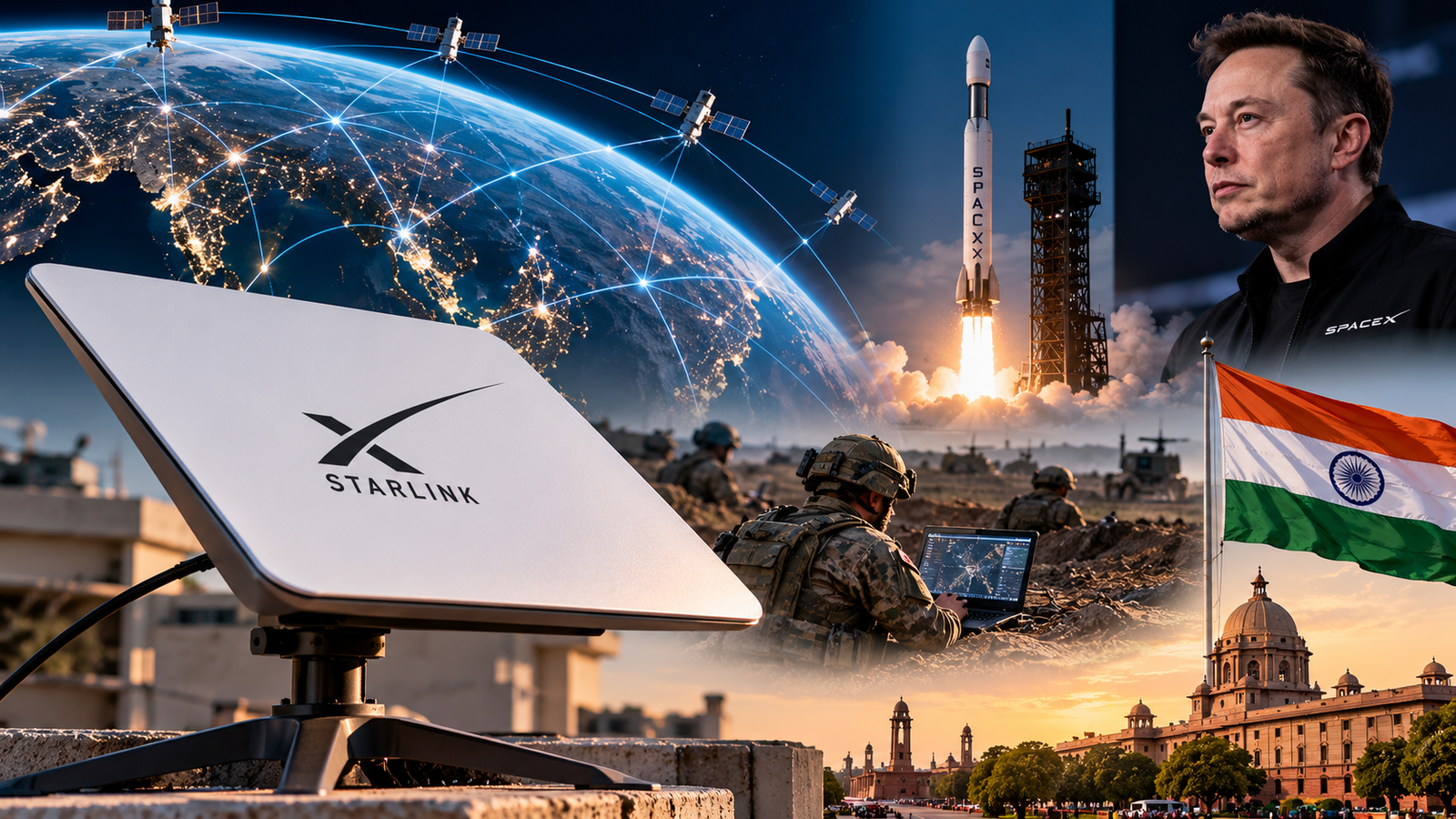
Starlink is not merely Netflix from space.
Satellite communications can support military units, drones, intelligence networks, emergency services, ships, aircraft and battlefield command systems.
And Starlink’s parent company, SpaceX, is already deeply connected to the United States defence and intelligence establishment.
That does not prove Starlink is being introduced into India for espionage.
But it does mean India would be making a serious mistake if it treated foreign-controlled satellite infrastructure like an ordinary consumer telecom service.
Ukraine Proved Starlink Can Influence a War
The clearest evidence comes from Ukraine.
After Russia invaded Ukraine, Starlink became critically important because Russian attacks damaged conventional telecommunications infrastructure.
Ukrainian forces used Starlink for battlefield communications, coordinating units and supporting drone operations.
Then something extraordinary happened.
Reuters reported that Elon Musk ordered Starlink coverage switched off across parts of Ukraine during a major Ukrainian counteroffensive in September 2022.
The outage reportedly disrupted military communications, drone operations and targeting while Ukrainian forces were attempting to advance against Russian positions.
Think about what that means.
A private foreign company controlled infrastructure important enough that changing satellite coverage could influence military operations thousands of kilometres away.
That should immediately interest Indian defence planners.
Imagine the Same Problem During an Indian War
Consider a hypothetical future India-Pakistan or India-China conflict.
Indian civilians, businesses, border communities or even government agencies have become heavily dependent on Starlink.
Then Washington and New Delhi develop a serious political disagreement.
Or the United States wants India to limit certain military operations.
Or SpaceX itself decides that providing service in a particular combat zone creates unacceptable risk.
What happens if coverage changes?
What happens if terminals are disabled?
What happens if certain geographic areas become inaccessible?
Ukraine demonstrated that this is no longer a theoretical question.
When another country or foreign corporation controls essential communications infrastructure, that control becomes strategic leverage.
India should never place itself in a position where its ability to communicate during a national emergency depends primarily on a decision made in California or Washington.
SpaceX Already Works Deeply With the US Military
Another uncomfortable fact is that SpaceX is not simply a civilian broadband company.
Reuters reported that SpaceX has received approximately $22 billion in US government contracts, including major relationships with NASA and the Department of Defense.
Starlink itself has been purchased by the Pentagon for communications.
US military organizations including the Army, Air Force and Special Operations Command have used or contracted SpaceX satellite capabilities.
Then there is Starshield.
Starshield is SpaceX’s national-security satellite platform.
Unlike consumer-focused Starlink, Starshield is specifically designed for government and military applications, including secure communications and other national-security missions.
Reuters reported that the programme has a multibillion-dollar arrangement involving a US intelligence agency.
So it would be naive to think of SpaceX’s satellite network solely as commercial internet infrastructure.
The same company sits at the intersection of:
civilian communications
military communications
satellite launches
intelligence programmes
national-security infrastructure
and US defence contracts.
That makes sovereign safeguards essential.
Could Starlink Be Used Against India?
Technically, satellite communications can support both civilian and military activity.
That is exactly why India itself treats the technology as sensitive.
India’s 2026 satellite-network rules explicitly state that authorised satellite networks must not be used for unauthorised surveillance or electronic warfare or in a way that prejudices India’s sovereignty and security.
That wording is significant.
The Indian government itself recognises that satellite networks can potentially be exploited for activities extending far beyond ordinary internet access.
The same regulations require operational and control facilities for satellite gateways and connected terminals to be located in India.
Operators must provide lawful interception capabilities.
Authorities must also be able to identify and geographically monitor terminals.
Why would these requirements exist if satellite broadband were simply another harmless consumer service?
Because governments understand its strategic possibilities.
One Major Risk: Unauthorized Terminals
Starlink terminals are portable.
That is one of the technology’s greatest strengths.
It can also become a security problem.
Imagine unauthorized terminals being smuggled into:
border regions,
insurgency-affected areas,
military-sensitive zones,
or locations used by hostile intelligence networks.
Such equipment could theoretically provide communications independent of ordinary Indian cellular infrastructure.
India’s new rules specifically require satellite companies to report attempts by unregistered terminals to access their networks and include measures aimed at identifying equipment clandestinely brought into the country.
Again, that tells us something.
Indian regulators have already identified clandestine satellite-terminal access as a national-security risk.
Another Risk: Internal Destabilization
Starlink itself does not create civil unrest.
But uncontrolled satellite communications could theoretically become useful infrastructure for groups attempting to operate outside conventional communication networks.
A hostile intelligence service, militant network or organized criminal group with unauthorized access could potentially seek satellite connectivity when terrestrial communications were being monitored or disrupted.
This is one reason India’s rules require operators to support location-based interception and monitoring and identify the location of active terminals when directed by authorities.
That does not mean Starlink will cause internal instability.
It means any powerful communications network that cannot be fully monitored and controlled by the sovereign state creates additional security considerations.
The Bigger Danger Is Dependency
Perhaps the largest risk is not espionage.
It is dependency.
Suppose Starlink becomes extremely successful in India.
Millions of customers join.
Government agencies use it.
Airlines use it.
Ships use it.
Remote communities depend upon it.
Emergency infrastructure begins relying upon it.
Indian alternatives fail because they cannot achieve sufficient scale.
Ten years later, Starlink is no longer merely a foreign company operating in India.
It becomes infrastructure India cannot easily function without.
That is when commercial dependence becomes geopolitical leverage.
Europe has already recognized this problem.
Governments there have been exploring alternatives to Starlink because of concerns about depending on a US-controlled satellite network for strategically important communications.
European companies Nokia and ICEYE recently announced development of sovereign low-Earth-orbit communications systems where governments could maintain ownership and control of satellites, ground infrastructure and terminals.
If Europe considers sovereign satellite communications important, India should ask why it should think differently.
This Is Why India Needs Its Own Starlink
India’s answer should not simply be:
Ban Starlink.
That could eliminate useful competition and technology.
India’s answer should be much more ambitious:
Build an Indian Starlink capable of competing with it.
Jio Satellite Communications and OneWeb India already hold relevant Indian satellite-service authorisations alongside Starlink.
But India should go further.
Indian companies need help achieving enough scale to compete internationally.
India should develop:
domestically controlled satellite constellations,
Indian ground stations,
Indian satellite terminals,
Indian encryption technologies,
Indian launch capability,
Indian semiconductor supply chains,
and sovereign military satellite communications.
The goal should be redundancy.
If one system disappears tomorrow, India should have another system ready.
America Protects Its Own Strategic Technology
There is another important lesson here.
The United States itself treats advanced technology as national power.
Washington protects semiconductors.
It restricts advanced technology exports when national security is involved.
It funds defence technology companies.
It awards billions in government contracts to American space companies.
It maintains domestic intelligence and communications capabilities.
That behaviour is perfectly rational.
Countries protect technologies that affect national power.
India should do exactly the same.
Strategic autonomy cannot mean depending on another country’s companies while hoping political relations remain friendly forever.
International Relations Can Change Quickly
Today’s partner can disagree with you tomorrow.
India and the United States currently cooperate extensively across defence, technology, intelligence and trade.
That cooperation can be valuable.
But countries pursue interests, not permanent friendships.
India has previously faced American sanctions.
The United States sanctioned India following the 1998 nuclear tests.
Washington and New Delhi have also disagreed at various times over Pakistan, Russia, trade and other strategic issues.
That history does not mean America is inherently India’s enemy.
It demonstrates something more useful:
India must preserve the ability to make independent decisions even when powerful partners disagree.
That is strategic autonomy.
Data Sovereignty Matters Too
Satellite internet generates more than browsing traffic.
Networks can potentially produce information about:
terminal locations,
usage patterns,
network activity,
traffic volumes,
device identities,
and geographic demand.
At sufficient scale, such metadata can itself become strategically valuable.
India’s licensing framework therefore requires Indian traffic to pass through gateways established in the country and mandates privacy, monitoring and lawful-interception requirements.
These rules should not be treated as bureaucratic obstacles.
They are national-security safeguards.
Starlink Is Also Expanding Toward Ordinary Mobile Phones
The strategic importance of satellite networks may soon grow even further.
SpaceX is rapidly developing direct-to-device satellite communication, where ordinary smartphones can communicate directly with satellites without requiring traditional satellite terminals.
The US FCC is currently expanding spectrum availability for these services, while SpaceX has acquired major spectrum assets to support its ambitions.
If satellite-to-phone communications become widespread, companies controlling satellite constellations could eventually operate a global communications layer that bypasses significant portions of conventional terrestrial infrastructure.
India must prepare for that world now—not after the technology becomes impossible to replace.
India’s Strategy Should Be Clear
India can allow Starlink.
But the conditions should be uncompromising.
Critical traffic should remain under Indian jurisdiction.
Indian security agencies must have lawful monitoring capabilities.
Unauthorized terminals must be detected.
Sensitive defence networks should never depend entirely on foreign systems.
Government communications should have sovereign alternatives.
And Indian companies must be given enough policy, capital and procurement support to build competing infrastructure.
Most importantly, India should never allow one foreign company to become indispensable.
India Needs Companies the World Depends On
There is also an economic dimension.
India cannot become a technological superpower merely by becoming the world’s largest market for American technology.
Google dominates search.
Meta dominates major social platforms.
Microsoft, Amazon and Google dominate cloud infrastructure.
Nvidia dominates high-end AI accelerators.
SpaceX dominates commercial satellite launches and low-Earth-orbit broadband.
India needs companies capable of competing in these industries globally.
The objective of Atmanirbhar Bharat should not be producing inferior domestic substitutes protected forever from competition.
It should be creating companies strong enough that Europe, Africa, Southeast Asia and eventually America itself want to purchase Indian technology.
That is how technological power is created.
Conclusion: This Is About Sovereignty, Not Elon Musk
The central issue is not whether Elon Musk is trustworthy.
It is not whether the United States is friendly today.
And it is not whether Starlink is good technology.
Starlink is exceptionally capable technology.
That is precisely why India must take it seriously.
Ukraine demonstrated that satellite communication can influence battlefield outcomes.
SpaceX has deep relationships with the US military.
Starshield works specifically in the national-security domain.
European governments are building alternatives because they do not want critical communications dependent on one American provider.
And India’s own regulations explicitly recognize risks involving surveillance, electronic warfare and unauthorized satellite terminals.
Those are facts.
They do not prove Starlink is plotting against India.
They prove something more important:
India cannot outsource strategic communications and simply hope they will always remain available.
A country that wants strategic autonomy needs the ability to communicate, compute, manufacture and defend itself without requiring permission from another country or corporation.
Let Starlink compete.
Use its technology.
Learn from it.
But simultaneously build an Indian alternative powerful enough that if Starlink disappeared tomorrow, India would barely notice.
That is the difference between being a large technology market—
and being a technological power.
Frequently Asked Questions
Can Starlink be used for military operations?
Yes. Starlink has already supported military communications and drone-related operations in Ukraine, and the Pentagon has purchased Starlink services.
Is SpaceX connected to US intelligence agencies?
SpaceX operates Starshield, a national-security-focused satellite business, and Reuters has reported a multibillion-dollar agreement involving a US intelligence agency.
Could Starlink be switched off during a war?
Technically, satellite operators control geographic availability. Reuters reported that Musk ordered service disabled over areas of Ukraine during a 2022 military counteroffensive.
Is Starlink spying on India?
There is no credible public evidence establishing that Starlink is currently conducting espionage in India. However, foreign-controlled satellite infrastructure presents potential security and dependency risks, which is why India imposes strict gateway, monitoring and interception requirements.
Does India recognize satellite internet as a national-security risk?
Indian regulations specifically prohibit authorised satellite networks from being used for unauthorized surveillance, electronic warfare or activities prejudicial to India’s sovereignty and security.
Does India have alternatives to Starlink?
Jio Satellite Communications and OneWeb India Communications also hold relevant satellite authorisations in India.
Disclaimer: This article analyses the strategic risks associated with dependence on foreign-controlled satellite communications. It does not allege that Starlink or SpaceX is currently conducting espionage or destabilisation operations against India. Hypothetical scenarios are presented to illustrate national-security vulnerabilities and are distinguished from documented events.
