













































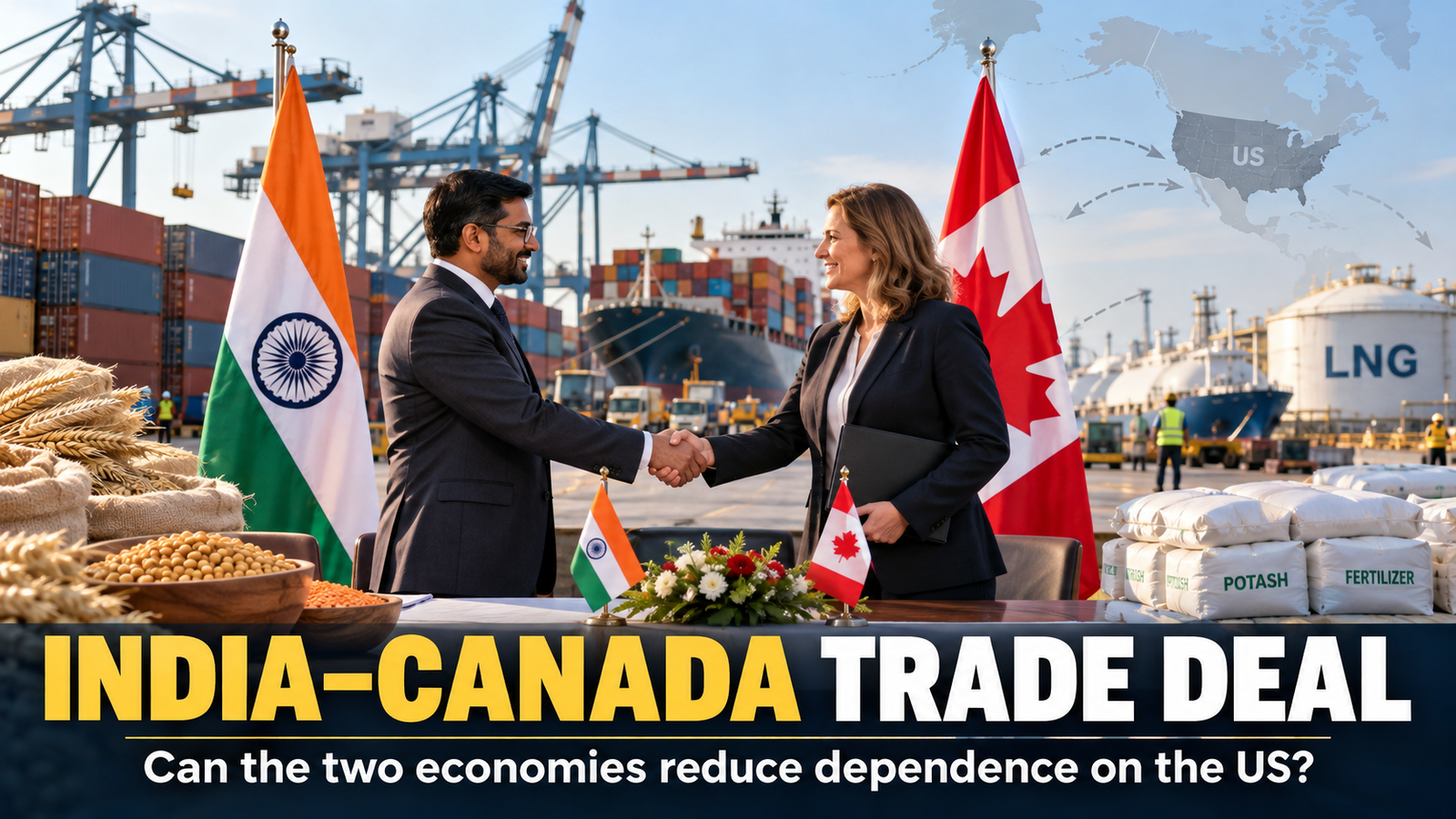
India–Canada Trade Deal Gains Momentum: Can the Two Economies Reduce Their Dependence on the US?

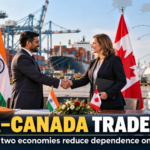
After years of political tension, India and Canada are rapidly rebuilding their economic relationship—and trade is now at the centre of the reset.
The two countries are negotiating a Comprehensive Economic Partnership Agreement, or CEPA, with both governments aiming to complete negotiations by the end of 2026.
Five negotiating rounds have already taken place, and Canadian Trade Minister Maninder Sidhu and Indian Commerce Minister Piyush Goyal met again this week as Canada led a major trade mission to India.
The ambition is substantial.
Canada and India want to increase annual bilateral trade from C$30.4 billion in 2025 to C$70 billion by 2030.
But the agreement may be about much more than simply selling more products to each other.
For both countries, it is increasingly about reducing economic dependence on the United States.
What Is the $107 Billion India–Canada Figure?
Recent headlines have caused some confusion.
There is not currently a $107 billion India–Canada trade deal.
The figure refers to Canadian investment already present in India.
Canadian Trade Minister Maninder Sidhu said Canadian companies, institutions and pension funds have invested close to US$107 billion in India, particularly across infrastructure and other long-term assets.
Canadian pension funds have become major investors in Indian roads, airports, renewable energy, real estate and financial infrastructure.
That investment relationship could expand significantly if CEPA gives investors greater predictability and easier market access.
And another major transaction has just reinforced that trend.
Canada’s Fairfax Financial agreed to acquire a 60.7% stake in IDBI Bank for about $5.56 billion, potentially becoming one of India’s largest cross-border banking investments.
Why Canada Desperately Needs New Markets
Canada’s biggest economic vulnerability is obvious.
It depends enormously on the United States.
In 2025, around 72% of Canadian merchandise exports went to the US, even after that share declined from the previous year.
That means changes in Washington can rapidly affect Canadian jobs, factories and exports.
Tariffs on Canadian steel, aluminium, automobiles or other products can immediately create economic pressure north of the border.
Prime Minister Mark Carney’s government has therefore set a goal of doubling Canadian exports to markets outside the United States over the next decade.
India fits perfectly into that strategy.
It is one of the world’s largest consumer markets, has a rapidly expanding middle class and requires enormous quantities of energy, minerals, infrastructure and technology.
For Canada, India offers something extremely valuable:
scale outside the American market.
India Also Has Reasons to Diversify Away From the US
India is nowhere near as dependent on the United States as Canada is.
But America remains one of India’s most important export markets.
US–India goods and services trade reached almost $240 billion in 2025, including more than $100 billion in US imports of Indian goods.
Recent American tariff disputes have therefore demonstrated India’s own vulnerability.
Industries that become excessively dependent on US customers can suddenly face tariffs, regulatory restrictions or political pressure.
India’s solar industry provides an extreme example: the US currently absorbs an overwhelming share of India’s exported solar modules, leaving manufacturers exposed when American trade rules change.
Canada gives Indian exporters another large, wealthy developed market.
The more markets India develops, the less damaging any single country’s policy change becomes.
Canada Has Something India Needs: Energy
Perhaps the most important long-term opportunity is energy.
India’s economy is growing rapidly, but the country remains heavily dependent on imported energy.
Canada possesses enormous reserves of:
oil
natural gas
uranium
potash
critical minerals
and renewable-energy resources.
The two governments have already launched a new Strategic Energy Partnership covering LNG, LPG, uranium, solar and hydrogen.
One particularly important agreement is already signed.
Canadian uranium producer Cameco will supply India with nearly 22 million pounds of uranium between 2027 and 2035 under a C$2.6 billion agreement.
That supports India’s plan to dramatically expand nuclear power.
For India, Canadian energy can diversify supply away from excessive dependence on West Asia or other individual suppliers.
For Canada, India becomes another enormous customer beyond the US.
That is exactly what economic diversification looks like.
Critical Minerals Could Become Even More Important
Future technologies depend on minerals such as lithium, nickel, cobalt, copper and rare-earth elements.
These materials are essential for:
electric vehicles,
batteries,
semiconductors,
defence systems,
renewable energy,
and advanced manufacturing.
Canada has large mineral resources.
India has rapidly expanding manufacturing demand.
The two governments have already signed an agreement to cooperate across exploration, mining, processing and investment in critical minerals.
If developed successfully, Canada could supply raw materials while India builds more downstream manufacturing capacity.
That could create supply chains less dependent on either China or the United States.
Agriculture Could Be Another Major Winner
Canada is a major agricultural exporter.
India is one of the world’s largest food markets.
Canadian exports to India already include vegetables and pulses, while Canadian stakeholders see significant opportunities in agriculture and agri-food trade.
India, meanwhile, could gain improved Canadian access for:
processed foods,
pharmaceuticals,
textiles,
machinery,
engineering goods,
and other manufactured products.
But agriculture will also be one of the difficult areas in negotiations.
Canada wants India to reduce tariffs and non-tariff barriers affecting agricultural exports, while both governments will want to protect sensitive domestic producers.
That is one reason a comprehensive agreement takes time.
Indian Pharmaceuticals Could Gain
India is already a major supplier of affordable generic medicines globally.
Canada imports substantial quantities of pharmaceutical products and faces the same healthcare-cost pressures affecting many advanced economies.
Reducing trade barriers and improving regulatory cooperation could allow Indian pharmaceutical companies to expand further in Canada.
In 2025, pharmaceuticals were already among Canada’s significant merchandise imports from India.
That creates a potentially complementary relationship:
Canada gets greater access to competitively priced medicines while Indian pharmaceutical companies gain access to another wealthy developed market.
Aerospace Could Be Huge
Canada has one of the world’s most sophisticated aerospace industries.
Companies including Bombardier, CAE and numerous aerospace suppliers possess expertise India increasingly needs.
India’s aviation market is expanding rapidly.
Canadian officials have highlighted India’s plans for more airports and thousands of additional aircraft as a major commercial opportunity.
This could create partnerships involving:
aircraft components,
pilot training,
simulation,
airport infrastructure,
maintenance,
and aerospace manufacturing.
India gains technology and industrial capability.
Canada gains access to one of the fastest-growing aviation markets in the world.
Services Could Become Just as Important as Goods
The relationship is already much larger than merchandise trade alone.
In 2025, Canada exported about C$15.2 billion in services to India, while importing approximately C$4.5 billion in Indian services.
Education has traditionally been a large part of Canada’s services exports.
But future growth could come increasingly from:
AI,
financial services,
IT,
engineering,
consulting,
research,
digital technology,
and professional services.
India possesses a huge skilled workforce.
Canada has advanced research institutions and strong financial, AI and technology ecosystems.
A trade agreement could make those connections significantly deeper.
Can India Really Help Canada Reduce Reliance on America?
Yes—but not replace it.
That distinction matters.
The United States is geographically next door to Canada and deeply integrated into Canadian supply chains.
No agreement with India is going to replace hundreds of billions of dollars in Canada-US trade.
But diversification does not require replacing America.
It requires ensuring America is not the only realistic option.
If Canada can increase trade with India, Europe, ASEAN and other markets simultaneously, Washington’s ability to economically pressure Canada becomes smaller.
That is one reason Canadian officials explicitly connect the India trade agreement with their broader goal of doubling non-US exports.
The Same Logic Applies to India
India does not need to reduce trade with America.
It needs to reduce dependence on America.
There is an enormous difference.
India can continue exporting pharmaceuticals, technology services, electronics and manufactured goods to the United States while simultaneously expanding in:
Canada,
Europe,
the Gulf,
Africa,
Australia,
ASEAN,
and Latin America.
Then, if Washington suddenly introduces a tariff on one Indian industry, the economic damage becomes more manageable.
Diversification is not anti-American.
It is basic economic risk management.
The Relationship Has Changed Remarkably Fast
Perhaps the most striking part of this story is how quickly India–Canada relations have recovered.
Only a few years ago, diplomatic tensions had severely damaged the relationship.
Today, ministers are meeting repeatedly.
Prime Minister Mark Carney has visited India.
CEPA negotiations are moving quickly.
Canadian investment in India is already close to the $107 billion figure cited by Sidhu.
A major uranium supply agreement has been signed.
Fairfax is buying control of IDBI Bank.
And bilateral trade has a C$70 billion target.
Reuters reported on October 14 that Canada is now trying to conclude the CEPA before the end of this year.
That is a remarkable economic reset.
Conclusion
The emerging India–Canada trade relationship is not a $107 billion trade deal.
It may ultimately become something more strategically important.
The $107 billion figure represents existing Canadian investment in India, while the CEPA aims to more than double bilateral trade to C$70 billion annually by 2030.
For Canada, India offers access to a massive growing economy at a time when Ottawa urgently wants to reduce its overwhelming dependence on US trade.
For India, Canada offers energy, uranium, critical minerals, capital, aerospace expertise and another wealthy market for Indian goods and services.
The relationship is unusually complementary.
Canada has resources India needs.
India has the scale Canada needs.
And both countries have discovered the same strategic lesson:
economic dependence on one market creates political vulnerability.
Neither India nor Canada needs to abandon the United States.
But both benefit from having more options.
If CEPA succeeds, the most important result may therefore not be whether bilateral trade reaches exactly C$70 billion.
It may be that two major economies become less vulnerable to decisions made in Washington because they have built a stronger economic bridge with each other.
Frequently Asked Questions
Is there a $107 billion India–Canada trade deal?
No. The roughly US$107 billion figure refers to Canadian investments in India, including investments by Canadian pension funds and institutions.
What is the actual India–Canada trade target?
The two governments aim to increase bilateral goods-and-services trade from C$30.4 billion in 2025 to C$70 billion annually by 2030.
What trade agreement are India and Canada negotiating?
They are negotiating a Comprehensive Economic Partnership Agreement (CEPA) covering areas including goods, services, investment, intellectual property, rules of origin and regulatory barriers.
When could the India–Canada trade agreement be completed?
Both governments have said they are targeting completion of negotiations by the end of 2026.
Why does Canada want more trade with India?
Canada is trying to diversify away from excessive dependence on the United States. More than 70% of its merchandise exports still go to the US.
What can Canada supply to India?
Important opportunities include uranium, LNG and LPG, critical minerals, pulses, aerospace technology, infrastructure investment and advanced technology.
What can India export to Canada?
Potential growth areas include pharmaceuticals, machinery, engineering products, textiles, digital and IT services, food products and other manufactured goods.
