











































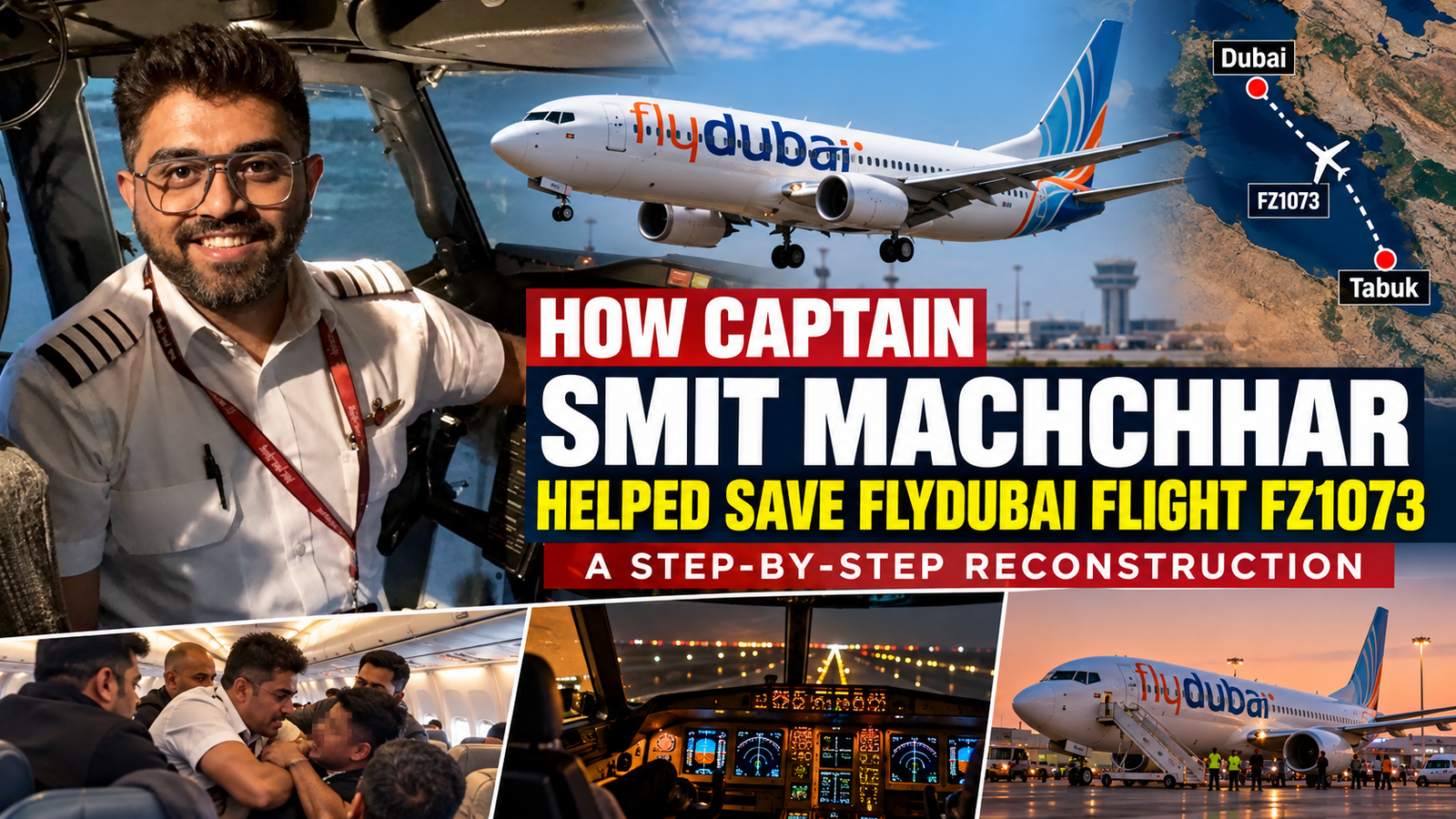
How Captain Smit Machchhar Helped Save Flydubai Flight FZ1073: A Step-by-Step Reconstruction

What began as a routine Flydubai flight from Dubai to Tel Aviv turned into a terrifying fight for survival thousands of feet above the Middle East.
At the centre of the emergency was Captain Smit Machchhar, an Indian pilot who was seriously wounded inside the cockpit but still managed to perform one crucial action that gave everyone else on board a chance to survive.
Flydubai Flight FZ1073 was carrying 174 people when the co-pilot allegedly attacked Machchhar and attempted to force the Boeing 737 into a catastrophic descent. The motive remains under investigation, but the sequence of events is becoming clearer through passenger accounts and official statements.
Here is how the incident unfolded.
1. The Flight Leaves Dubai for Tel Aviv
Flydubai Flight FZ1073 departed Dubai bound for Tel Aviv.
For most passengers, it initially appeared to be a normal commercial flight.
Roughly two hours into the journey, however, the situation inside the cockpit reportedly changed dramatically. According to Israeli officials, the co-pilot attacked Captain Smit Machchhar with a knife.
Passengers in the cabin did not immediately know what was happening.
Some initially thought the violent aircraft movements were caused by severe turbulence.
2. Captain Smit Is Attacked Inside the Cockpit
The confrontation appears to have begun with the co-pilot allegedly stabbing Captain Machchhar.
Machchhar was seriously injured and bleeding.
Israeli officials say the co-pilot then attempted to take control of the aircraft and force it downward.
Within seconds, a cockpit fight had become an emergency involving everyone on board.
The aircraft reportedly began descending at an alarming rate. Reuters said it lost nearly 14,000 feet in less than 30 seconds, while other flight-tracking accounts reported a substantial rapid descent over a slightly longer period.
3. The Aircraft Goes Into a Terrifying Dive
Passengers suddenly felt the aircraft drop.
People screamed.
Parents grabbed their children.
Some passengers later described believing the aircraft was about to crash.
Passenger Adam Polo told CBS News that he hugged his six-year-old son while his wife held their three-year-old daughter, trying to remain calm for the children.
Another passenger described the plane as being almost out of control during the incident.
At this stage, most people in the cabin still did not know exactly what had happened inside the cockpit.
4. Captain Smit Makes the Critical Move
This appears to have been the decisive moment.
Despite being wounded, Captain Machchhar reportedly managed to unlock the cockpit door.
That single action changed the situation.
Modern aircraft cockpits are intentionally designed to be difficult to enter from the cabin for security reasons. If Machchhar had been unable to release the door, passengers and crew may not have been able to intervene.
According to Israel’s Foreign Ministry and Israeli officials, Machchhar managed to open the cockpit even after being stabbed.
That gave people outside the cockpit access to the fight taking place inside.
5. Passengers Rush Toward the Cockpit
Once the cockpit became accessible, several passengers moved forward.
Among them was Israeli passenger Yaniv Hayun, who was travelling with his family.
Hayun later said he ran toward the cockpit after hearing the commotion.
He and several other passengers reportedly entered or reached the cockpit area and confronted the co-pilot.
Another passenger, Asaf Rajuan, was also credited with helping fight and restrain the attacker.
The passengers were no longer simply waiting for the pilots to save them.
They had become part of the rescue.
6. The Co-Pilot Is Overpowered
Several passengers and crew members reportedly fought with the co-pilot and eventually subdued him.
Reuters reported that Hayun and three other Israeli passengers helped overpower the attacker.
Another passenger, Tzvika Manes, reportedly used airline earphones to help tie him down.
The struggle was chaotic.
Video footage from the aftermath showed blood inside the aircraft, while passengers described shouting and confusion around the cockpit.
But the immediate threat was finally under control.
7. A Passenger Helps Pull the Aircraft Out of the Dive
Even after the attacker was restrained, the aircraft itself still had to be stabilized.
According to Hayun’s account, he began pulling back on the aircraft controls while the situation inside the cockpit was being brought under control.
He later said his familiarity with aviation disaster programmes such as Air Crash Investigation gave him some idea of what to do.
This was not the final solution.
The aircraft still needed qualified pilots.
Fortunately, there were additional pilots on board.
8. Two Off-Duty Pilots Take Control
Two Flydubai pilots who were travelling as passengers were reportedly called forward.
Once the co-pilot was restrained, the reserve pilots entered the cockpit and took control of the aircraft.
They stabilized the Boeing 737 and prepared for an emergency diversion.
This was another crucial piece of luck and preparation.
Captain Machchhar was too badly injured to continue flying normally.
Without qualified replacement pilots on the aircraft, the situation could have been far more complicated.
9. Captain Smit Receives Medical Help
While the replacement pilots focused on flying, passengers and medical personnel turned their attention to the wounded captain.
A doctor on board reportedly helped treat Machchhar’s injuries.
Other passengers assisted both with first aid and with maintaining control of the attacker.
The rescue had effectively become a coordinated effort involving:
The injured captain.
Passengers.
Cabin crew.
Doctors.
Off-duty pilots.
Every group played a different role.
10. The Aircraft Diverts to Saudi Arabia
Instead of continuing to Tel Aviv, the pilots diverted the aircraft to Tabuk, Saudi Arabia.
The Boeing 737 landed safely.
All 174 people aboard survived, and no passengers were reported to have suffered serious injuries. Captain Machchhar required hospitalization and surgery for his wounds.
Saudi authorities detained the co-pilot and began questioning him.
The passengers were later transferred and continued their journey to Israel.
Why Captain Smit’s Action Was So Important
It would be inaccurate to say Captain Machchhar saved the aircraft entirely by himself.
The passengers who fought the attacker were essential.
The replacement pilots who landed the aircraft were essential.
The medical personnel and cabin crew were essential.
But Machchhar appears to have performed the action that made the rest possible:
he opened the cockpit door while seriously wounded.
Without that, passengers may never have reached the cockpit in time.
That is why both Indian Prime Minister Narendra Modi and Israeli Prime Minister Benjamin Netanyahu publicly praised him after the incident.
From Mumbai to an International Aviation Hero
Machchhar is originally from Mumbai.
According to Reuters, he initially considered entering his family’s textile business before discovering an interest in aviation at 19.
He later trained in New Zealand, spent more than a decade flying for SpiceJet and joined Flydubai in 2022.
He has accumulated nearly 9,750 flight hours across approximately 15 years of aviation experience.
That experience may have mattered enormously during the few seconds in which he was injured but still able to act.
What Investigators Still Do Not Know
The full motive behind the attack has not yet been conclusively established.
Netanyahu has said the co-pilot appeared to have undergone radical Islamist indoctrination and was suicidal, but investigations by Saudi and UAE authorities are continuing. Israeli intelligence agencies are also examining the incident.
Flydubai has urged against speculation while the investigation remains active.
So while the physical sequence of the emergency is becoming clearer, the reason behind it is still being established.
Conclusion: A Chain of Decisions Saved 174 Lives
The survival of Flydubai Flight FZ1073 was not the result of one dramatic Hollywood-style moment.
It was a chain reaction.
The co-pilot allegedly attacked Captain Smit.
The aircraft began falling.
The wounded captain opened the cockpit.
Passengers rushed forward.
They subdued the attacker.
Someone helped pull back the controls.
Reserve pilots entered the cockpit.
Doctors treated the wounded.
The aircraft landed safely.
And 174 people walked away alive.
Captain Smit Machchhar’s courage stands out because he acted after being seriously injured and at a moment when only seconds may have mattered.
But perhaps the most powerful lesson from Flight FZ1073 is that survival came from people doing what they could, one after another, under extraordinary pressure.
One person opened the door.
Others entered.
Others fought.
Others flew.
And together, they prevented a catastrophe.
Frequently Asked Questions
What exactly did Captain Smit Machchhar do?
After allegedly being stabbed by the co-pilot, Machchhar managed to unlock the cockpit door, allowing passengers and crew to enter and overpower the attacker.
Did Captain Smit land the aircraft?
No. He was seriously injured. Two other Flydubai pilots travelling aboard the aircraft reportedly took control and landed the plane safely in Tabuk, Saudi Arabia.
How many people were saved?
There were 174 people aboard, according to official statements reported by Reuters and CBS.
Who subdued the co-pilot?
Several passengers and crew members reportedly intervened, including Yaniv Hayun, Asaf Rajuan and others.
Is the incident confirmed as terrorism?
Authorities are investigating the motive. Israeli officials have described the alleged attacker as radicalized, but the full investigative findings have not yet been released.
Disclaimer: This reconstruction is based on publicly available reporting and official statements as of October 1, 2026. Investigations into the co-pilot’s motive and the exact sequence inside the cockpit are ongoing, and some details may change as aviation and security authorities release further findings.
