















































Japan Asian Games Mismanagement: Athlete Chaos Raises Questions Over Cost Cutting

Japan has long been associated with punctuality, efficiency and meticulous organisation. However, the chaotic start to the Aichi-Nagoya Asian Games 2026 has seriously challenged that reputation.
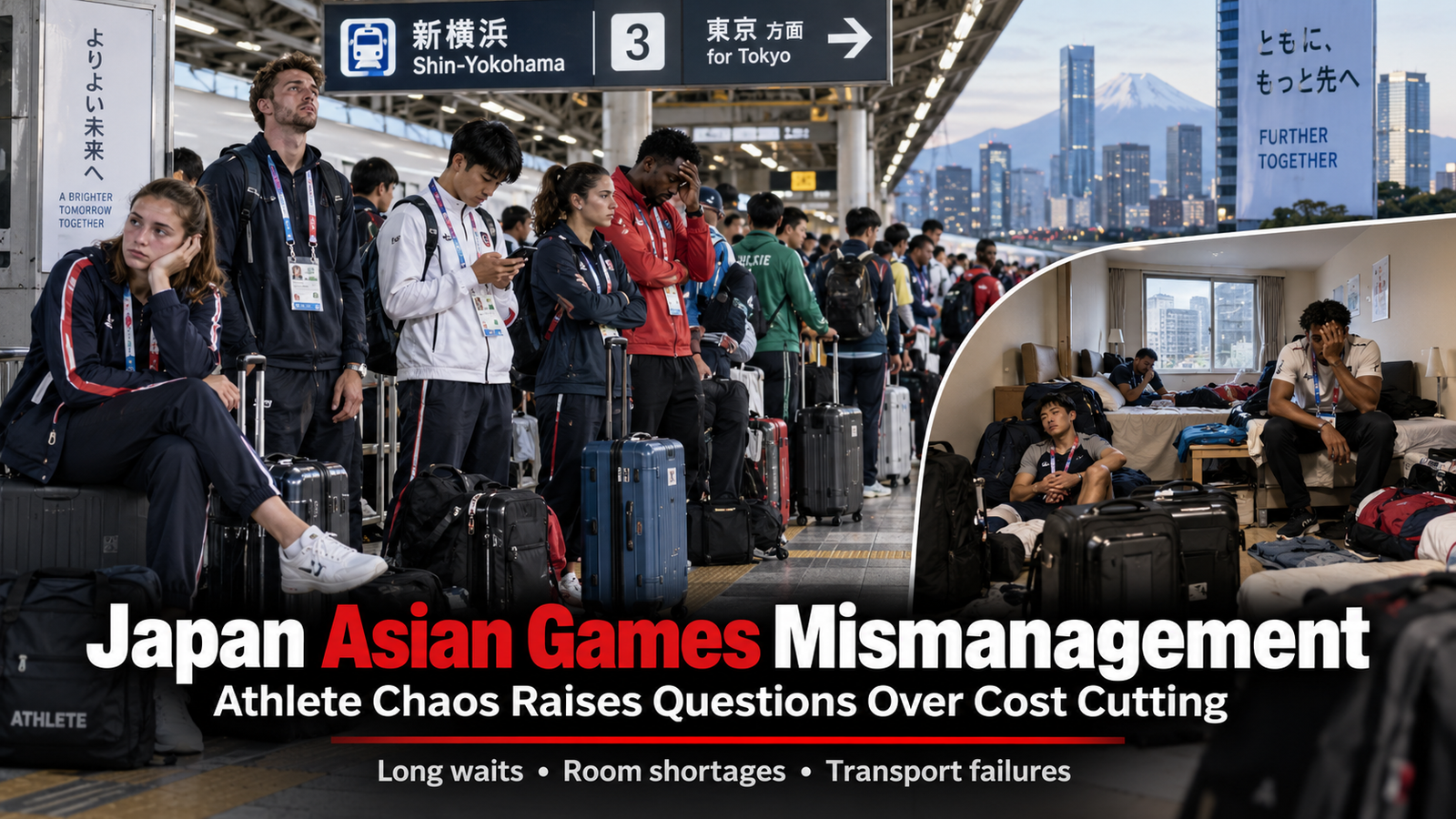
Athletes and officials reported hours-long accommodation delays, overcrowded rooms, transport failures and inadequate arrangements. Some Indian participants were reportedly left waiting for six to ten hours before receiving rooms, with athletes seen resting on floors in an assembly area.
Athletes Waited Hours for Their Rooms
According to The Indian Express, an Indian mixed martial arts athlete waited approximately ten hours for accommodation. After finally entering his room and sleeping for about 30 minutes, two other athletes reportedly arrived because they had been allocated the same room.
Indian wushu coaches and support staff said they waited more than six hours. Some had little more than water and snacks before receiving their rooms late at night.
Reports also described:
- Coaches, athletes and officials being placed together
- Men and women being assigned shared accommodation
- An Indian rower reportedly sharing with an athlete from another delegation
- Cramped rooms and beds unsuitable for taller athletes
- Long journeys between hotels and training facilities
- Delayed or insufficient buses
- Accreditation problems affecting coaches and officials
South Korea’s football team was reportedly transported to a baseball venue instead of the football stadium. Indian shooters faced journeys of up to two hours to reach their training range.
These were not minor inconveniences. Accommodation, food, privacy and reliable transportation directly affect an athlete’s recovery and performance.
Cost Cutting Created a Predictable Risk
The organisers abandoned the original plan for a dedicated Athletes’ Village. Instead, approximately 17,000 athletes and officials were distributed among hotels, temporary container-style cabins and the Costa Serena cruise ship.
The Olympic Council of Asia defended this approach, arguing that a permanent village could become an expensive “white elephant” after the Games. Organisers also said they had initially prepared for around 15,000 participants, but the number increased after additional sports were included.
Avoiding unnecessary construction is sensible. Major sporting events have repeatedly left host cities with expensive and underused buildings. However, sustainability cannot become an excuse for inadequate planning.
If organisers expected 15,000 people but ultimately accepted 17,000, backup rooms, additional staff and faster accreditation systems should have been secured before athletes arrived. Cost efficiency is successful only when essential services continue to function.
Even Team Japan considered moving athletes into backup hotels after room-allocation problems emerged, according to Reuters. That shows the problems were not limited to complaints from foreign delegations.
Would India Have Been Judged More Harshly?
The controversy raises an uncomfortable question about international narratives.
If athletes had slept on floors, waited ten hours for rooms and been transported to the wrong venue at an event hosted by India, would the coverage have described these incidents simply as early logistical difficulties?
More likely, India’s infrastructure, governance and ability to host global events would all have been questioned. Images of exhausted athletes might have been repeatedly presented as evidence of wider national failure.
Japan should not be unfairly attacked, but it should be evaluated by the same standards applied to India and other developing countries. A country’s established reputation for efficiency should not protect its organisers from legitimate scrutiny.
Fair reporting means acknowledging Japan’s failures without exaggeration—and giving India the same fairness when problems occur at Indian events.
Is Japan’s Economy Responsible?
Japan’s economy is not collapsing, but it does face serious structural pressures. Growth remains slow, the population is ageing, public debt is extremely high and rising costs have placed pressure on government budgets.
The IMF projected Japanese economic growth of approximately 0.8% in 2026, while the OECD forecast was even lower. Japan is still one of the world’s largest and wealthiest economies, but its governments must increasingly balance social welfare, debt servicing, infrastructure and security spending.
The Asian Games have also become far more expensive than originally expected. Inflation, the weak yen and rising construction and operating costs encouraged organisers to search for savings. Scrapping the permanent village was one of their biggest cost-control measures.
Therefore, economic pressure probably influenced the cost-conscious approach. But describing the accommodation failures as proof that Japan is becoming poor would be an exaggeration. The stronger explanation is that organisers adopted a risky accommodation model and did not prepare adequately for the final number of participants.
Was Asian Games Money Diverted to Defence?
Japan is unquestionably increasing military expenditure. Its government approved a record defence budget of around ¥9 trillion for fiscal year 2026 as it responds to concerns involving China, North Korea and regional security.
However, there is currently no public evidence that funding intended for the Asian Games was directly transferred to defence.
Japan’s defence budget is primarily a national-government responsibility, while the Games involve the organising committee, Aichi Prefecture, Nagoya city and other stakeholders. Rising defence expenditure may contribute to Japan’s broader fiscal pressures, but that does not prove a direct diversion of money.
The distinction is important. It is reasonable to question national priorities, especially when military spending is rising while athletes face poor facilities. It is not responsible to present an unverified connection as an established fact.
Japan Must Accept Accountability
IOC President Kirsty Coventry subsequently praised some of the accommodation after inspecting the facilities, noting that the modular rooms were air-conditioned and met basic standards. Her assessment deserves to be included, but it does not erase the documented check-in, transport and room-allocation failures.
Japan’s experiment with hotels, cabins and a cruise ship may eventually offer lessons for reducing waste at major sporting events. At the start of these Games, however, the execution fell short.
The real lesson is straightforward: sustainability and cost cutting must never come at the expense of athletes. Japan should be judged fairly, but fairness does not mean silence. It means applying the same standards to Tokyo, Nagoya, Delhi or any other host city.
Frequently Asked Questions
Did athletes wait for more than 12 hours at a Japanese railway station?
Reliable reporting documents waits of approximately six to ten hours in an accommodation assembly area. Some secondary reports claimed longer delays, but the railway-station version has not been reliably established.
Why did Japan not build an Athletes’ Village?
Organisers wanted to control costs and avoid leaving behind an expensive, underused development. Athletes were instead accommodated in hotels, temporary cabins and a cruise ship.
Did Japan divert Asian Games funding to defence?
There is no verified evidence of a direct transfer. Japan has increased defence spending, but the Games and national defence budgets involve different institutions and funding structures.
Disclaimer: This article is based on publicly available reports as of September 20, 2026. It contains editorial analysis and opinion. Claims concerning direct links between Asian Games expenditure, Japan’s economy and defence spending should not be treated as established facts unless confirmed by official financial records.
