

















































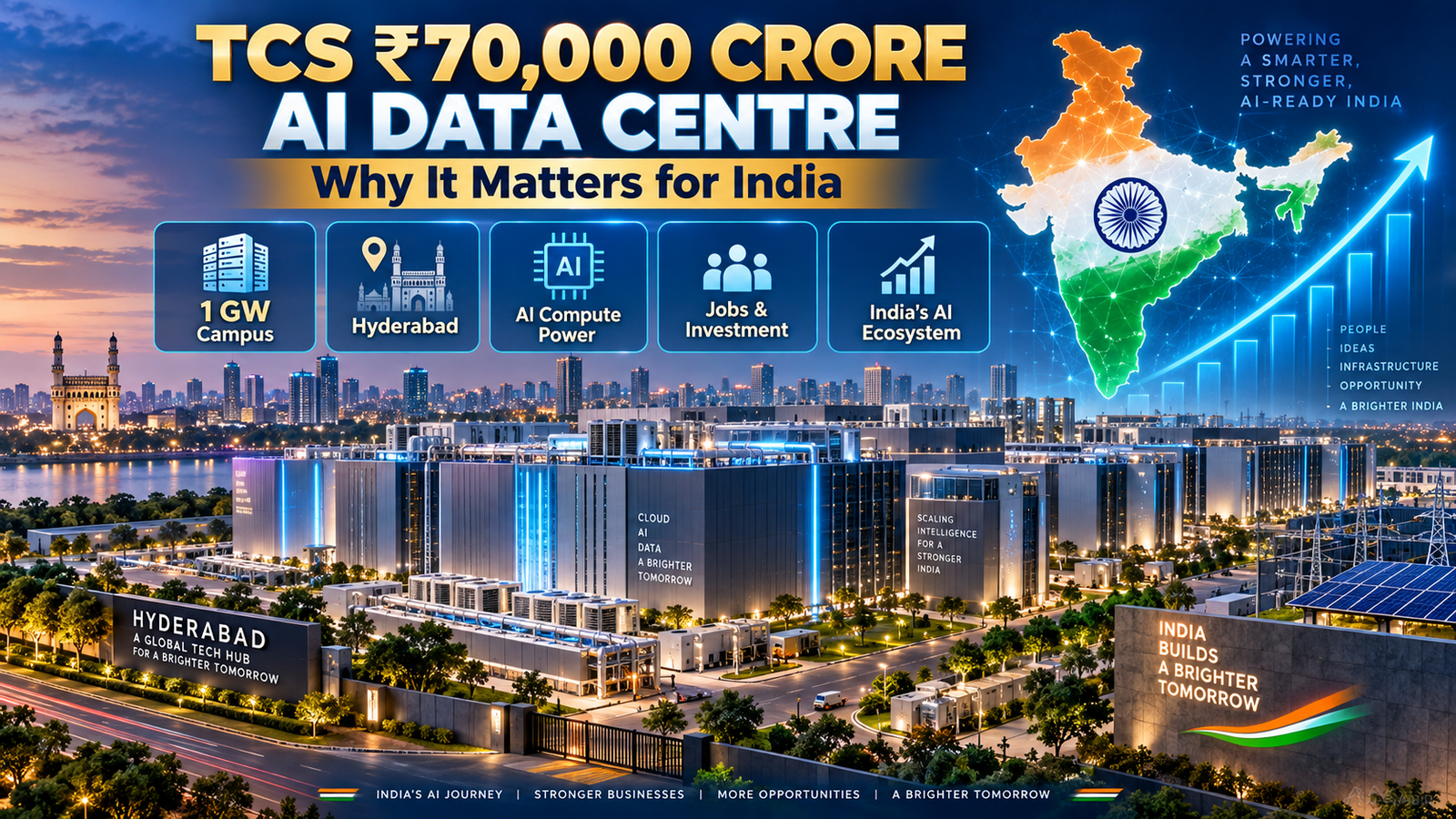

TCS Plans ₹70,000 Crore AI Data Centre in Hyderabad: India’s Next Digital Leap?
India’s artificial-intelligence ambitions have received a major boost. HyperVault, a subsidiary of Tata Consultancy Services, plans to develop a massive AI-ready data-centre campus in Hyderabad with a capacity of up to one gigawatt.
HyperVault and its partners are expected to invest as much as ₹70,000 crore in the project. If fully completed, it could become one of India’s largest and most advanced AI-computing campuses.
The announcement is important because the global AI race is no longer only about software. Countries also need powerful data centres, reliable electricity, high-speed networks and thousands of advanced processors to train and operate AI models.
What Has TCS Announced?
According to the official TCS announcement, HyperVault has secured approximately 264 acres of land in Hyderabad for the proposed campus.
The facility will be designed for global technology companies, hyperscalers and businesses requiring high-performance AI computing.
Its main features are expected to include:
- Capacity of up to one gigawatt
- High-density GPU infrastructure
- Direct-to-chip liquid cooling
- Support for AI training and inference
- High-speed network connectivity
- Green-energy integration
- Water-neutral design principles
The campus will be developed in phases, depending on customer demand and changing technology requirements.
This detail matters: ₹70,000 crore is the potential combined investment by HyperVault and its partners over multiple phases. It is not money that has already been spent or an immediate investment by TCS alone.
Why Is a 1 GW Data Centre Significant?
A one-gigawatt data-centre campus would have access to as much as one billion watts of electrical capacity at full development.
AI infrastructure consumes far more electricity than an ordinary office or conventional server facility. Advanced GPUs must process enormous amounts of data while operating continuously. They also generate substantial heat, requiring specialised cooling systems.
The proposed campus could support thousands of high-performance computing systems used for:
- Training large AI models
- Cloud computing
- Scientific research
- Financial-services applications
- Healthcare technology
- Cybersecurity
- Defence and strategic computing
- Generative AI services
However, the one-gigawatt figure represents the project’s planned maximum capacity. The entire campus will not become operational at once.
Why Hyderabad Was Selected
Hyderabad has emerged as one of India’s leading technology and data-centre destinations. The city already hosts major global cloud, software and digital-services companies.
It offers several advantages:
- A large pool of technology professionals
- Expanding digital infrastructure
- Availability of industrial land
- Support from the Telangana government
- Connectivity to major domestic and international markets
- An established IT and startup ecosystem
TCS chief executive K. Krithivasan said Hyderabad has the scale, talent and supporting ecosystem needed to serve global customers.
The Telangana government expects the project to generate several thousand direct and indirect jobs. These could emerge across construction, electrical engineering, cooling, networking, cybersecurity and data-centre operations.
How the Project Can Strengthen India’s AI Ecosystem
More Computing Capacity Inside India
Indian companies frequently depend on computing infrastructure operated by a small number of global providers.
Building more AI-ready capacity inside India can give startups, research institutions and enterprises better access to domestic computing resources. It can also help organisations process sensitive data within the country.
Support for Sovereign AI
Sovereign AI refers to a country’s ability to develop and operate AI systems using infrastructure governed by its own laws and national priorities.
Domestic data centres can support data localisation, regulatory compliance and greater control over strategic information. This is especially relevant for government services, banking, healthcare and critical infrastructure.
New Opportunities for Indian Businesses
A facility of this scale will require much more than servers. It could create demand for:
- Power and renewable-energy systems
- Cooling equipment
- Fibre-optic networks
- Construction and engineering services
- Cybersecurity solutions
- Cloud-management software
- Maintenance and technical support
The benefits could therefore extend to Indian manufacturers, infrastructure companies and specialised technology firms.
A New Direction for TCS
TCS is primarily known as an information-technology services company. HyperVault allows it to participate more directly in the infrastructure powering the AI economy.
TCS could eventually offer customers a more complete package combining data-centre capacity, cloud services, cybersecurity, AI development and business transformation.
Will It Make India Self-Reliant in AI?
The project can improve India’s control over AI infrastructure, but one data-centre campus cannot make the country completely self-reliant.
India still imports most of the advanced GPUs and semiconductor equipment required for large AI systems. Several networking components, specialised cooling technologies and high-end processors also come from international suppliers.
True AI self-reliance will require progress in multiple areas:
- Domestic semiconductor manufacturing
- Indian-designed AI chips
- Affordable renewable electricity
- Advanced cooling systems
- Cloud and cybersecurity platforms
- Skilled AI engineers and researchers
- Locally developed foundational AI models
The Hyderabad campus can become an important part of that ecosystem, but it is not the entire solution.
Power and Water Will Be Major Challenges
A one-gigawatt data-centre development would require an enormous and dependable power supply. Telangana will need to expand generation, grid connectivity and backup systems without creating pressure on electricity availability for residents and other industries.
TCS says the campus will use green energy and follow water-neutral design principles. These are positive commitments, but their success will depend on the final engineering plan, renewable-energy agreements and transparent measurement.
Liquid cooling can make high-density computing more efficient, but large data centres must still carefully manage heat, electricity and water.
What Happens Next?
HyperVault will build the project gradually as customers sign agreements and demand for AI computing grows.
Important developments to watch include:
- Environmental and construction approvals
- Power-supply agreements
- Renewable-energy arrangements
- The beginning of the first construction phase
- Partnerships with global technology companies
- Confirmed customer commitments
- The number and type of jobs created
The project’s real impact will become clearer once construction begins and HyperVault announces its first major customers.
Conclusion
TCS’s proposed ₹70,000 crore AI data-centre campus could become a landmark project for India’s digital economy.
At full scale, the Hyderabad facility could provide the computing power needed by AI companies, cloud providers, researchers and strategic industries. It could also attract international investment while creating opportunities for Indian technology and infrastructure businesses.
However, the announcement should be understood accurately. The investment is “up to” ₹70,000 crore, will involve HyperVault and its partners, and will be deployed in phases based on demand.
If TCS can secure customers, obtain reliable green energy and manage the facility’s environmental impact, HyperVault could help move India from being a major supplier of IT services to becoming a global centre for AI infrastructure.
Frequently Asked Questions
What is HyperVault?
HyperVault is a TCS subsidiary focused on developing large-scale, AI-ready data-centre infrastructure in India.
How much will the Hyderabad project cost?
HyperVault and its partners expect to invest up to ₹70,000 crore. The amount will be deployed in phases and represents a potential maximum rather than completed spending.
What will be the capacity of the data centre?
The Hyderabad campus is planned to have a maximum capacity of up to one gigawatt when fully developed.
How many jobs will the project create?
TCS says it could generate several thousand direct and indirect jobs. A precise officially confirmed employment figure has not been disclosed.
When will the entire campus be completed?
TCS has not announced a final completion date for the entire campus. Development will take place in phases according to customer demand and technological requirements.
Will the project make India independent of imported AI chips?
No. It will strengthen domestic computing infrastructure, but India will remain dependent on imported advanced GPUs and other technologies unless local semiconductor capabilities also expand.
Disclaimer: This article is based on official company information and credible public reporting available as of September 6, 2026. The ₹70,000 crore investment and one-gigawatt capacity are projected maximum figures for a phased development by HyperVault and its partners. Construction schedules, investment levels, customers, employment and sustainability outcomes may change. This content is intended for news and educational purposes and does not constitute financial or investment advice.
