






























Jaishankar’s Azerbaijan Visit: How India Is Securing a Trade Corridor That Could Transform Its Economy

While headlines focus on wars, tariffs and international political confrontations, India is quietly working on something that could be economically important for decades.
On October 23, External Affairs Minister Dr. S. Jaishankar visited Baku, Azerbaijan, meeting President Ilham Aliyev and Foreign Minister Jeyhun Bayramov.
The discussions covered energy, investment, trade and regional security.
But one issue deserves particular attention:
The International North–South Transport Corridor, or INSTC.
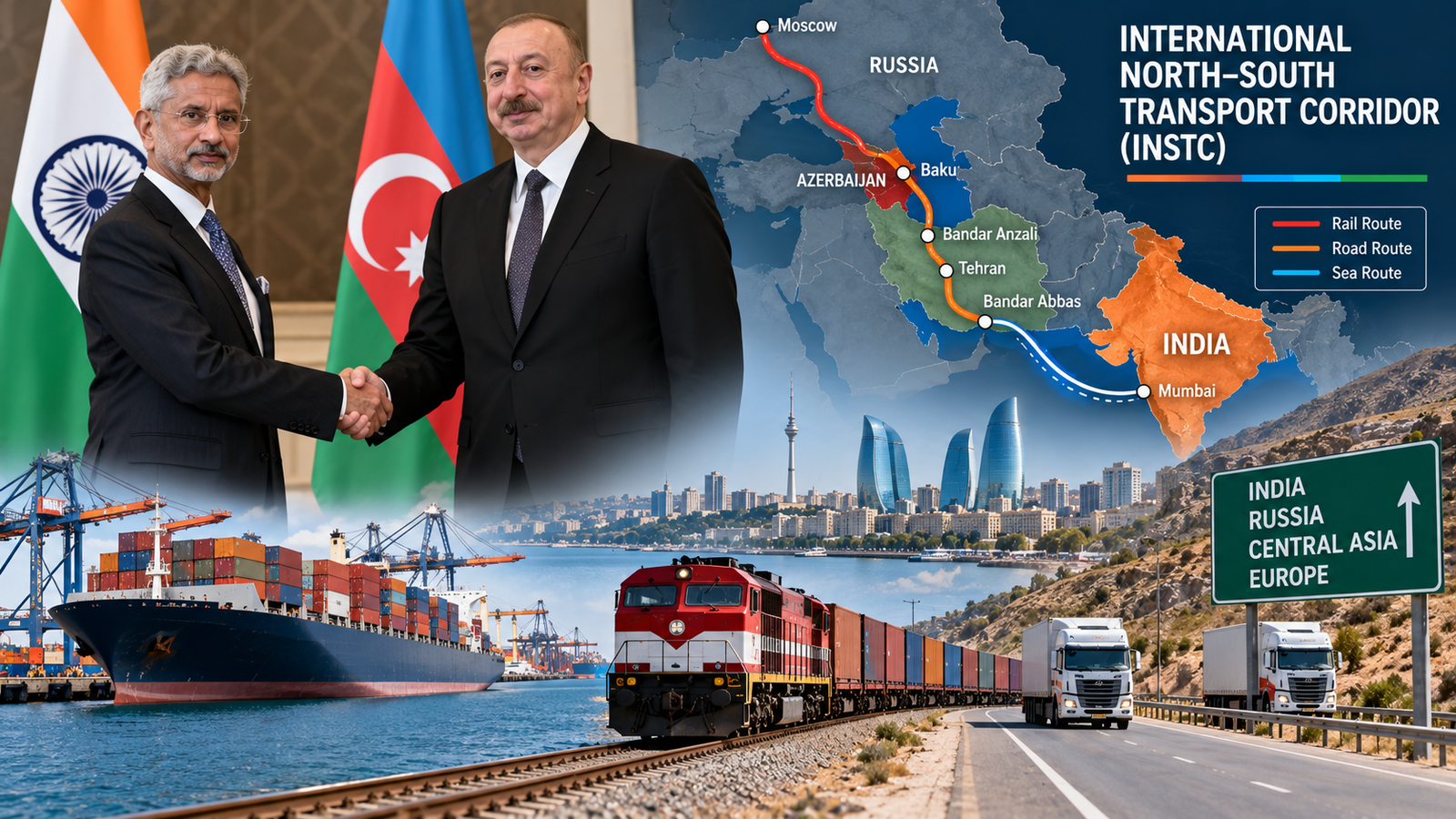
The proposed 7,200-kilometre multimodal network could strengthen India’s access to Russia, Central Asia and parts of Europe through maritime, rail and road connections.
And Azerbaijan occupies a strategically important position along one of its principal routes.
Why Jaishankar Went to Azerbaijan
India and Azerbaijan have experienced significant diplomatic differences.
Baku maintains close relations with Pakistan and Türkiye, while India has developed defence and strategic partnerships with Armenia.
During Operation Sindoor in 2025, Azerbaijan’s position on the India-Pakistan confrontation further strained relations.
However, geopolitics does not always permit countries to remain permanently distant from one another.
Azerbaijan’s location makes it an important partner for Eurasian connectivity.
Jaishankar’s visit—the first standalone bilateral visit by an Indian external affairs minister to Azerbaijan in eight years—therefore represented an effort to rebuild cooperation.
Following talks with Bayramov, Jaishankar described the discussions as productive and confirmed that both countries would coordinate more closely on the INSTC.
Source: The Indian Express — India and Azerbaijan Seek Diplomatic Reset, October 24, 2026
What Is the International North–South Transport Corridor?
Imagine Indian pharmaceutical products manufactured in Gujarat or Maharashtra reaching Russian and Central Asian markets through a combination of sea routes, railways and roads.
The INSTC is designed to make that movement more efficient.
One major western route would operate broadly as follows:
India → Iranian ports → Iran’s transport network → Azerbaijan → Russia → onward markets
Unlike a single railway, the INSTC is a network involving multiple countries and transport modes.
There are also eastern routes through Turkmenistan and Kazakhstan, and maritime connections across the Caspian Sea.
This gives India the prospect of multiple routes into Eurasia rather than dependence on one conventional shipping corridor.
Why This Corridor Matters Economically
Today, many shipments between India and European destinations travel through the Arabian Sea, Red Sea, Suez Canal and Mediterranean.
That is an essential global trade route.
But disruptions in the Red Sea or Suez Canal can force vessels onto much longer voyages around Africa.
The INSTC offers an alternative for suitable cargo.
Historical feasibility assessments have suggested that certain journeys could be approximately 30% cheaper and 40% faster than conventional routes.
However, these are route-specific estimates, not guaranteed savings for every shipment.
Actual commercial performance depends on port handling, railway connections, customs procedures, insurance and freight demand.
Source: Indian Council of World Affairs — Strengthening Eurasian Connectivity Through INSTC
Azerbaijan Is a Critical Link
Look at the geography.
Iran lies south of Azerbaijan.
Russia lies to its north.
Azerbaijan therefore provides a potential land connection between Iranian transport infrastructure and Russia’s wider railway network.
That makes its cooperation especially important to the INSTC’s western branch.
The two foreign ministers discussed the opportunities offered by Azerbaijan’s North–South transport infrastructure, Port of Baku and other logistics facilities.
They also discussed improving air connectivity and expanding trade and investment.
Source: AzerNews — Azerbaijan and India Discuss Expanding Cooperation, October 23, 2026
This is why India’s diplomatic engagement matters.
Even when commercial infrastructure exists, border procedures, political disagreements and poor coordination can prevent efficient trade.
Stronger diplomatic relations can make solving those problems easier.
One Railway Link Could Make a Major Difference
The unfinished Rasht–Astara railway in Iran remains one of the biggest obstacles to seamless movement along the INSTC’s western route.
This missing section is roughly 162 kilometres long.
Its completion would improve railway connectivity between Iran and Azerbaijan.
Without it, certain cargo movements require additional road transfers, handling and logistical coordination.
Those steps add cost and time.
Research from the Observer Research Foundation and other institutions identifies this missing rail link as a major bottleneck.
Therefore, closer India-Azerbaijan cooperation is useful, but it does not by itself complete the corridor.
The infrastructure still has to be delivered.
Source: Observer Research Foundation — INSTC Eastern Corridor: India’s Gateway to Central Asia
Which Indian Industries Could Benefit?
The corridor could create opportunities across several Indian industries.
Pharmaceuticals: India is a major exporter of generic medicines. More reliable logistics could support deliveries into Eurasian markets.
Engineering goods: Indian manufacturers could gain alternative transport routes for machinery, automotive components and industrial equipment.
Textiles and consumer goods: Competitive freight arrangements could improve access to certain markets.
Agricultural products: Faster transport could help some food exporters, although refrigeration, customs and product-specific requirements would remain important.
Energy and industrial inputs: India could diversify how selected commodities and industrial materials move between Eurasia and its domestic economy.
None of these benefits is automatic.
Businesses would need competitive freight rates, reliable shipping schedules, access to banking services and predictable border procedures.
But improving connectivity expands their commercial options.
Could the Corridor Reduce India’s Dependence on the Suez Canal?
For some trade routes, yes.
That is one of the INSTC’s attractions.
India does not need to abandon the Suez Canal.
Instead, it can develop alternative corridors so a disruption in one region does not affect every shipment in the same way.
However, the INSTC is not immune to geopolitical risk.
It passes through Iran and involves routes connected with Russia—two countries affected by significant international sanctions.
Financing, insurance and payments can therefore be complicated.
Regional conflicts, border disruptions and incomplete infrastructure also create risks.
The objective is greater diversification, not replacing one vulnerable route with another.
The Armenia-Azerbaijan Dimension
India’s relationship with Armenia is another important part of this diplomatic story.
Armenia has purchased Indian defence equipment, while Azerbaijan has cultivated close security ties with Pakistan and Türkiye.
At first glance, this makes closer engagement with Baku politically complicated.
But India can maintain a defence partnership with Armenia while pursuing economic and transport discussions with Azerbaijan.
Jaishankar also welcomed progress toward peace between Armenia and Azerbaijan, emphasizing dialogue and regional stability.
A more stable South Caucasus would support regional logistics and trade investment.
For India, stronger diplomatic engagement across the region could reduce the risk of being excluded from strategically important infrastructure discussions.
Why the Visit Matters During the West Asia Crisis
The wars and instability affecting West Asia have reinforced the importance of resilient supply chains.
Fuel prices, shipping insurance and freight schedules can change quickly when conflict threatens major routes.
India is a large importer of energy and a major exporter of manufactured goods and services.
It therefore benefits from having multiple trade connections.
The INSTC could provide additional access to Russia and Central Asia while supporting India’s broader connectivity strategy.
It also complements other initiatives aimed at improving links between India, the Gulf and Europe.
These routes serve different markets and involve different political and logistical challenges.
Developing more than one option is an important part of long-term economic resilience.
Will INSTC Boost India’s Economy Tremendously?
The corridor has meaningful economic potential.
Lower transport costs could improve the competitiveness of selected Indian exports.
Shorter delivery times could help businesses manage inventory.
Improved access to Eurasian markets could encourage companies to explore new customers.
Better trade connectivity can also support logistics, warehousing, shipping and infrastructure investment.
But no credible assessment can currently establish how much additional Indian GDP Jaishankar’s October visit will generate.
The economic outcome depends on future infrastructure completion, trade volumes, sanctions compliance and actual freight costs.
The opportunity is significant.
The benefits must still be earned through execution.
What India Needs to Do Next
Diplomatic coordination is only the beginning.
To make the INSTC commercially successful, participating countries need to improve border processing, standardize documentation, modernize railway and port facilities and increase cargo reliability.
India also needs practical arrangements for trade payments and insurance that comply with applicable laws.
Most importantly, the corridor requires regular commercial cargo volumes.
A transport corridor becomes economically successful not because governments announce it, but because exporters find it cheaper, faster and more dependable than available alternatives.
That is the next test.
Conclusion: A Quiet Diplomatic Visit With Major Economic Potential
Dr. Jaishankar’s visit to Azerbaijan may not have attracted the attention given to larger diplomatic summits.
Yet its significance should not be underestimated.
India is attempting to improve relations with a country situated along a strategically important Eurasian trade route.
Azerbaijan is seeking closer economic cooperation.
Both countries have agreed to coordinate more closely on the INSTC.
And India is continuing its effort to create alternatives for accessing Russia, Central Asia and other international markets.
The corridor will not transform India’s economy overnight.
It still faces incomplete rail links, infrastructure costs and substantial geopolitical obstacles.
But the strategic logic is clear.
A country with more reliable trade routes has more economic choices.
Those choices can reduce logistical risk, strengthen exporters and improve India’s position in international commerce.
The real achievement will come when diplomatic agreements translate into completed infrastructure and regularly operating freight services.
Jaishankar’s Azerbaijan visit represents one step toward that goal.
And it is a step worth watching.
Frequently Asked Questions
Why did Dr. Jaishankar visit Azerbaijan in October 2026?
He visited Baku on October 23 to improve bilateral relations and discuss trade, investment, energy, connectivity and regional security.
What is the INSTC?
The International North–South Transport Corridor is a roughly 7,200-kilometre multimodal network connecting India with Iran, Russia, Central Asia and onward markets.
How does Azerbaijan help India’s trade?
Azerbaijan provides a potential land-transit connection between Iran and Russia along the INSTC’s western route.
Can INSTC reduce shipping costs?
Historical studies suggest potential savings for some routes, but actual costs depend on cargo type, infrastructure, transit procedures and market conditions.
Is the entire INSTC operational?
Some routes are already handling cargo, but key infrastructure gaps remain, including the Rasht–Astara rail connection.
Will this corridor replace the Suez Canal?
No. It provides an additional route for suitable trade, rather than replacing the Suez Canal’s role in global shipping.
How does the project benefit Indian exporters?
It could provide alternative access to Eurasian markets, shorter delivery times on certain routes and more competitive logistics once infrastructure and operational arrangements improve.
Editorial Disclaimer: This analysis is based on publicly reported diplomatic discussions and research available as of October 24, 2026. India and Azerbaijan agreed to closer INSTC coordination; no completed transport-security agreement or guaranteed economic return from the visit has been publicly established.
