





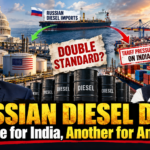
































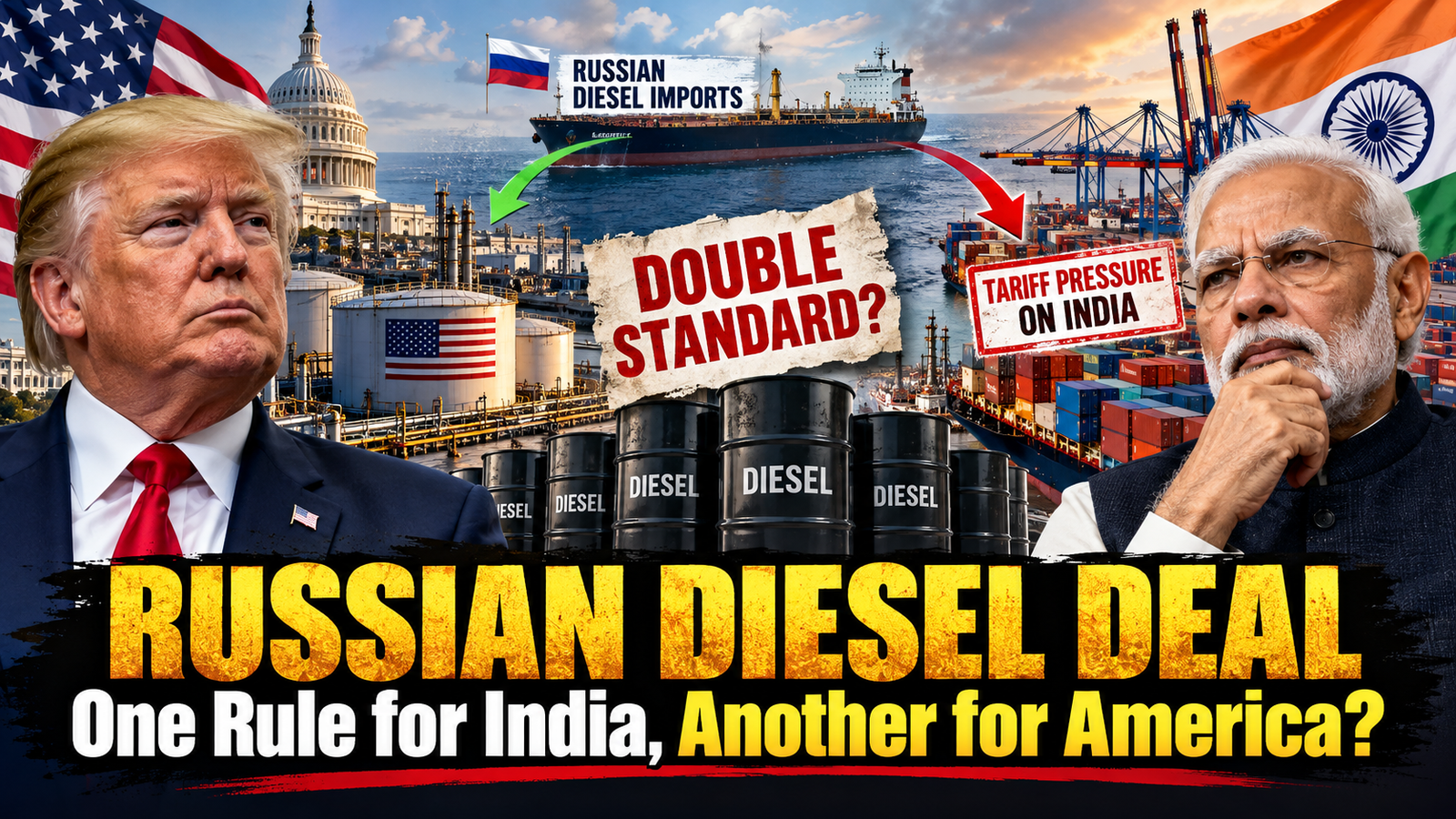
One Rule for India, Another for America? The Russian Diesel Deal Exposes Washington’s Double Standard

For years, Washington has pressured India over its purchases of Russian energy.
Indian crude imports have been criticized as helping finance Moscow’s war in Ukraine.
American lawmakers pushed legislation threatening countries buying Russian oil and gas with enormous tariffs.
India was clearly one of the countries potentially exposed.
Then Washington’s own fuel prices became painful.
And suddenly the principle became flexible.
On October 9, President Donald Trump announced an agreement with Russian President Vladimir Putin under which Russia would immediately make more than 300,000 metric tonnes of diesel available to the United States and global markets, followed by substantially larger quantities.
The US Treasury simultaneously issued General License 135, explicitly authorizing transactions involving the sale, delivery, offloading and importation of diesel fuel of Russian Federation origin.
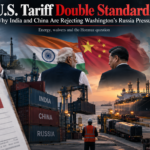
The contrast with Washington’s treatment of India is difficult to ignore.
Just Weeks Earlier, Washington Passed the Graham Sanctions Law
On September 18, Trump signed the Lindsey O. Graham Sanctioning Russia and Iran Act of 2026.
The legislation was intended to reduce Russia’s ability to finance its war in Ukraine.
Among its most consequential provisions is authority for tariffs of up to 100% on goods from major countries purchasing Russian oil or gas.
India, one of the world’s largest buyers of Russian crude, is among the economies potentially affected by those provisions.
The message appeared straightforward:
Buying Russian energy helps Moscow.
Countries continuing to do so may face economic punishment.
Three weeks later, Washington itself decided Russian diesel was acceptable when American fuel prices became politically and economically uncomfortable.
Critics are understandably calling that a double standard.
Why Is America Turning to Russia?
The explanation is not complicated.
America needs cheaper diesel.
US diesel prices have risen sharply amid disruptions to global refining capacity and the continuing Gulf conflict.
Reuters reported that Trump reached the arrangement with Putin specifically as his administration sought to bring fuel prices down before the November 3 congressional elections.
The Treasury therefore temporarily relaxed restrictions that had prevented Russian diesel from entering the American market.
In other words, Washington made the same calculation India has repeatedly defended:
energy security matters.
India purchases Russian crude partly because discounted barrels help control its enormous energy-import bill.
India imports the majority of the crude oil it consumes.
Expensive energy feeds directly into:
transportation costs,
food prices,
manufacturing costs,
inflation,
the rupee,
and household budgets.
When New Delhi explains this, Washington frequently frames the issue around geopolitics.
When American consumers face similar pressure, Washington suddenly emphasizes affordability and energy security.
That contradiction deserves scrutiny.
India Never Claimed It Was Buying Russian Oil as a Favour to Moscow
India’s argument has consistently been based on national interest.
India needs enormous quantities of energy.
Russian crude became available at competitive prices after Western sanctions transformed global oil flows.
Indian refiners bought it.
Much of the justification was straightforward economics.
India has also repeatedly argued that keeping Russian crude in the global market prevented international oil prices from climbing even further.
Whether one agrees with India’s policy or not, its logic has been remarkably consistent:
India will buy energy from suppliers that protect Indian economic interests.
Washington’s newest diesel decision suggests the United States ultimately follows the same principle when its own domestic interests are threatened.
The US Has Not Yet Necessarily Received the Diesel
There is one distinction worth making.
As of October 10, Washington has authorized and announced the Russian diesel arrangement, but reporting does not yet establish that all of the announced fuel has physically arrived at US ports.
Trump said more than 300,000 tonnes would be supplied immediately, with additional volumes expected later.
So the accurate statement is that the United States has opened the door to Russian diesel imports and entered a supply arrangement with Moscow.
That alone is politically significant.
Ukraine Is Furious
Ukraine immediately recognized the contradiction.
President Volodymyr Zelenskiy criticized the American decision, arguing that allowing Russia to earn money from petroleum exports amounts to supporting resources that can ultimately help finance Moscow’s war effort.
That is essentially the same argument Western governments previously used against India.
If Russian oil purchased by India contributes money to the Russian economy, Russian diesel purchased through an American-sanctioned arrangement logically raises the same question.
The nationality of the buyer does not change where the revenue ultimately goes.
Washington Even Pressured Ukraine Over Russian Refineries
The situation becomes even more extraordinary.
The United States has reportedly pressured Ukraine to limit attacks on Russian oil-refining infrastructure because those strikes were contributing to global fuel shortages and higher diesel prices.
Trump then negotiated directly with Putin to increase Russian diesel supplies.
From Kyiv’s perspective, this creates an uncomfortable sequence:
Russia attacks Ukraine.
Ukraine attacks infrastructure supporting Russia’s economy.
Higher fuel prices hurt the United States.
Washington pressures Ukraine over those attacks.
Washington then relaxes sanctions so Russian diesel can return to the market.
Whatever strategic justification Washington provides, the episode demonstrates how quickly geopolitical principles can bend when domestic economic interests become sufficiently important.
And India Is Still Facing the Threat of 100% Tariffs
This is where New Delhi has reason to ask difficult questions.
The Graham legislation gives Trump broad authority to impose tariffs of up to 100% against major purchasers of Russian energy.
Reuters reported this week that the new law has become one of the obstacles hanging over the already stalled India-US trade negotiations.
India could therefore theoretically face punitive tariffs for buying Russian crude to protect its energy security—
while the United States grants itself a sanctions waiver so it can obtain Russian diesel to protect American consumers.
If sanctions principles contain exemptions when American national interests require them, India can reasonably argue that its own energy-security requirements deserve recognition as well.
This Is Why India Must Negotiate From National Interest
India should learn an important lesson from this episode.
Major powers rarely conduct foreign policy primarily through morality.
They conduct it through national interest.
The United States does.
China does.
Russia does.
European countries do.
India should too.
When Washington needs sanctions, it uses sanctions.
When Washington needs Russian diesel, it creates an exemption.
When tariffs serve American interests, tariffs become legitimate policy.
When American consumers face higher fuel prices, affordability suddenly becomes the priority.
This is not unique to the United States.
It is how international politics frequently operates.
The mistake would be India pretending otherwise.
India Should Not Accept Unequal Standards
India does not need to abandon its relationship with Washington.
The United States remains an important market, technology partner, investment source and strategic partner.
But partnership does not mean accepting every American policy as morally authoritative.
New Delhi has legitimate interests of its own.
Energy affordability is one of them.
Food security is another.
Access to technology matters.
Protecting Indian exporters matters.
Maintaining strategic autonomy matters.
If Washington expects India to absorb higher energy costs for geopolitical objectives, while exempting itself when American diesel prices become politically damaging, New Delhi has grounds to challenge the consistency of that policy.
The Episode Also Weakens the Sanctions Narrative
Sanctions work partly through credibility.
Countries must believe the rules will be applied consistently.
If powerful countries create exemptions whenever domestic costs become uncomfortable, other governments may increasingly ask why they should bear economic pain that Washington itself will not accept.
That could have consequences beyond India.
Emerging economies across Asia, Africa and Latin America already question whether Western sanctions architecture applies equally to everyone.
The Russian diesel decision could reinforce that skepticism.
Why Strategic Autonomy Matters
India has historically resisted tying itself completely to any major power bloc.
This episode demonstrates why.
Imagine if India had abandoned Russian energy entirely because Washington demanded it.
Indian refiners would have lost a major supplier.
India’s negotiating leverage would have declined.
Then, when American fuel prices surged, Washington itself reopened access to Russian diesel.
That is precisely why strategic autonomy should not be confused with being anti-American or pro-Russian.
It means India retains the freedom to make decisions based on Indian interests.
America Is Entitled to Protect Its Consumers
There is also a fair argument from Washington’s side.
American leaders are responsible for American citizens.
If additional Russian diesel can reduce fuel shortages and lower transportation costs, a US administration can argue that it has a responsibility to act.
That argument is understandable.
But it produces an obvious follow-up question:
Why should India not have the same right?
India has 1.4 billion people.
Higher energy prices affect inflation, transport, agriculture and manufacturing throughout the country.
If national interest justifies flexibility for Washington, India will naturally expect the same principle to apply to New Delhi.
Conclusion: Principles Cannot Change With the Buyer
There is nothing inherently shocking about America purchasing Russian diesel.
Countries make pragmatic decisions.
What deserves scrutiny is demanding sacrifice from other countries while claiming exemptions when the same sacrifice becomes inconvenient at home.
On September 18, Washington enacted legislation capable of imposing tariffs of up to 100% on major purchasers of Russian energy.
On October 9, Washington authorized imports of Russian diesel because American fuel prices had become a serious domestic problem.
Those two decisions were separated by only three weeks.
India should remember that the next time it is lectured about purchasing Russian energy.
The issue is not whether America has the right to protect its national interests.
Of course it does.
The issue is whether Washington acknowledges that India has exactly the same right.
International rules gain credibility when powerful and less-powerful countries are expected to follow comparable standards.
When principles change depending on who needs the oil, countries stop seeing a rules-based system.
They begin seeing power politics.
And India should conduct its foreign policy with that reality clearly in mind.
Frequently Asked Questions
Is the United States buying Russian diesel?
President Trump announced an agreement on October 9 for Russia to supply more than 300,000 tonnes immediately, with additional quantities planned. The US Treasury issued a licence explicitly authorizing transactions involving Russian-origin diesel, including imports.
Did America ban Russian energy?
The United States imposed extensive restrictions on Russian energy following the invasion of Ukraine. The October 2026 Treasury licence temporarily relaxes restrictions specifically involving Russian diesel.
What does the Graham sanctions law say?
The Lindsey O. Graham Sanctioning Russia and Iran Act of 2026, signed September 18, gives the US president authority to impose tariffs of up to 100% on major importers of Russian oil and gas and targets other entities supporting Russian sanctions evasion.
Could India face the 100% tariff?
India is a major purchaser of Russian crude and is among the countries potentially exposed under the law. Actual implementation depends on presidential decisions, statutory criteria and available waivers.
Why does India buy Russian crude?
Russian crude has provided Indian refiners with an additional competitively priced source of oil. India’s large dependence on imported energy makes cost and supply security major economic concerns.
Has Russian diesel already arrived in America?
The United States has authorized the imports and Trump announced an immediate supply agreement, but public reporting available on October 10 does not yet establish that the announced quantities have all physically arrived at US ports.
Disclaimer: This article analyses the consistency of US sanctions and energy policies. References to a “double standard” represent an analytical interpretation based on the contrast between US pressure on major Russian-energy buyers and the October 2026 decision to authorize Russian diesel transactions. The tariff legislation provides substantial presidential discretion, and potential tariffs on India are not equivalent to an automatic 100% tariff on all Indian goods.
