
















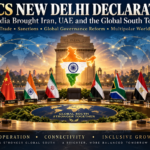






BRICS New Delhi Declaration: How India Brought Iran, UAE and the Global South Together in a New World Order

BRICS New Delhi Declaration: India’s Moment in the New World Order
The BRICS New Delhi Declaration is more than a diplomatic document. It is a signal that the global balance of power is changing.
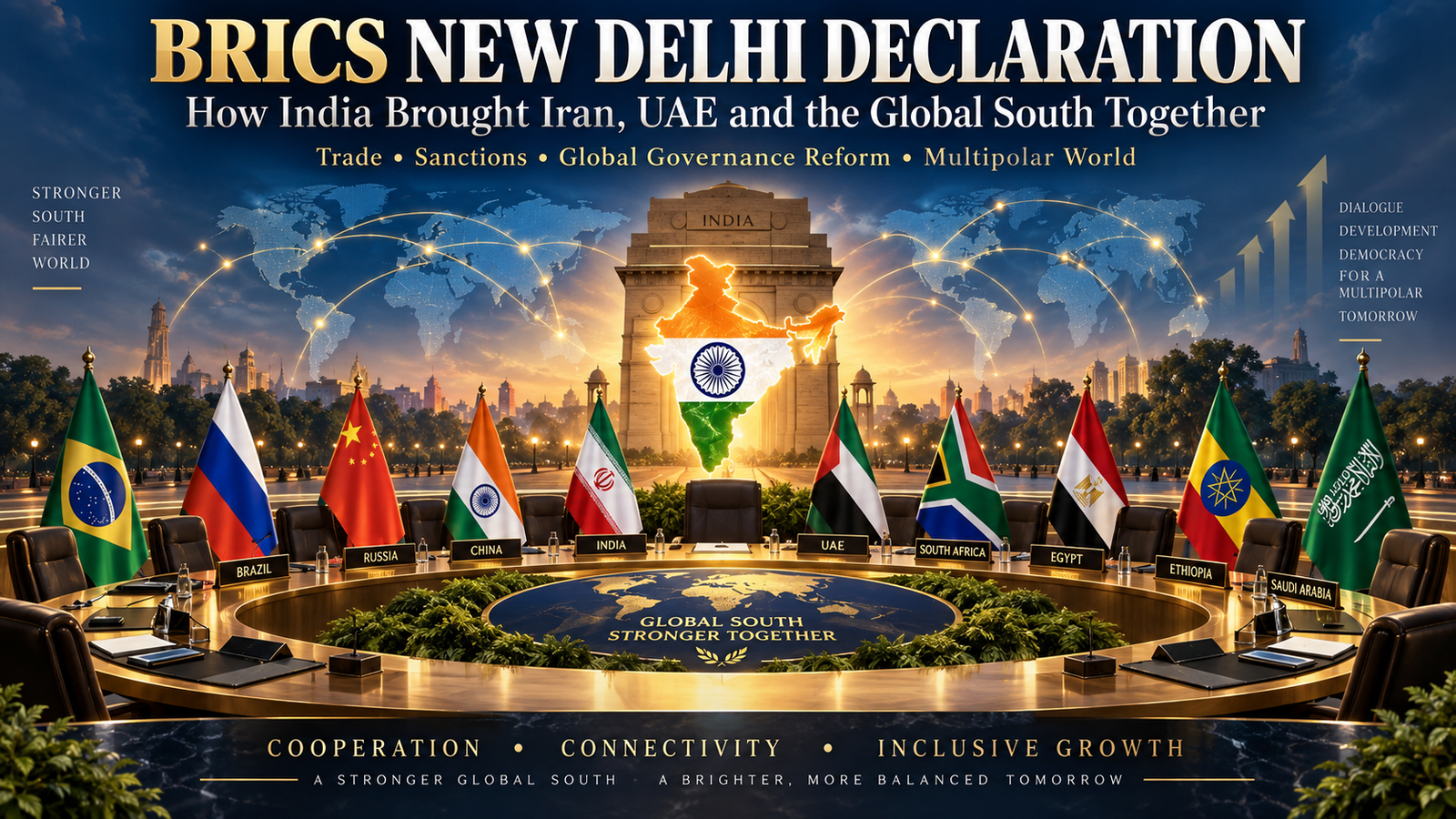
At the 18th BRICS Summit in New Delhi, India managed to bring together countries with very different interests, including Iran, the UAE, Russia, China, Brazil, South Africa, Egypt, Ethiopia and Indonesia. The result was a joint declaration that called for a fairer international order, reform of global institutions, stronger representation for developing countries and opposition to unilateral sanctions not approved by the United Nations.
This matters because BRICS is no longer a small economic grouping. It is becoming a serious platform for the Global South. The New Delhi Declaration shows that countries outside the Western bloc are no longer willing to simply follow rules written by a few powerful nations.
According to Reuters, BRICS adopted the New Delhi Declaration while calling for restraint in the Middle East and expressing concern over unilateral tariff and non-tariff measures. The summit included both Iran and the UAE, making consensus difficult but diplomatically significant. Reuters
Why India’s Role Was Important
India’s biggest achievement was not just hosting the summit. It was managing contradictions.
Iran is under heavy Western sanctions. The UAE is a close partner of the United States and a major Gulf economy. Russia is facing Western sanctions over Ukraine. China has its own rivalry with Washington. Brazil, South Africa, Egypt, Ethiopia and Indonesia each have different economic and strategic priorities.
Bringing all these countries onto one declaration required careful diplomacy.
India did not position BRICS as an anti-West military bloc. Instead, India framed it as a platform for reform, development, trade fairness and respect for national sovereignty. That is India’s diplomatic strength: it can speak with the West, work with Russia, maintain ties with Iran, build strong relations with the Gulf and still lead the Global South.
What the BRICS Declaration Said
The New Delhi Declaration called for a more representative and fairer international order. It supported reform of global governance institutions and greater participation of emerging markets and developing countries.
The declaration also criticized unilateral sanctions and coercive measures that are not approved by the UN Security Council. This is important because many developing nations feel that sanctions are often used as political weapons by powerful countries.
The official declaration states that BRICS members oppose unilateral coercive measures that are contrary to international law and the UN Charter. It also raised concerns about rising tariffs, protectionism and trade restrictions that affect global supply chains. PMO India
This language directly challenges the idea that one country or one bloc should control the rules of global trade and finance.
Iran and UAE in the Same Room: Why It Matters
One of the most important parts of the summit was the presence of Iran and the UAE in the same BRICS framework.
Iran represents resistance to Western pressure and sanctions. The UAE represents a globally connected Gulf economy with strong links to the US, Europe, India and China. These two countries do not always share the same strategic view, especially on West Asian politics.
Yet both were part of the BRICS declaration.
That shows the strength of India’s balancing approach. India has built energy, trade and strategic ties with the UAE while also maintaining civilizational and strategic relations with Iran. For India, both countries are important: the UAE for investment, diaspora and trade; Iran for connectivity, energy security and access to Central Asia through projects like Chabahar.
The declaration’s call for maximum restraint in the Middle East was therefore not a small sentence. It was a diplomatic compromise that allowed different countries to support peace without forcing every member into one rigid position.
Is This the End of US Dominance?
It would be too simplistic to say that US dominance is over. The United States is still the world’s largest military power, a major technology leader and a central player in global finance.
But what is clearly changing is unquestioned US dominance.
Countries are now looking for alternatives. They want more choices in trade, energy, payment systems, supply chains and diplomatic partnerships. BRICS is becoming one of those alternatives.
This does not mean every BRICS country agrees on everything. India and China have border tensions. Russia and China have different long-term goals. Gulf countries balance between the US and Asia. But the common message is clear: the world is moving toward multipolarity.
In simple terms, countries do not want to be forced to choose only one side anymore.
India as a Key Player in the Multipolar World
India is in a unique position.
It is a member of BRICS, the Quad, the G20 and the Shanghai Cooperation Organisation. It buys oil from Russia, has strong defence ties with France and the US, maintains relations with Iran, attracts Gulf investment and competes with China.
This gives India diplomatic flexibility.
The New Delhi Declaration shows that India can act as a bridge between competing worlds. It can talk about Global South concerns without completely breaking with the West. It can support reform of global institutions without presenting itself as a reckless revolutionary power.
That is why India’s role is rising. It is not just joining the new world order. It is helping shape it.
What This Means for the Global South
For developing countries, the BRICS declaration sends a strong message.
The Global South wants fairer trade, better access to finance, more representation in global institutions and less pressure from unilateral sanctions. Many countries believe the current system gives too much power to Western-led institutions.
BRICS is trying to create a platform where emerging economies can negotiate collectively.
This could influence future debates on:
Trade in local currencies
Energy security
Food supply chains
Climate finance
Technology transfer
UN Security Council reform
Alternative payment systems
Development funding
If BRICS becomes more coordinated, it could slowly reduce dependence on Western-dominated financial and trade systems.
The Challenge Ahead
BRICS has influence, but it also has challenges.
The group includes countries with different political systems, economic models and security concerns. Turning declarations into real action will not be easy. BRICS still needs stronger institutions, better coordination and practical mechanisms for trade, payments and investment.
India’s challenge will be to keep BRICS balanced. It must ensure the platform does not become dominated by China or reduced to anti-West symbolism. For India, the best version of BRICS is one that strengthens the Global South while protecting India’s independent foreign policy.
Conclusion
The BRICS New Delhi Declaration is important because it shows where the world is heading.
The old order, where a few Western powers controlled global rules, is being questioned. Countries like India, UAE, Iran, Brazil, Russia, China, South Africa, Egypt, Ethiopia and Indonesia are demanding a larger voice.
India’s success was in bringing different powers together and producing a declaration that spoke about multipolarity, trade fairness, sanctions, reform and peace.
This does not mean the US has disappeared from global power. But it does mean the world is no longer comfortable with one-country dominance.
The new world order is becoming multipolar, and India is positioning itself as one of its most important rule-shapers.
Frequently Asked Questions
What is the BRICS New Delhi Declaration?
The BRICS New Delhi Declaration is the joint statement adopted at the 18th BRICS Summit in New Delhi. It focuses on global governance reform, multipolarity, trade fairness, sustainable development and opposition to unilateral sanctions.
Why is India’s role important in BRICS?
India plays a balancing role. It maintains relations with the West, Russia, Iran, the UAE and the Global South, allowing it to act as a bridge between different geopolitical blocs.
Why are Iran and UAE important in this declaration?
Iran and the UAE represent different strategic positions in West Asia. Their participation in the same BRICS declaration shows India’s ability to manage diplomatic complexity.
Does BRICS challenge US dominance?
BRICS challenges the idea of a US-led unipolar world. However, it does not mean the US is no longer powerful. It means more countries are demanding a multipolar system.
Is BRICS anti-West?
India has presented BRICS as a platform for reform and development, not simply as an anti-West alliance. The focus is on fairer representation, trade balance and Global South priorities.
Disclaimer:
This article is for news and informational purposes only. It is based on publicly available reports and official statements related to the BRICS New Delhi Declaration. Geopolitical developments can change quickly, and readers should refer to official government releases and credible news sources for the latest updates.
