
















































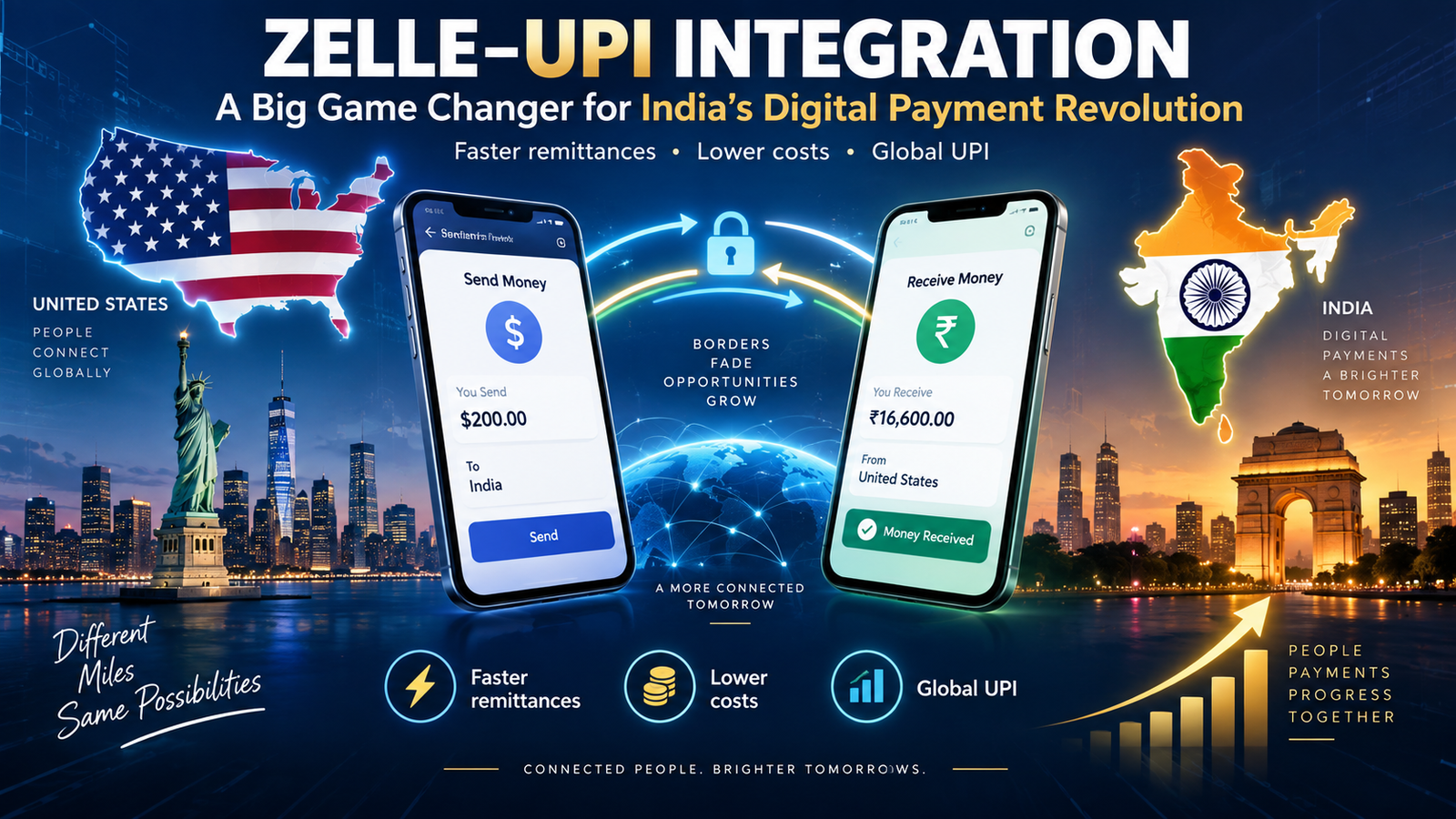
Zelle-UPI Integration: India’s UPI Goes Global With Faster US Remittances

India’s UPI story is no longer limited to paying a tea vendor, splitting a restaurant bill, or scanning a QR code at a local shop. It is now entering a much bigger arena: global payments.
Bank of America is reportedly working with Early Warning Services, the operator of Zelle, on a pilot to link Zelle in the United States with India’s Unified Payments Interface. The proposed bridge would connect two major real-time payment ecosystems and could make India-US remittances faster, simpler and more transparent if launched successfully. Business Standard
This is not just another fintech update. It is a sign that UPI is moving from being India’s domestic digital payment success story to becoming a serious global payment rail.
What Is the Zelle-UPI Integration?
Zelle is one of the most widely used peer-to-peer payment networks in the United States. It allows users to send money directly between bank accounts using a mobile number or email address.
UPI, operated by the National Payments Corporation of India, allows instant payments using a mobile number, QR code or virtual payment address. It has become the backbone of India’s digital economy.
The proposed Zelle-UPI bridge would make it easier for users in the US to send money to India through familiar payment systems. Instead of relying only on traditional remittance channels, users could potentially move funds more quickly through connected real-time payment networks.
Why This Matters for India
The India-US corridor is one of the most important remittance corridors in the world. Millions of Indians live, work or study in the United States. They regularly send money home for family expenses, education, healthcare, investments and property payments.
Today, international transfers can still involve delays, high charges, exchange-rate markups and limited visibility. A Zelle-UPI connection could reduce some of that friction.
If implemented well, it may offer:
Faster transfers between the US and India
Lower transaction costs compared with traditional remittance models
More transparent payment tracking
Better convenience for NRIs and Indian professionals
Stronger use of India’s domestic digital payment infrastructure globally
That is why this development is being seen as a major milestone. It directly connects India’s fintech strength with one of the world’s largest economies.
UPI Is Already Going Global
UPI’s global journey did not begin with Zelle. India has already been expanding UPI through international partnerships.
According to Reuters, Prime Minister Narendra Modi recently said UPI should integrate with payment systems in more countries. UPI is already active in several international markets, including Singapore, UAE, France and Nepal. Reuters also reported that UPI processed 24.51 billion transactions worth ₹29.82 trillion in August 2026 alone. Reuters
Government data also shows the scale of UPI’s growth. As of June 2026, nearly 55.49 crore users were onboarded on UPI, and UPI transaction volume reached 24,161.69 crore in FY 2025-26. PIB
These numbers explain why global financial institutions are paying attention. UPI is no longer an experiment. It is one of the world’s most successful real-time payment systems.
Why Zelle Makes This More Important
Zelle is deeply connected with the US banking ecosystem. Early Warning Services says the Zelle network crossed $1 trillion in payments in 2024, with 151 million enrolled accounts. Early Warning
That makes Zelle different from a small fintech app. It already has scale, trust and bank integration in the American market.
If Zelle and UPI become interoperable, it could create a powerful bridge between the US banking system and India’s instant payment network. For everyday users, the biggest benefit would be simplicity. Sending money to India could become closer to sending money domestically.
A Big Win for NRIs
For NRIs, this could be one of the most practical benefits of UPI’s global expansion.
Many Indians abroad still depend on remittance platforms, bank wires or money-transfer companies. These services work, but they are not always instant or low-cost.
A Zelle-UPI bridge could make payments to India feel more natural. A user in the US may be able to send money through a familiar banking interface, while the receiver in India gets funds through UPI-linked infrastructure.
This can help families, students, small businesses and professionals who regularly move money between the two countries.
What India Gains Strategically
This is not only about convenience. It is also about financial influence.
For decades, global payments have been dominated by Western card networks, correspondent banking systems and international money-transfer companies. India’s UPI offers a different model: low-cost, real-time, mobile-first and bank-linked payments.
If more countries connect with UPI, India gains:
Stronger fintech diplomacy
Greater influence in global payment standards
More efficient remittance flows
Better support for Indian travellers and diaspora
A stronger case for rupee-linked digital payments
This is why UPI’s global expansion should be seen as part of India’s larger digital public infrastructure strategy.
Challenges Ahead
The Zelle-UPI bridge is promising, but it is not risk-free or guaranteed.
Cross-border payments involve strict rules around money laundering, fraud prevention, exchange rates, data protection and consumer protection. US and Indian regulators will need to ensure that the system is safe and compliant.
There are also practical questions:
Who will handle foreign exchange conversion?
What fees will users pay?
How fast will settlement actually be?
Which banks will support the service first?
Will small businesses be included or only retail users?
Until these details are officially confirmed, it is better to treat this as a major pilot, not a fully launched service.
Conclusion
The proposed Zelle-UPI integration could become a turning point for India’s digital payment journey.
UPI has already changed how Indians pay inside India. Now, it is beginning to change how Indians may send and receive money across borders. If the Zelle-UPI bridge succeeds, it could make India-US remittances faster, cheaper and easier for millions of people.
More importantly, it sends a powerful message: UPI is no longer just India’s payment system. It is becoming a global payment network.
Frequently Asked Questions
What is the Zelle-UPI integration?
It is a proposed pilot that would connect Zelle in the US with India’s UPI system for cross-border payments and remittances.
Is Zelle-UPI already launched?
No. Based on current reports, it is being worked on as a pilot. It has not yet become a full public service.
Who will benefit from Zelle-UPI integration?
NRIs, Indian professionals, students, families and small businesses using the India-US payment corridor could benefit if the service launches successfully.
Why is UPI going global?
UPI is fast, low-cost and widely used. India wants to connect it with more countries to support travellers, diaspora payments and international commerce.
Is UPI available outside India?
Yes. UPI has already been linked with payment systems and merchant networks in several countries, including Singapore, UAE, France, Nepal and others.
Disclaimer:
This article is for news and informational purposes only. The Zelle-UPI integration is currently reported as a pilot or proposed payment bridge and has not been fully launched as a public consumer service. Final features, fees, availability, exchange rates, supported banks and timelines may change depending on regulatory approvals, banking partnerships and official announcements. Readers should verify details with official bank, NPCI, Zelle or regulatory sources before making financial decisions.
