














































Zelensky’s Starlink Plea Is a Warning for India: Why Foreign-Controlled Satellite Internet Can Become a National-Security Risk

Ukraine has just given India a lesson in technological dependence that should not be ignored.
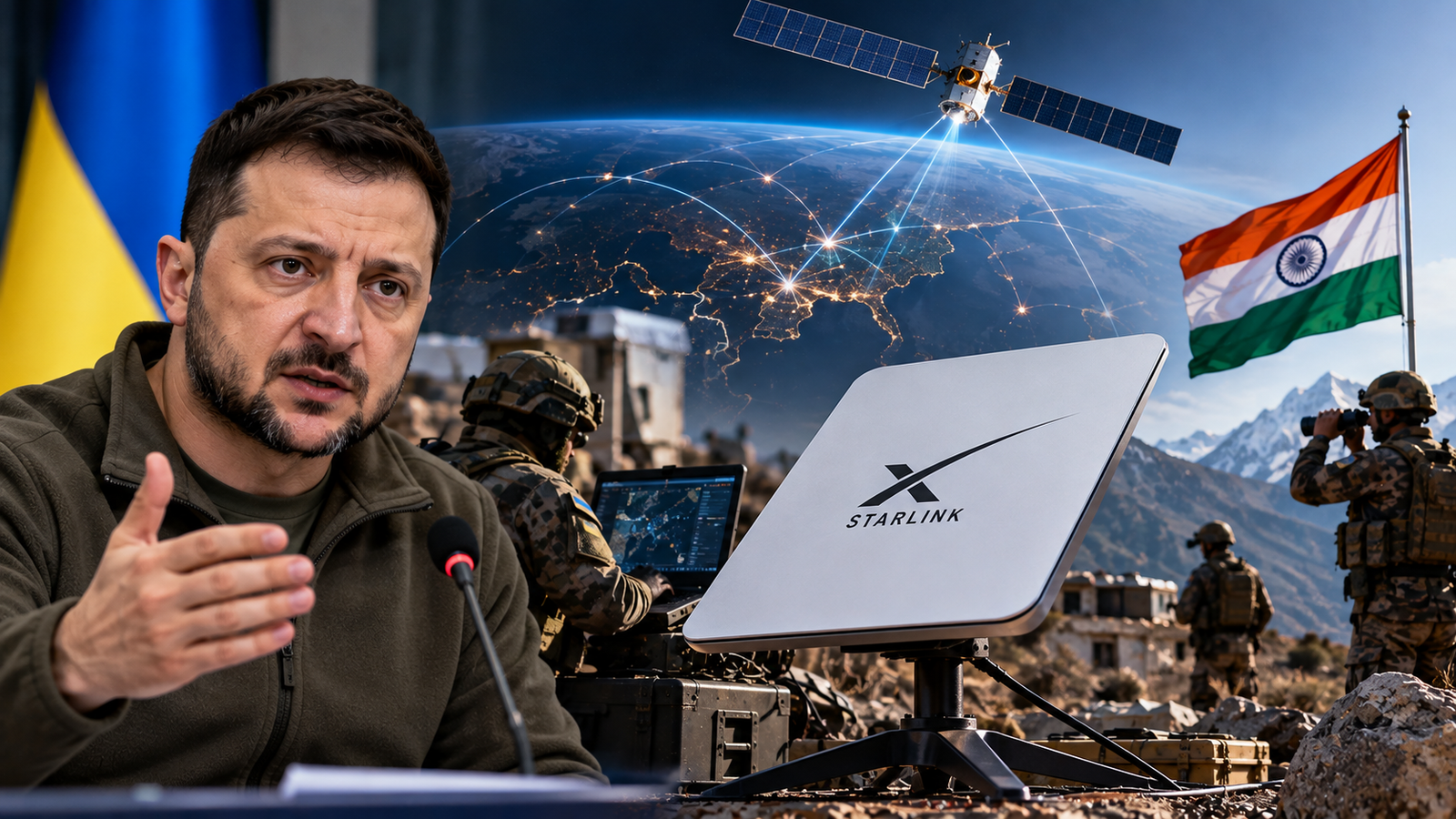
President Volodymyr Zelensky has publicly appealed for the restoration of satellite connectivity after restrictions affected Ukraine’s battlefield communications and drone operations.
Speaking about the disruption, Zelensky warned that the decision could lead to “a lot of human losses” and said Ukraine was asking for the system to be switched back on. (pravda.com.ua)
Ukraine has become heavily dependent on SpaceX satellite systems during its war with Russia.
And now, during one of the most dangerous moments of the conflict, Kyiv has discovered the uncomfortable reality of relying on technology it does not fully control.
For India, the lesson should be obvious:
critical communications infrastructure cannot be treated like an ordinary consumer service.
What Happened in Ukraine?
Ukraine has used SpaceX satellite networks extensively since Russia’s invasion.
Starlink has supported civilian connectivity, while Starshield, the military-focused version, has been used for secure battlefield communications and drone operations.
This week, Ukrainian officials reported that military-grade satellite connectivity had been restricted for terminals moving above certain speeds.
That reportedly affected Ukraine’s ability to operate some drones and conduct battlefield missions. (reuters.com)
The disruption came while Russia was continuing missile and drone attacks against Ukrainian infrastructure.
Zelensky responded publicly.
He said the restrictions were a major mistake and warned that lives could be lost if satellite communications remained unavailable during continued attacks. (abc.net.au)
That is an extraordinary position for the leader of a sovereign country to be in.
A nation at war was effectively asking for access to communications infrastructure controlled outside its borders.
Musk Says the US Government Controls Starshield
This is the most important part of the story.
Elon Musk publicly distinguished civilian Starlink from Starshield.
According to Musk, Starshield systems are owned and controlled by the US government, and decisions involving speed and usage are determined by the US military and ultimately the US president. (reuters.com)
That means the military version of the technology is not simply an independent commercial network.
It is part of a wider US national-security architecture.
Reuters reports that the Pentagon is Starshield’s largest customer and has invested billions of dollars in secure satellite communications, missile-warning systems and reconnaissance capabilities. (reuters.com)
That does not mean civilian Starlink customers are automatically under military control.
But it demonstrates how closely SpaceX’s satellite infrastructure intersects with US strategic interests.
Ukraine’s Problem Is Dependence
The real issue is not Elon Musk personally.
It is not even whether one restriction was technical, military or political.
The issue is structural.
Ukraine became dependent on a foreign communications system.
Once that happened, decisions made outside Ukraine could immediately affect:
drone operations,
battlefield communications,
air defence,
military logistics,
and potentially the safety of Ukrainian soldiers and civilians.
Reuters reported that European officials are now urgently examining alternatives because there is no quick replacement for the American satellite infrastructure Ukraine currently uses. (reuters.com)
That is the real warning for India.
Imagine India in a Future Border Conflict
Now apply the same logic to India.
Imagine that Starlink becomes deeply embedded across India over the next decade.
Remote villages depend on it.
Businesses use it.
Ships use it.
Airlines use it.
Border regions use it.
Emergency agencies use it.
Government departments begin depending on it.
Then India faces a major confrontation with Pakistan or China.
At the same time, Washington disagrees with India’s military strategy.
Would satellite coverage remain unchanged?
Would every terminal continue operating?
Could geographic restrictions be imposed?
Could military use be prohibited?
Would India have an immediate replacement?
Nobody can answer those questions with certainty.
And that uncertainty itself is the national-security problem.
A country cannot discover its communications dependence after a war begins.
Starlink and Starshield Are Different—but the Ecosystem Matters
It is important not to confuse the two systems.
Starlink is primarily a commercial satellite broadband network.
Starshield is designed specifically for government and military users.
But Reuters notes that the two systems rely on related SpaceX satellite infrastructure. (reuters.com)
That matters because the same company operates across civilian communications, military communications, satellite launches and national-security programmes.
India therefore cannot evaluate Starlink only by asking:
“Is the internet fast?”
It must also ask:
Who ultimately controls the infrastructure?
Can access be restricted geographically?
What happens during sanctions or conflict?
Where is sensitive traffic routed?
Can India operate independently if access disappears?
Those are far more important questions.
India Is Already Concerned About the Security Risk
India’s own regulations show that New Delhi understands the problem.
Satellite operators are required to keep gateway, control and network facilities inside India.
Domestic traffic cannot simply be routed abroad.
Providers must also support lawful interception and monitoring.
Most significantly, India’s satellite rules prohibit networks from being used for unauthorised surveillance, electronic warfare or activities that could threaten India’s sovereignty and security. (dot.gov.in)
Those requirements exist for a reason.
Satellite communications are strategic infrastructure.
Starlink Is Still Awaiting Final Security Clearance in India
As of October 2026, Starlink has obtained preliminary Indian authorisations but is still awaiting final security clearances and spectrum-related approvals before full commercial operations can begin.
Reliance Jio’s satellite venture and Bharti-backed services are also awaiting similar regulatory approvals. (reuters.com)
That means India still has time to decide what level of dependence it is willing to tolerate.
The Ukraine episode should become part of that assessment.
This Is Not Just About Spying
Much of the Starlink debate focuses on whether a foreign network could spy on India.
There is no public evidence showing that Starlink is currently conducting espionage against India.
But that is only one possible risk.
The bigger strategic risks are:
Service denial.
Access could theoretically be restricted under certain conditions.
Geographic controls.
Satellite operators can control where and how terminals function.
Technology dependence.
Once millions of users depend on proprietary hardware, replacing the network becomes difficult.
Foreign political leverage.
A government may gain influence when infrastructure vital to another country depends on companies within its jurisdiction.
Emergency vulnerability.
A crisis is the worst possible moment to discover that a critical network requires foreign approval.
Ukraine is now experiencing exactly that dilemma.
Europe Is Learning the Same Lesson
Europe is also beginning to realize that dependence on American satellite infrastructure creates strategic vulnerability.
Following uncertainty around US support for Ukraine, European governments have accelerated efforts to develop sovereign satellite alternatives.
The EU is developing IRIS², while individual countries are pursuing additional secure satellite capabilities.
But Reuters notes that these alternatives will take years to become fully operational. (reuters.com)
Europe waited until dependence became obvious.
India should not make the same mistake.
India Needs Its Own Satellite Network
India already possesses major advantages.
ISRO has world-class launch capability.
Indian private-space companies are expanding rapidly.
Reliance Jio and Bharti have entered satellite communications.
India has enormous telecom engineering capability.
The logical next step is to build a fully sovereign Indian satellite-broadband ecosystem.
That means:
Indian-controlled constellations.
Indian ground stations.
Indian terminals.
Indian encryption.
Indian network-control systems.
Indian launch capability.
And secure government and defence networks that do not depend on foreign permission.
India can still allow foreign companies to compete.
But competition must never become dependence.
Should India Ban Starlink?
The strategic question is more complicated than a simple ban.
Starlink could provide genuine benefits in remote and underserved areas.
Competition could also improve services and reduce prices.
But India should consider strict limits on where foreign-controlled satellite systems can become critical.
For example, sensitive defence communications should have sovereign alternatives.
Border infrastructure should not rely on one foreign provider.
Government emergency networks should maintain independent backup systems.
And India should ensure that domestic companies receive enough opportunities to build scale and compete internationally.
The objective should be:
use foreign technology without becoming hostage to foreign technology.
Ukraine Shows What Happens When the Backup Does Not Exist
Ukraine cannot simply replace Starlink overnight.
Thousands of terminals are already integrated into military operations.
Its drones, communications systems and battlefield processes have adapted around the network.
European substitutes cannot immediately replicate that capability. (reuters.com)
That is precisely how technological dependence develops.
At first, a foreign technology is convenient.
Then it becomes useful.
Then essential.
Then extremely difficult to replace.
By the time the strategic risk becomes obvious, building an alternative may require years.
The Lesson for India Is Bigger Than Starlink
This principle applies to many technologies.
Cloud computing.
Artificial intelligence.
Semiconductors.
Operating systems.
Satellite communications.
Telecommunications equipment.
Cybersecurity.
Defence electronics.
A country aspiring to become a major power cannot permanently depend on foreign companies for every critical layer of its technological infrastructure.
Strategic autonomy in the twenty-first century is increasingly technological.
Conclusion
President Zelensky’s appeal should be studied carefully in New Delhi.
Ukraine is fighting for survival.
Yet a communications system critical to its battlefield operations was restricted, and Ukraine could not simply switch to another provider.
Zelensky publicly warned that people could die.
Musk, meanwhile, said the military Starshield network is controlled by the US government and that usage restrictions are decided by American authorities. (reuters.com)
That is not a conspiracy theory.
It is a real example of how technological dependence can become strategic vulnerability.
India therefore has every reason to scrutinize Starlink extremely carefully.
The question should not be whether Starlink is a good internet service.
It probably is.
The question should be:
Can India afford to build critical communications infrastructure around a system it does not ultimately control?
Ukraine’s experience suggests the answer deserves far more caution than enthusiasm.
India can permit competition.
India can use foreign technology.
But its military, government, emergency services and strategic infrastructure must always have sovereign alternatives.
Because in peacetime, foreign technology looks like convenience.
In wartime, control becomes everything.
And India should never have to plead with another country or corporation to switch its communications back on.
Frequently Asked Questions
What did Zelensky say about Starlink?
Zelensky said restrictions on the satellite service were a major mistake and warned that continued disruption during Russian attacks could lead to significant human losses. (pravda.com.ua)
Was Starlink completely switched off in Ukraine?
No. The latest dispute primarily involved restrictions affecting military-grade Starshield-related services and certain high-speed mobile operations. Services have since begun being restored. (reuters.com)
Does the US government control Starlink?
Commercial Starlink remains a SpaceX service. Musk says Starshield, the military version used by governments, is owned and controlled by the US government, with usage decisions determined by US military authorities. (reuters.com)
Is Starlink currently operating commercially in India?
Starlink has obtained important preliminary licences, but as of October 2026 it is still awaiting final security clearances and related approvals before full commercial deployment. (reuters.com)
Can India impose security restrictions on satellite providers?
Yes. Indian rules require gateways and control infrastructure inside India, lawful-interception capabilities and safeguards against surveillance, electronic warfare and threats to national sovereignty. (dot.gov.in)
Should India rely on Starlink for military communications?
India’s strategic communications would be safer with sovereign systems and multiple independent backups rather than dependence on any single foreign-controlled provider.
Disclaimer: This article analyses risks created by dependence on foreign-controlled satellite infrastructure. Commercial Starlink and military-focused Starshield are distinct services. There is no public evidence that Starlink is currently being used to conduct espionage or destabilisation operations against India.
