
















































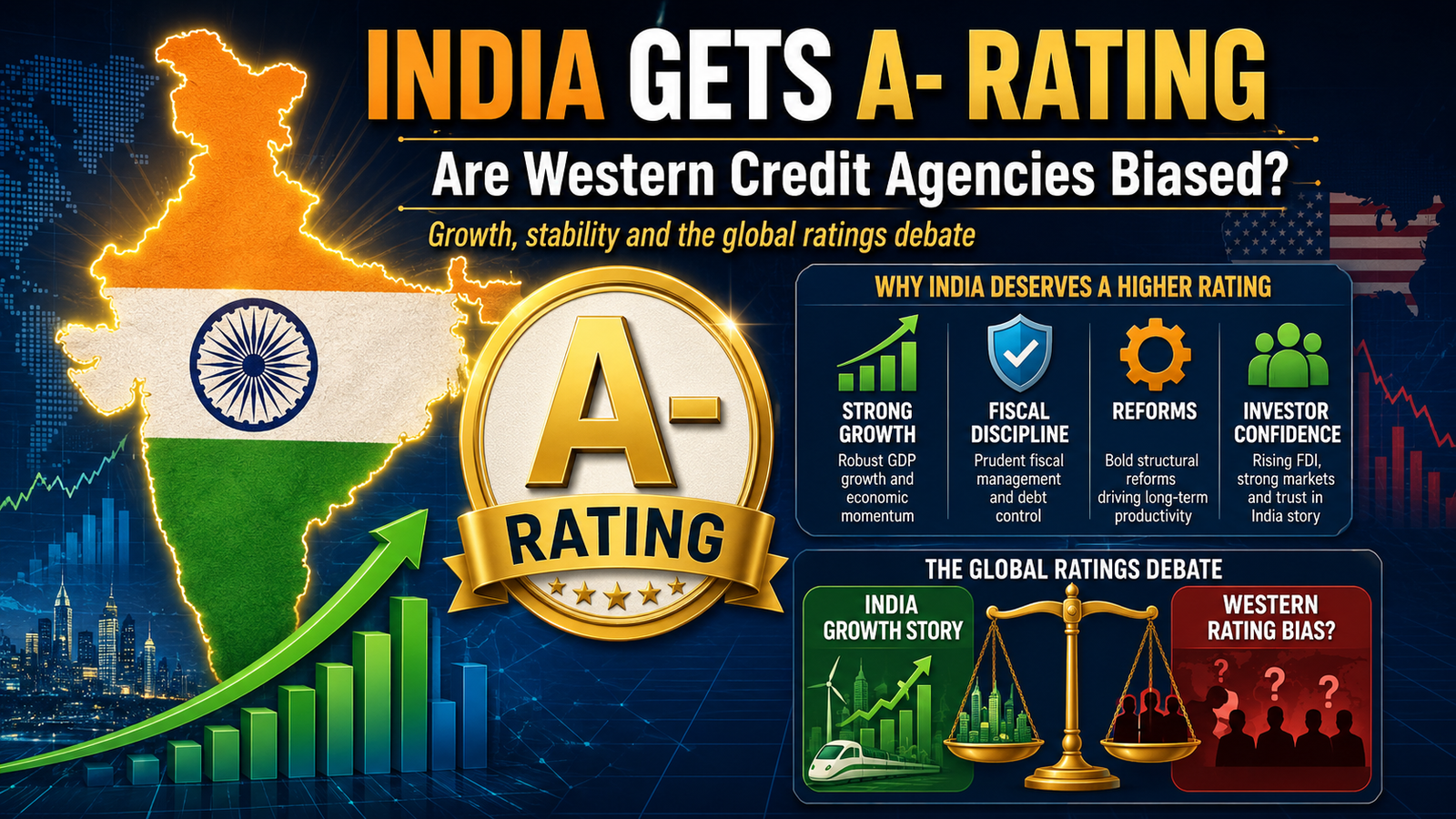

India Gets A- Rating: Are Western Credit Agencies Undervaluing Its Economy?
India has crossed an important financial milestone.
The Japan Credit Rating Agency, or JCR, upgraded India’s long-term foreign- and local-currency sovereign ratings from BBB+ to A-, with a stable outlook, on September 2, 2026.
JCR cited India’s rapid economic growth, strong domestic consumption, public investment, improving banking system and reforms such as GST, digital public infrastructure and the Insolvency and Bankruptcy Code.
The upgrade gives India its first sovereign rating in the “A” category in more than 35 years. It also raises an uncomfortable question: why do the dominant Western rating agencies continue to rate India much lower while assigning the heavily indebted United States a substantially higher grade?
What Does India’s A- Rating Mean?
An A- sovereign rating indicates that a country has a strong capacity to meet its financial obligations, although it may be more exposed to economic changes than countries with AA or AAA ratings.
JCR’s official rating announcement upgraded both India’s foreign- and local-currency ratings by one level and maintained a stable outlook.
The agency highlighted several Indian strengths:
- Economic growth of around 7%
- Strong private consumption
- Continued public infrastructure investment
- Improving financial-sector stability
- Non-performing bank loans falling below 2%
- Large foreign-exchange reserves
- Better tax collection and formalisation through GST
- Digital payments and direct-benefit transfers
India’s 7.8% GDP growth in the latest reported quarter strengthened the argument that its economy remains resilient even during global wars, energy disruptions and trade uncertainty.
How Do Western Agencies Rate India and America?
The three agencies dominating global sovereign ratings are S&P Global, Moody’s and Fitch. Their current assessments show a large difference between India and the United States.
| Rating agency | India | United States |
|---|---|---|
| S&P Global | BBB | AA+ |
| Moody’s | Baa3 | Aa1 |
| Fitch | BBB- | AA+ |
| Japan Credit Rating Agency | A- | Not used here for comparison |
Why Does the United States Still Receive a Higher Rating?
A sovereign rating does not measure which economy is growing faster or which government manages its finances more responsibly. It primarily estimates the probability that a government will fail to repay its debt fully and on time.
America receives several exceptional advantages under that calculation.
The dollar is the leading reserve currency
Central banks, companies and investors around the world need US dollars and Treasury securities.
This creates consistent demand for American debt, even when the US government runs large deficits. No other country currently has a government-bond market with comparable size and global liquidity.
America borrows in its own currency
The United States issues most of its debt in dollars—a currency controlled by its own central bank.
India also borrows predominantly in rupees, but the rupee does not have the same international demand or reserve-currency role.
America’s monetary power reduces the possibility of an involuntary default caused by a shortage of foreign currency. It does not remove inflation or political-default risks, but it gives Washington much greater financial flexibility.
Higher income and stronger revenue capacity
Rating models place substantial weight on per-capita income, institutional history, financial-market depth and the government’s ability to raise taxes.
The United States scores strongly on these indicators despite its deteriorating debt position.
Treasury bonds remain the global benchmark
US government bonds are widely treated as the world’s main “risk-free” financial asset. Banks, pension funds and governments use them for reserves, collateral and regulatory requirements.
Downgrading America too aggressively would therefore have consequences across the financial system. This unique position gives the US a protection that ordinary borrowers do not enjoy.
Why Do Western Agencies Keep India Near BBB?
India’s economic strengths are increasingly difficult to ignore. However, the Big Three continue to focus on several weaknesses.
Fitch recently estimated India’s combined central and state government debt at approximately 84.4% of GDP, compared with a 57% median for countries in the BBB category. It also cited high fiscal deficits, lower GDP per person and governance indicators as rating constraints.
At the same time, Fitch acknowledged India’s rapid growth, macroeconomic stability and strong external buffers. It expects India’s foreign-exchange reserves to reach approximately $733 billion by the end of FY2027. Fitch has nevertheless retained its BBB- rating—the lowest investment-grade level.
S&P upgraded India from BBB- to BBB in August 2025, its first Indian upgrade in 18 years. Moody’s continues to rate India Baa3, also the lowest investment-grade category.
This slow response creates the impression that agencies recognise India’s improvements only after a considerable delay.
Are the Ratings Biased Against India?
JCR’s A- rating does not, by itself, prove deliberate anti-India bias. Different agencies can assign different weights to growth, fiscal debt, reserves, institutional factors and financial-market development.
However, criticism of the Western-dominated system is not baseless.
Research discussed by the Bank for International Settlements has found evidence that high-income countries can receive stronger ratings even after several economic fundamentals are considered. Other studies argue that differences in institutions and default history can explain part of the gap.
The areas creating the greatest credibility concerns include:
Slow recognition of emerging-market improvements
Structural reforms, digitalisation, foreign reserves and stronger banking systems may take years to produce a meaningful upgrade.
Economic deterioration during a crisis can trigger a much faster downgrade.
Heavy reliance on subjective indicators
Ratings incorporate governance, institutional effectiveness and political-risk assessments. These indicators are partly judgement-based and can reflect a Western institutional perspective.
Reserve-currency privilege
Treating dollar dominance as a major credit strength is financially understandable. But it also creates a circular advantage: America receives a high rating partly because investors trust its debt, while investors trust that debt partly because agencies continue to rate it highly.
Limited competition
S&P, Moody’s and Fitch control most of the international ratings market. This concentration gives a small group of private institutions enormous influence over the borrowing costs of entire countries.
JCR’s different conclusion shows that India’s fundamentals can support a substantially higher rating when evaluated through another methodology.
Does the JCR Upgrade Matter?
Yes—but its immediate market effect may be limited.
JCR is influential in Japan and parts of Asia, but it does not have the same global reach as the Big Three. Many international investment funds and regulatory systems rely primarily on S&P, Moody’s and Fitch.
The upgrade could still help India by:
- Increasing confidence among Japanese investors
- Improving the financing environment for Indian companies
- Supporting foreign investment in Indian bonds
- Strengthening India’s case for upgrades from other agencies
- Reducing the perceived risk attached to Indian assets
The most important impact may be reputational. India can now point to an independent international agency that places it firmly inside the A-rated category.
What India Must Still Improve
India should continue challenging questionable rating assumptions, but it should not dismiss every criticism.
The country still needs to:
- Reduce combined central and state government deficits
- Lower its interest burden
- Improve income per person
- Create more productive employment
- Strengthen judicial and regulatory efficiency
- Improve the quality and consistency of official data
- Maintain stable inflation and foreign-exchange reserves
Progress in these areas would make it increasingly difficult for any agency to justify keeping India close to the lowest investment-grade level.
Conclusion
Japan Credit Rating Agency’s decision to upgrade India to A- is a major vote of confidence in the country’s economic transformation.
It also exposes a striking gap. The United States faces debt exceeding 100% of GDP, trillion-dollar deficits and rising interest costs, yet Western agencies continue to rate it many levels above India.
Some of that gap is justified by America’s reserve currency, deep financial markets and ability to borrow in dollars. But those advantages should not become permanent excuses for overlooking fiscal deterioration in developed countries or underestimating progress in emerging economies.
The most balanced conclusion is that rating agencies are not completely ignoring America’s debt—they have removed its AAA status. However, their models appear to give advanced reserve-currency economies considerably more tolerance while demanding years of proof before recognising improvement in countries such as India.
If that gap becomes increasingly disconnected from economic reality, the agencies risk losing the credibility on which their ratings ultimately depend.
Frequently Asked Questions
Which Japanese agency upgraded India to A-?
Japan Credit Rating Agency upgraded India’s long-term foreign- and local-currency sovereign ratings from BBB+ to A- on September 2, 2026.
What is India’s rating from the Big Three?
S&P rates India BBB, while Fitch assigns BBB- and Moody’s assigns the equivalent Baa3 rating.
Why is the US rated higher despite its enormous debt?
The dollar’s reserve-currency status, America’s large economy, deep Treasury market, high income and ability to borrow in its own currency reduce its perceived default risk.
Are Western credit-rating agencies biased?
There is academic evidence supporting concerns about home-country or advanced-economy bias, but the findings are not universal. Differences also reflect income, institutions, currency power, fiscal conditions and default history.
Disclaimer: This article is intended for news, education and public-policy discussion. Sovereign credit ratings are opinions issued by independent agencies and are not guarantees of economic performance or investment safety. The discussion of possible bias represents analysis based on publicly available research and rating methodologies; it does not allege unlawful conduct by any agency. Ratings and economic figures may change after publication. Readers should consult official agency releases before making financial decisions.
