















































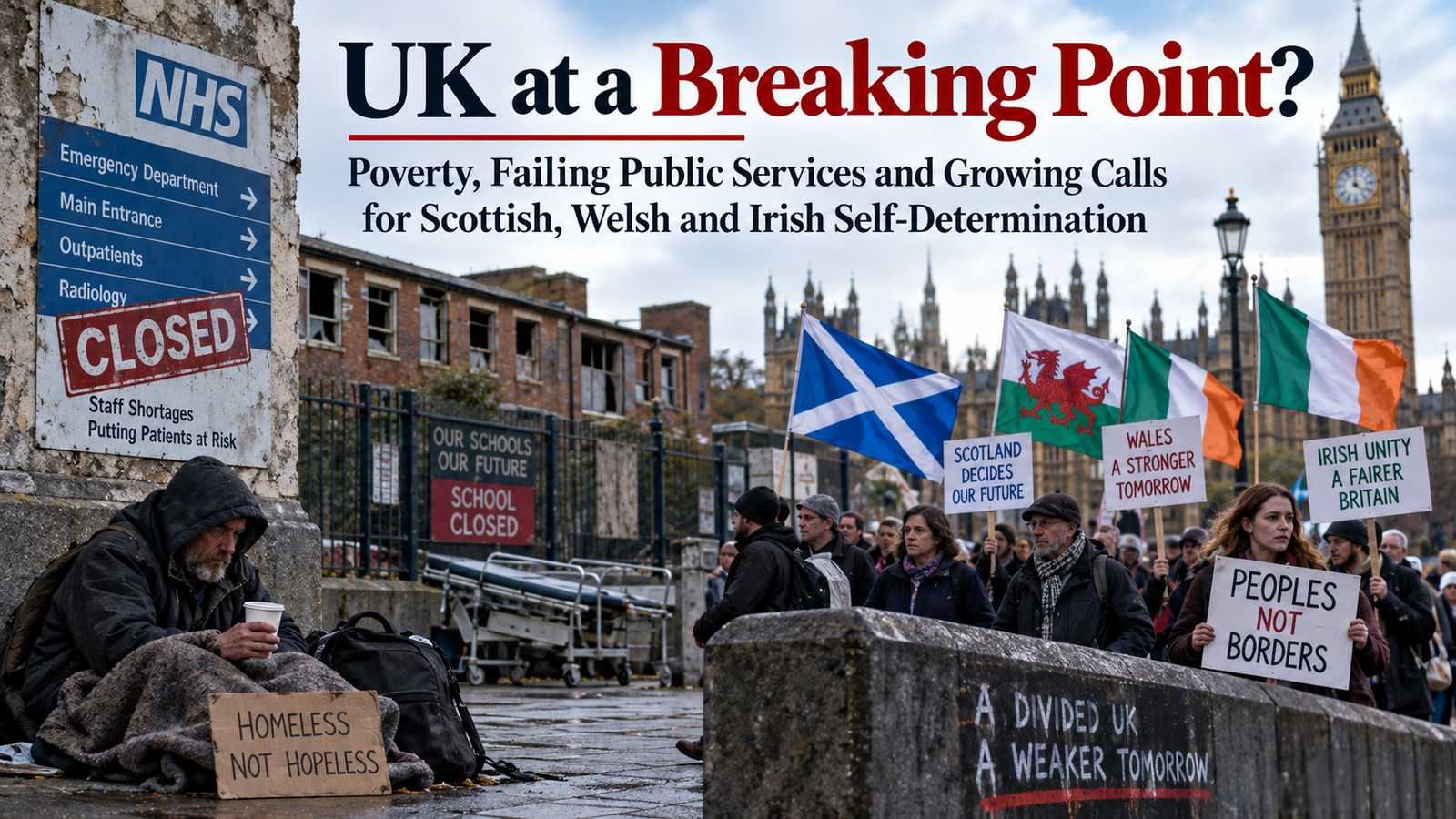
Celtic Leaders’ UK Break-Up Summit: Why Irish Unity and Self-Determination Are Back

Celtic Leaders’ UK Break-Up Summit: Is the United Kingdom Entering a New Era?
The future of the United Kingdom is once again under serious debate.
Leaders from Scotland, Wales and Northern Ireland are expected to meet in Cardiff to affirm their right to seek independence from the UK. According to The Guardian, Plaid Cymru leader Rhun ap Iorwerth, Scottish National Party leader John Swinney and Sinn Féin vice-president Michelle O’Neill are expected to sign a memorandum of understanding calling on Westminster to prepare and facilitate constitutional change in Wales, Scotland and Northern Ireland. Sinn Féin president Mary Lou McDonald is also expected to attend. The Guardian
This is not just another political meeting. It reflects a deeper question: should the UK remain a centralized union, or should its nations be allowed to decide their own future through democratic referendums?
For many in Scotland, Wales and Ireland, the answer is becoming clearer. The people must have the right to choose.
Why This Summit Matters
The Cardiff summit comes at a time when pro-independence parties hold major influence across the Celtic nations. Scotland has long debated independence. Wales has seen rising support for greater self-government. In Northern Ireland, the discussion around Irish unity is becoming more mainstream.
The summit is expected to discuss not only independence, but also Europe, energy, the economy and cooperation between the Celtic nations. That is important because the debate is no longer only emotional or historical. It is increasingly practical.
What would trade look like?
How would energy cooperation work?
What relationship would independent nations have with Europe?
How would a united Ireland function economically and politically?
These questions need planning, not fear.
Why Irish Unity Is Back in Focus
Irish unity is no longer a fringe debate. It is now part of the serious constitutional conversation across Ireland and the UK.
The Good Friday Agreement created a peaceful democratic framework for Northern Ireland’s future. It allows for the possibility of a border poll if it appears likely that a majority would support Irish reunification. That means Irish unity is not about force. It is about consent, democracy and preparation.
Reuters reported that U.S. President Donald Trump recently reiterated support for Irish unity during a visit to Ireland, while Irish Prime Minister Micheál Martin said he supports unity in principle but does not believe a referendum would pass immediately. Reuters
That is the responsible position: support the principle, prepare the details and allow the people to decide.
Why It May Be Time to Prepare for a United Ireland
Ireland was divided more than a century ago. Since then, generations have lived with the political, social and economic consequences of partition.
Today, the situation is different. Ireland is a successful EU member state. Northern Ireland has a younger generation that grew up after the worst years of conflict. Brexit changed the relationship between Northern Ireland, Britain and the Republic of Ireland. Many people now see Irish unity not only as a nationalist dream, but as a practical future that deserves planning.
A united Ireland could offer:
A single economic framework for the island
Closer integration with the European Union
Better long-term planning for infrastructure and healthcare
A clearer identity for people who feel disconnected from Westminster
A peaceful democratic settlement based on consent
However, unity cannot be rushed. Unionist communities must be respected. Their identity, culture, rights and security must be protected in any future arrangement. A united Ireland would only be successful if it is inclusive, not victorious.
Scotland and Wales Are Also Asking Democratic Questions
Scotland voted against independence in 2014, but the issue has not disappeared. Support has remained significant, and Brexit changed the context because Scotland voted strongly to remain in the European Union.
Wales is also changing. Plaid Cymru’s rise has pushed Welsh nationhood into the centre of political debate. Welsh First Minister Rhun ap Iorwerth recently said Westminster must understand that Wales is a nation, “not a region in England,” and argued for stronger devolved powers, including over policing and justice. The Guardian
This is the heart of the issue. If the UK is truly a voluntary union, then its nations must have the democratic right to stay or leave.
Is the Break-Up of the UK Good for Democracy?
A peaceful and democratic separation can be good for democracy if people freely choose it.
The UK often presents itself as a defender of democratic values around the world. But democracy must also apply at home. If Scotland, Wales or Northern Ireland want a referendum, Westminster should not treat that demand as a threat. It should treat it as a democratic question.
A union that survives only because people are denied the right to vote is not a strong union. A strong union must be able to persuade people to stay.
If Westminster believes the UK works, it should make the case openly. If national movements believe independence or Irish unity is better, they should present detailed plans. Then voters should decide.
That is democracy.
No More Ignoring the Celtic Nations
For too long, UK politics has been dominated by Westminster and England-focused debates. Scotland, Wales and Northern Ireland often feel like afterthoughts in decisions made from London.
Brexit made this worse. Scotland and Northern Ireland voted differently from England and Wales, but the final direction was decided by the UK-wide result. That created a feeling that smaller nations can be overruled even on major constitutional questions.
This is why the Cardiff summit matters. It sends a message that the Celtic nations are not passive regions. They are political communities with their own histories, languages, identities and democratic mandates.
The UK’s Future Must Be Chosen, Not Forced
The United Kingdom may survive. It may reform into a looser and fairer union. Or it may gradually separate into independent nations with new partnerships.
But the old model is under pressure.
If Westminster wants to preserve the UK, it must offer more than fear of change. It must offer respect, equality and a serious transfer of power. If it refuses, demands for independence and Irish unity will only grow stronger.
The Cardiff summit is therefore not simply about breaking up the UK. It is about asking whether the UK can still call itself a voluntary union.
Conclusion
The meeting of Irish, Scottish and Welsh leaders marks a turning point in the debate over the UK’s future.
Irish unity deserves serious preparation. Scotland deserves the right to decide its future. Wales deserves to be treated as a nation, not a region. And the people of Northern Ireland deserve a peaceful, democratic choice under the Good Friday Agreement.
The break-up of the UK may sound dramatic, but peaceful self-determination is not chaos. It is democracy.
If the people choose change through lawful referendums, that choice should be respected. The future of these islands should not be decided by fear, nostalgia or Westminster control. It should be decided by the people who live there.
Frequently Asked Questions
What is the Cardiff summit about?
The Cardiff summit is expected to bring together pro-independence leaders from Scotland, Wales and Northern Ireland to discuss self-determination, constitutional change, Europe, energy and cooperation.
Are leaders planning to break up the UK?
They are expected to demand the right to hold democratic referendums on their constitutional futures. Any actual change would require public support and legal processes.
What is Irish unity?
Irish unity means Northern Ireland joining the Republic of Ireland to form one political unit on the island of Ireland. Under the Good Friday Agreement, this can only happen through democratic consent.
Is Scottish independence still possible?
Yes, but it would require a legally recognized referendum or another democratic pathway accepted by Westminster and Scottish voters.
Why is Wales part of this debate?
Wales has seen rising support for greater self-government and independence, especially as Welsh leaders argue that Westminster does not fully respect Wales as a nation.
Disclaimer:
This article is for news and opinion-based informational purposes only. Constitutional change in the UK, including Irish unity, Scottish independence or Welsh independence, would require legal processes, democratic consent and detailed negotiations. Readers should follow official government statements and credible news sources for the latest updates.
