
















































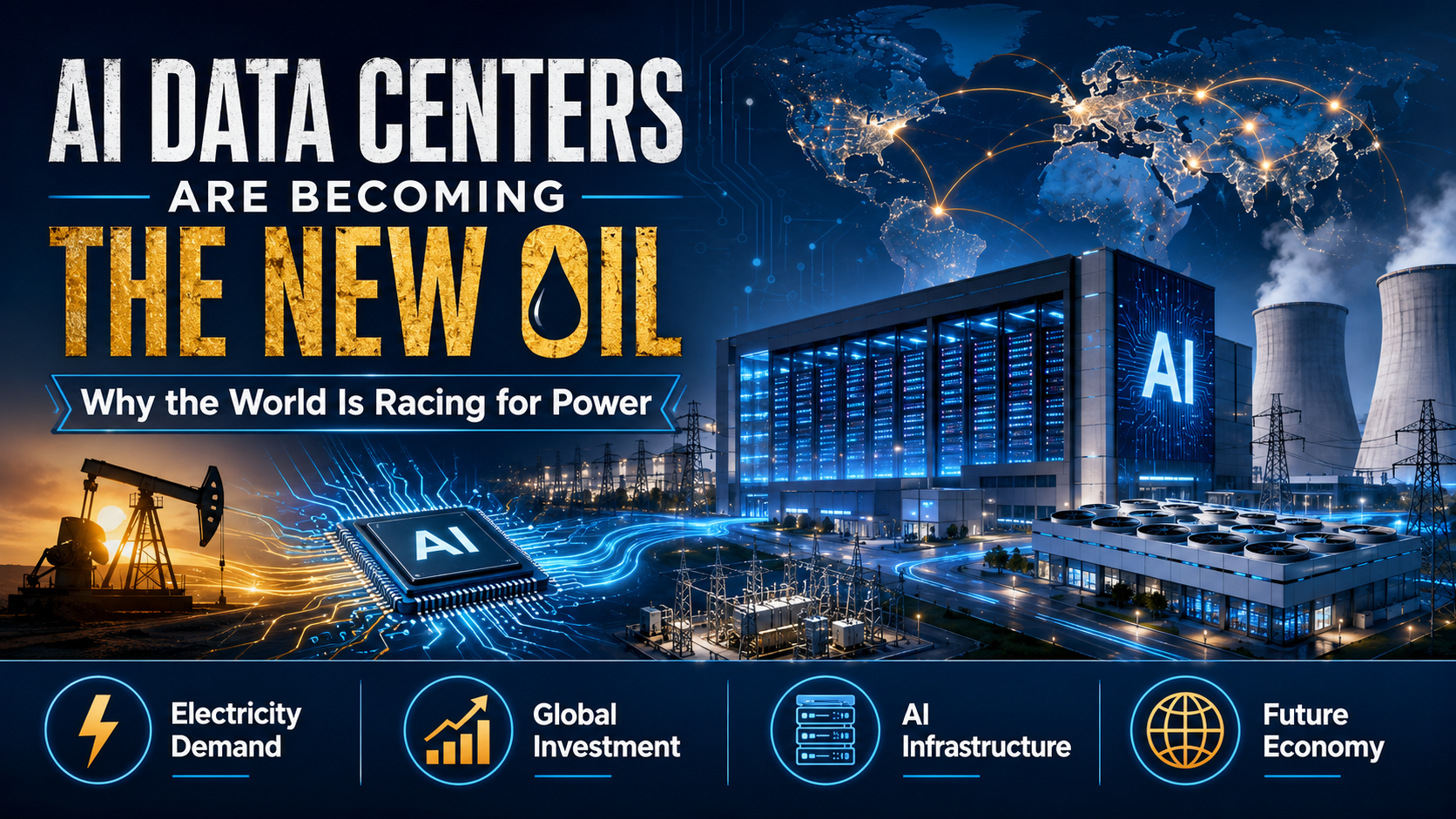
AI Data Centers Are Becoming the New Oil: Why the World Is Racing for Power

Artificial Intelligence is no longer only about chatbots, apps and smart tools. The real battle behind AI is now happening inside massive data centers that need huge amounts of electricity, advanced chips, cooling systems and reliable power supply.
This is why AI data centers have become one of the biggest trending topics in technology and finance. Big Tech companies are spending hundreds of billions of dollars on AI infrastructure, and investors are now asking one key question: when will this spending turn into real profits?
In simple words, AI is becoming the new oil — not because it is fuel, but because the future digital economy may depend on who controls computing power.
The Global Power Demand Is Exploding
The AI boom is creating a new electricity challenge. Reuters reported that U.S. power consumption is expected to hit record highs in 2026 and 2027, driven by AI-hungry data centers and wider electrification. The U.S. Energy Information Administration projected electricity demand to rise from 4,195 billion kWh in 2025 to 4,269 billion kWh in 2026 and 4,399 billion kWh in 2027.
That means AI is not only changing the internet. It is changing the energy grid.
Every AI model needs data centers. Every data center needs power. Every power shortage can delay AI expansion.
This is why energy companies, chipmakers, cloud providers and governments are now part of the same race.
Why Investors Are Watching Closely
The stock market is also becoming more dependent on AI. MarketWatch reported that the current market rally is now being driven more by AI than oil, with investors focusing heavily on AI infrastructure, semiconductors and data centers.
But there is also a risk. If Big Tech keeps spending heavily without showing strong returns, investors may become nervous. Data centers are expensive to build. Chips are costly. Power supply is limited. Cooling requires water and energy. Land availability is also becoming a challenge.
This is why the AI boom is both exciting and risky.
It can create massive growth, but it also needs massive capital.
Data Centers Are Becoming Strategic Assets
Earlier, countries fought for oil fields, ports and manufacturing hubs. Now, they are also competing for data centers, chips and clean electricity.
Reuters reported that electricity demand from U.S. data centers could rise from 31 GW in 2025 to 66 GW in 2027, according to Goldman Sachs research. Developers are even buying power-generation assets to secure electricity for AI computing.
This shows how serious the race has become. AI companies cannot wait years for grid connections. They need power now.
That is why nuclear energy, solar farms, gas plants, battery storage and private power agreements are becoming part of AI strategy.
The Water and Climate Challenge
The AI boom also has an environmental side.
Reuters reported that UN researchers warned AI could double data center power and water consumption by 2030.
This does not mean AI is bad. But it means AI growth must be planned responsibly.
If data centers are built without clean energy, efficient cooling and smart grid planning, the world could face higher emissions, water pressure and electricity shortages.
The next generation of AI will not only be judged by speed and intelligence. It will also be judged by sustainability.
Why This Matters for India
This trend is a huge opportunity for India.
India has a growing digital economy, low-cost engineering talent, rising cloud demand and strong renewable energy capacity. If India builds reliable AI data centers, semiconductor capacity and clean power infrastructure, it can become a major AI infrastructure hub.
But India must avoid one mistake: depending only on foreign cloud providers.
For true digital sovereignty, India needs its own AI compute, Indian data centers, domestic chip partnerships and affordable electricity. This is important for healthcare, defence, fintech, education, agriculture and government services.
AI leadership will not come only from apps. It will come from infrastructure.
Who Will Benefit From This Boom?
The AI data center boom can benefit many sectors:
Chipmakers
Cloud companies
Power producers
Cooling technology firms
Construction companies
Renewable energy developers
Cybersecurity companies
Telecom and fibre network providers
But ordinary users may also feel the impact. If electricity demand rises too fast, power prices and grid pressure could increase in some regions.
That is why governments must plan carefully.
Final Thoughts
AI data centers are becoming the backbone of the next global economy. The world is moving from an internet economy to a compute economy, where electricity, chips and data centers are as important as oil, ports and factories once were.
For investors, this is one of the biggest technology-finance stories of the decade. For countries, it is a national competitiveness issue. For India, it is a major chance to become a global AI infrastructure power.
The future of AI will not be decided only by the smartest algorithm. It will be decided by who has the power — literally.
FAQs
Why are AI data centers trending?
AI data centers are trending because they power artificial intelligence tools, cloud computing, automation and future digital services.
Why do AI data centers need so much electricity?
AI models require powerful chips and servers that run continuously, creating heavy electricity and cooling demand.
Can AI increase electricity prices?
In some regions, rapid data center growth can increase pressure on the power grid, which may affect electricity planning and pricing.
Is this a good opportunity for India?
Yes. India can benefit by building AI data centers, clean power capacity, semiconductor partnerships and sovereign AI infrastructure.
Are AI data centers bad for the environment?
Not always. Their impact depends on energy source, cooling technology, water use and grid planning.
Disclaimer: This article is for informational and educational purposes only. It is not financial, investment or energy policy advice. Readers should verify information from official sources and consult qualified professionals before making financial decisions.