





































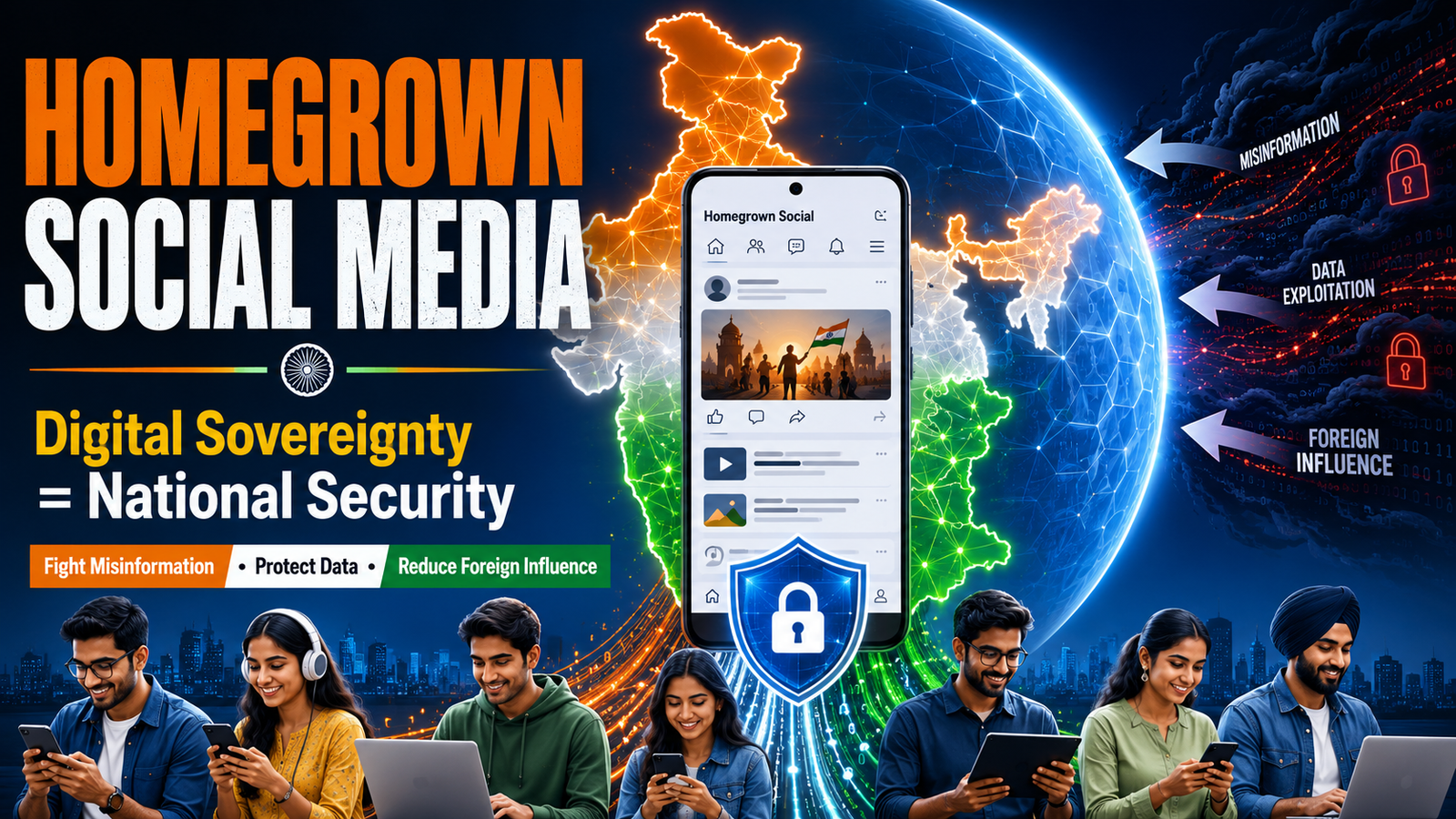
Why India Needs Homegrown Social Media: Digital Sovereignty Is Now National Security

India’s Public Opinion Is Now Controlled by Algorithms
India is one of the world’s biggest digital societies. Millions of Indians now get news, political opinions, social trends and protest updates from Instagram, Facebook, X and YouTube Shorts.
That is powerful — but also dangerous.
DataReportal reported that India had around 500 million active social media user identities in late 2025, showing the massive scale of India’s online population. When so many citizens depend on foreign-owned platforms for information, India’s national conversation becomes vulnerable to algorithmic bias, misinformation, fake news, bot networks, deepfakes and foreign narrative manipulation.
This is why India urgently needs strong homegrown social media platforms.
Foreign Platforms Are Not Neutral Town Squares
Facebook, Instagram, X and YouTube are private companies. Their algorithms decide what goes viral, what gets buried, what trend reaches youth and what outrage dominates the day.
The problem is not that every foreign company is deliberately anti-India. The problem is that India’s public mood is increasingly shaped by systems that are not built in India, not fully transparent to Indian regulators, and not always sensitive to Indian languages, social tensions and security realities.
A fake video in Hindi, Tamil, Bengali, Marathi or Punjabi can go viral within minutes. By the time fact-checkers respond, the damage is already done.
Recently, India’s PIB fact-check unit had to debunk viral AI-generated deepfake videos involving Prime Minister Modi and ministers, with reports saying some were traced to Pakistani handles. This shows how deepfakes and hostile propaganda can enter domestic debates through global platforms.
Misinformation Can Create Real-World Chaos
Social media misinformation is not only an online problem. It can create street anger, panic, communal tension, political confusion and distrust in institutions.
A fake video can trigger a protest.
A manipulated clip can damage a reputation.
A bot campaign can make a fringe idea look popular.
A foreign network can push divisive narratives during elections, protests or national crises.
That is why social media should now be treated as critical information infrastructure.
India cannot allow its democracy to be emotionally hijacked by anonymous accounts, foreign-funded influence networks or unaccountable algorithms.
Government Has Started Acting, But More Is Needed
India already has the IT Rules, 2021, which require social media intermediaries to follow due diligence, appoint grievance officers and respond to lawful takedown orders. PIB says the rules were created because misuse of social media, fake news, morphed images and online harms had become serious concerns.
The government also has powers under Section 69A of the IT Act to block websites, handles and posts in the interest of India’s sovereignty, defence, security and public order. In 2026, the government also strengthened the framework to address synthetically generated information, including deepfakes and AI-generated content.
Now Parliament is also paying attention. Economic Times reported that the Parliamentary Standing Committee on Communications and Information Technology has called Google, Meta, X and Snapchat for a discussion on digital platform regulation.
This is a good start. But India needs a bigger vision.
India Needs a Digital Firewall — But With Indian Democratic Values
Some people say India should copy China’s Great Firewall. China blocks many Western platforms and has built its own domestic digital ecosystem around platforms such as WeChat, Weibo and Douyin. Reports widely note that platforms like Facebook, Instagram, X and YouTube are inaccessible in mainland China without circumvention tools.
India should learn from China’s focus on digital sovereignty, but India should not blindly copy China’s censorship model.
India is a democracy. It needs a constitutional digital firewall, not a closed internet prison.
That means India should build safeguards against foreign interference, deepfakes, bot manipulation, child harm, communal misinformation and unlawful content — while protecting free speech, criticism, satire, journalism and peaceful political debate.
The goal should be security without suffocation.
Why Homegrown Platforms Are the Real Solution
Blocking foreign platforms alone is not enough. India needs alternatives that people actually want to use.
Koo, once promoted as an Indian alternative to X, shut down in 2024 after buyout talks failed. Reports noted that the company struggled with capital, retention and competition from global giants.
That failure teaches an important lesson: patriotism alone cannot build a successful social media platform.
India needs products that are fast, attractive, creator-friendly, multilingual, safe, scalable and profitable. A homegrown Indian platform must support Hindi, English and regional languages properly. It must protect creators. It must prevent spam. It must pay content creators fairly. It must use transparent algorithms. It must give users real appeal rights when accounts are blocked.
People will not shift because of slogans. They will shift if the product is better.
What Policy Should India Follow?
India should create a National Social Media Sovereignty Mission.
First, the government should support Indian social media startups with patient capital, cloud credits, AI moderation tools and public digital infrastructure.
Second, foreign platforms operating in India should be required to publish clearer transparency reports on political content, government takedown requests, algorithmic amplification and deepfake removal.
Third, India should require stronger local-language moderation. A platform with hundreds of millions of Indian users cannot depend on weak moderation for Indian languages.
Fourth, political ads, paid trends, bot networks and foreign-sponsored campaigns should be clearly labelled.
Fifth, deepfake content should be watermarked, traceable and removable quickly during elections, riots, terror attacks and national security crises.
Sixth, Indian user data should be protected under strong data rules, with stricter safeguards for children, elections, financial fraud and identity misuse.
Seventh, public institutions, ministries, schools and government campaigns should gradually support verified Indian platforms so that domestic networks get real adoption.
This Is Bigger Than Social Media
Homegrown social media is not just about apps. It is about national power.
The country that controls the platform controls the trend.
The country that controls the algorithm controls attention.
The country that controls data controls the future economy.
India cannot become a global power while depending completely on foreign apps to shape Indian political emotions, youth debates and cultural identity.
Digital India must also mean Indian-owned digital spaces.
Final Thoughts
India needs Facebook, Instagram, X and YouTube to follow Indian law. But India also needs its own powerful alternatives.
Foreign platforms have given Indians expression, business opportunities and global reach. But they have also become channels for misinformation, deepfakes, foreign influence and social chaos.
The answer is not blind censorship. The answer is digital sovereignty.
India must build strong homegrown social media platforms, regulate foreign platforms firmly, protect free speech responsibly and create a digital firewall against hostile influence.
In the 21st century, national security is not only about borders, missiles and armies.
It is also about data, algorithms and narratives.
If India wants to protect its democracy, youth and social harmony, homegrown social media is no longer optional.
It is the need of the hour.
FAQs
Why does India need homegrown social media?
India needs homegrown social media to protect data, reduce dependence on foreign algorithms, improve Indian-language moderation and strengthen digital sovereignty.
Are Facebook, Instagram, X and YouTube dangerous?
They are useful platforms, but they can also spread misinformation, deepfakes, fake trends and foreign narratives if monitoring is weak.
Should India copy China’s Great Firewall?
India should learn from China’s focus on digital sovereignty, but it should follow a democratic model that protects free speech and lawful criticism.
What should the Indian government do?
The government should support Indian platforms, demand transparency from foreign platforms, regulate deepfakes, label political ads and improve local-language moderation.
Why did Koo fail?
Koo showed that building a homegrown platform is difficult. Indian apps need strong technology, funding, creator incentives, retention and better product design to compete globally.
Disclaimer: This article is for informational and editorial commentary only. It does not claim that every foreign platform, protest, creator or social media user is involved in misinformation or foreign interference. The article supports lawful regulation, digital sovereignty, free speech protections and transparent accountability.