
















































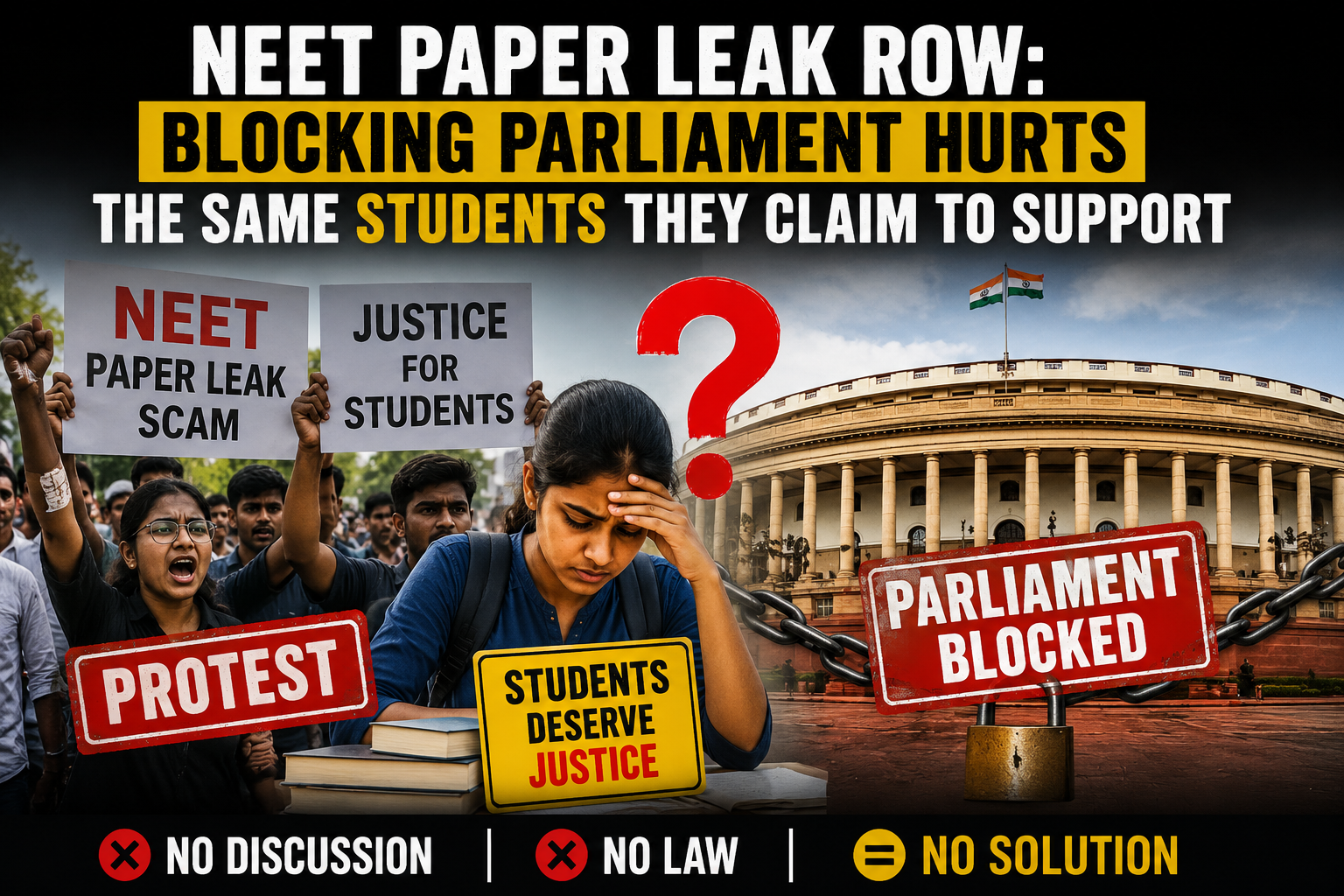
NEET Paper Leak Row: Why Blocking Parliament Hurts the Same Students the Opposition Claims to Support

The NEET Protest Has Exposed a Bigger Question
The NEET paper leak controversy has become one of India’s biggest youth issues of 2026.
Around 2 million students appeared for NEET on May 3, 2026, and the National Testing Agency later scrapped the exam after allegations of leaked questions, according to Reuters. A re-test was held on June 21. The controversy triggered massive youth-led protests, including the Cockroach Janta Party, or CJP, agitation at Jantar Mantar.
Students were angry. Their anger was understandable.
No hardworking student should lose a career opportunity because of paper leaks, organised cheating or exam corruption. In a country where lakhs of families sacrifice money, comfort and sleep for one exam, a leak is not just a technical failure. It is a betrayal of trust.
But now the issue has entered a new phase.
The ruling government has tabled the Public Examinations (Prevention of Unfair Means) Amendment Bill, 2026 to strengthen punishment against exam fraud. Yet Parliament has seen repeated disruptions, with the Opposition demanding discussion on police action against protesters before allowing debate on the Bill.
This raises a serious question: if everyone says they want justice for students, why not allow Parliament to debate the law that directly targets paper leaks?
What the Anti-Paper Leak Bill Proposes
The Bill was introduced in the Lok Sabha on July 27, 2026 by Union Minister Dr. Jitendra Singh. The government says it aims to strengthen the existing 2024 law by adding fast-tracked investigation, Special Fast Track Courts, special public prosecutors, time-bound appeals and tougher penalties.
The proposed punishment for individuals using unfair means increases from three-to-five years to five-to-ten years, while the maximum fine rises from ₹10 lakh to ₹50 lakh. For service providers involved in offences, the proposed fine rises from ₹1 crore to ₹5 crore, and their debarment from public exams rises from four years to eight years.
For organised examination crimes, the minimum imprisonment is proposed to rise to seven years, and the fine to ₹10 crore. The Bill also proposes completion of investigation within two months and trial within three months from the filing of the charge sheet.
In simple words, this Bill directly addresses the problem students are protesting about.
So why delay discussion?
Opposition Protest or Political Contradiction?
The Opposition has demanded urgent discussion on the alleged use of force against NEET protesters. That issue deserves examination. Peaceful protest is a democratic right, and any allegation of excessive police action should be reviewed seriously.
But Parliament cannot become a place where every discussion is blocked until one side gets its preferred political sequence.
The Economic Times reported that the government was ready for a structured discussion on the NEET issue, but the Opposition insisted that the Education Minister must resign first. This led to a stalemate and washed out Rajya Sabha business for the third day.
Later, after Dharmendra Pradhan resigned, the government introduced the anti-paper leak Bill. Yet debate again stalled amid Opposition protests demanding a statement from the Home Minister on alleged police action.
This is where the contradiction becomes visible.
If the goal is student welfare, then Parliament should debate the Bill line by line. If the Bill is weak, expose it. If the Bill needs stronger safeguards, propose amendments. If the government is wrong, challenge it with facts.
But blocking discussion sends the wrong message.
Students Need Reform, Not Only Slogans
The NEET issue is not a one-day political headline. It is a structural problem.
India’s exam system needs secure question paper handling, digital audit trails, stronger cyber protection, transparent exam centres, strict punishment for coaching mafias, quick trials and accountability for officials.
That cannot happen only through street slogans. It needs law, institutions and enforcement.
Reuters reported that Prime Minister Narendra Modi announced a task force led by Nandan Nilekani to overhaul the exam system, and the government introduced a Bill proposing tougher penalties, longer prison terms and higher fines for culprits.
That is exactly the moment when Parliament should function.
Students protested because they wanted change. Now that legislation has been tabled, lawmakers should do their job.
The CJP and the Question of Consistency
The CJP protest became powerful because it claimed to speak for youth accountability. But after Dharmendra Pradhan’s resignation, questions have now shifted to Punjab.
Hindustan Times reported that Punjab Education Minister Harjot Singh Bains is facing calls for resignation from opposition parties in Punjab, including the BJP and SAD, over alleged paper leaks in the state. The same report also noted that Punjab Chief Minister Bhagwant Mann denied the allegations and said there had not been a single paper leak under the AAP government.
This is where CJP’s consistency will be tested.
When CJP spokesperson Saurav Das was asked whether the group had demanded Bains’ resignation too, he said their immediate demand was specifically Dharmendra Pradhan’s accountability. He added that education ministers from any party should be held accountable if they fail to prevent paper leaks.
That statement is important.
If CJP wants to remain credible, it must apply the same standard everywhere — Centre, Punjab, Karnataka, Bihar, Bengal or any other state. Students do not care which party is ruling. They care whether their future is safe.
No political party should be protected from accountability.
Accountability Cannot Be Selective
India must avoid selective outrage.
If a paper leak happens under the central government, questions must be asked. If a paper leak or exam fraud allegation appears in an opposition-ruled state, questions must also be asked.
That is real student politics.
Otherwise, protest becomes political theatre.
The issue is not BJP vs Congress vs AAP. The issue is the future of Indian youth. A poor student preparing for NEET, SSC, UPSC, Railways or state exams does not have the luxury of political games. One leaked paper can waste years of preparation and destroy family savings.
That is why every party should support tough anti-paper leak laws.
Parliament Must Debate, Not Collapse
Democracy needs protest. But democracy also needs Parliament.
The Opposition has every right to criticize police action, demand accountability and ask tough questions. But it also has a responsibility to debate reforms that affect millions of students.
If the Bill is insufficient, improve it.
If penalties are too weak, strengthen them.
If safeguards are missing, add them.
If states need more responsibility, propose it.
If investigation powers need checks, debate them.
That is how Parliament should work.
Blocking the House may create headlines, but debating the Bill can create solutions.
Final Thoughts
The NEET paper leak row has become a turning point in Indian politics.
Students forced the system to respond. The Education Minister resigned. A task force was announced. A stronger anti-paper leak Bill was tabled.
Now Parliament must act.
The Opposition cannot claim to stand with students while refusing to allow discussion on a law meant to protect students. CJP and other protest voices must also prove that their accountability demand is not selective or party-driven.
India’s youth deserve more than slogans, hashtags and disruptions.
They deserve a leak-proof exam system, fast punishment for paper leak mafias, honest accountability across all parties and a Parliament that works.
The real test is not who shouts louder.
The real test is who helps fix the system.
FAQs
What is the anti-paper leak Bill 2026?
It is the Public Examinations (Prevention of Unfair Means) Amendment Bill, 2026, introduced to strengthen punishment, investigation and trial mechanisms for exam fraud and paper leaks.
Why is the Opposition disrupting Parliament?
Opposition parties have demanded urgent discussion and statements over alleged police action against student protesters before taking up the Bill.
Did the government table a Bill on paper leaks?
Yes. The government introduced the Public Examinations Amendment Bill, 2026 in the Lok Sabha on July 27, 2026.
What does the Bill propose?
It proposes tougher penalties, higher fines, Special Task Forces, Special Fast Track Courts, two-month investigations and three-month trial timelines.
Why is Punjab being discussed?
Opposition parties in Punjab have demanded Education Minister Harjot Singh Bains’ resignation over alleged paper leaks, while Punjab Chief Minister Bhagwant Mann has denied the allegations.
Disclaimer: This article is for informational and editorial commentary only. It does not claim that all protesters, opposition parties or student groups are politically motivated. Allegations related to paper leaks, police action and state-level accountability should be investigated through lawful and transparent processes.