















































Temple Graffiti and “Christian Nation” Politics: Is Anti-Hindu Hate Growing in Texas, USA?

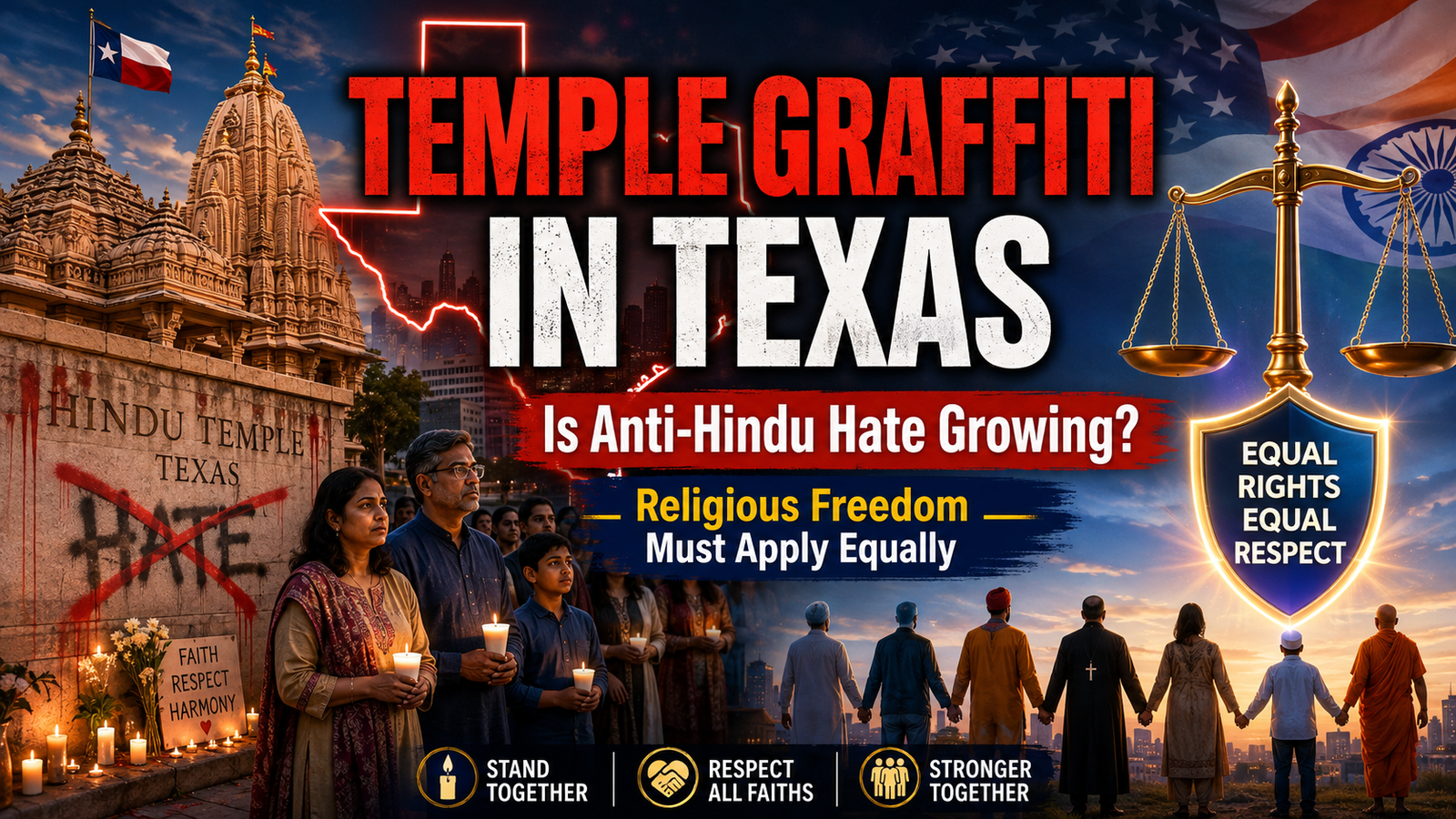
Hindu temples in Texas are meant to be places of prayer, peace and community. Yet several have faced graffiti, hostile demonstrations and increasingly aggressive political rhetoric.
These incidents raise a difficult question: Is a hardline section of the American right becoming openly hostile toward Hindus and Indian Americans?
Texas Temples Have Faced Repeated Hostility
In 2015, vandals painted “666” and an inverted cross on the North Texas Hindu Mandir in Dallas. Temple leaders responded by considering cameras, stronger lighting and fencing, CBS Texas reported.
In 2020, the Shiv Shakti Temple and Shri Nanak Center in Edinburg was defaced with religiously charged graffiti referencing the “Holy Spirit” and “wicked.” A woman was subsequently taken into custody after multiple houses of worship were vandalized.
The evidence does not establish that either crime was organized by a far-right movement. Nevertheless, more recent public rhetoric reveals a troubling ideological pattern.
From Peaceful Worship to an Alleged “Invasion”
In August 2024, approximately 25 members of a church protested outside Sugar Land’s Sri Ashtalakshmi Temple following the inauguration of its 90-foot Hanuman statue.
The protest remained nonviolent, but participants preached that Jesus was the only God and performed actions temple members considered disrespectful. Temple leaders consequently hired security and planned surveillance cameras, according to reporting cited by Hindu Press International.
The rhetoric intensified in 2025 when Republican Senate candidate Alexander Duncan called Hanuman a “false” Hindu deity and described America as a Christian nation. He was widely criticized for disregarding the country’s constitutional commitment to religious liberty.
In February 2026, Texas Republican activist Carlos Turcios circulated a video of Frisco’s Karya Siddhi Hanuman Temple while describing Indian immigrants as “third world aliens” and the temple’s presence as an “invasion,” The Times of India reported.
This language combines anti-immigrant prejudice with hostility toward Hindu worship. A temple built legally by American residents is not an invasion. It is an exercise of religious freedom.
America Is Not Constitutionally a Christian Nation
Americans are free to believe Christianity is the only true faith. They are also free to preach peacefully. However, personal theology cannot decide which communities belong in the United States.
The First Amendment prohibits establishing an official religion while protecting its free exercise. Those protections apply equally to churches, temples, mosques, synagogues and gurdwaras. The US Constitution does not make Hindu freedom conditional upon approval from the religious majority.
The Religious-Freedom Double Standard
Many American Christian organizations conduct missionary and charitable work abroad, including in India. India even maintains a formal Missionary Visa category, although religious activity remains subject to Indian law and regulatory oversight.
There is nothing inherently wrong with peaceful, lawful religious outreach. The hypocrisy begins when someone demands the freedom to promote Christianity in India but becomes offended when Hindus build temples and practise their faith in America.
Religious freedom cannot operate in only one direction.
Final Verdict: Equal Rights Must Mean Equal Respect
The actions of a few activists must not be attributed to all American Christians, conservatives or Republicans. Numerous Christians and political leaders have defended Hindu Americans and condemned religious hatred.
But silence allows extreme rhetoric to become normalized.
US authorities should investigate temple vandalism seriously, political parties should reject anti-Hindu prejudice, and media organizations should cover Hinduphobia with the same seriousness given to hatred against other religious minorities.
America’s promise is not that everyone must worship the same God. Its promise is that everyone may worship—or not worship—without intimidation.
Quick FAQs
Is anti-Hindu vandalism considered a hate crime in America?
It may qualify when evidence shows that a crime was motivated by religious bias. The FBI separately tracks anti-Hindu bias, although local reporting remains voluntary and incomplete.
Are all protests outside Hindu temples illegal?
No. Peaceful protest is protected speech. Trespassing, threats, vandalism, harassment and interference with worship may cross legal boundaries.
Editorial Note: This article distinguishes documented incidents from unproven claims about perpetrators. It does not attribute the beliefs or actions of individual activists to all Christians, conservatives or Americans.