











































Canada–US Trade Deal Collapses: Can America Be Trusted by India?
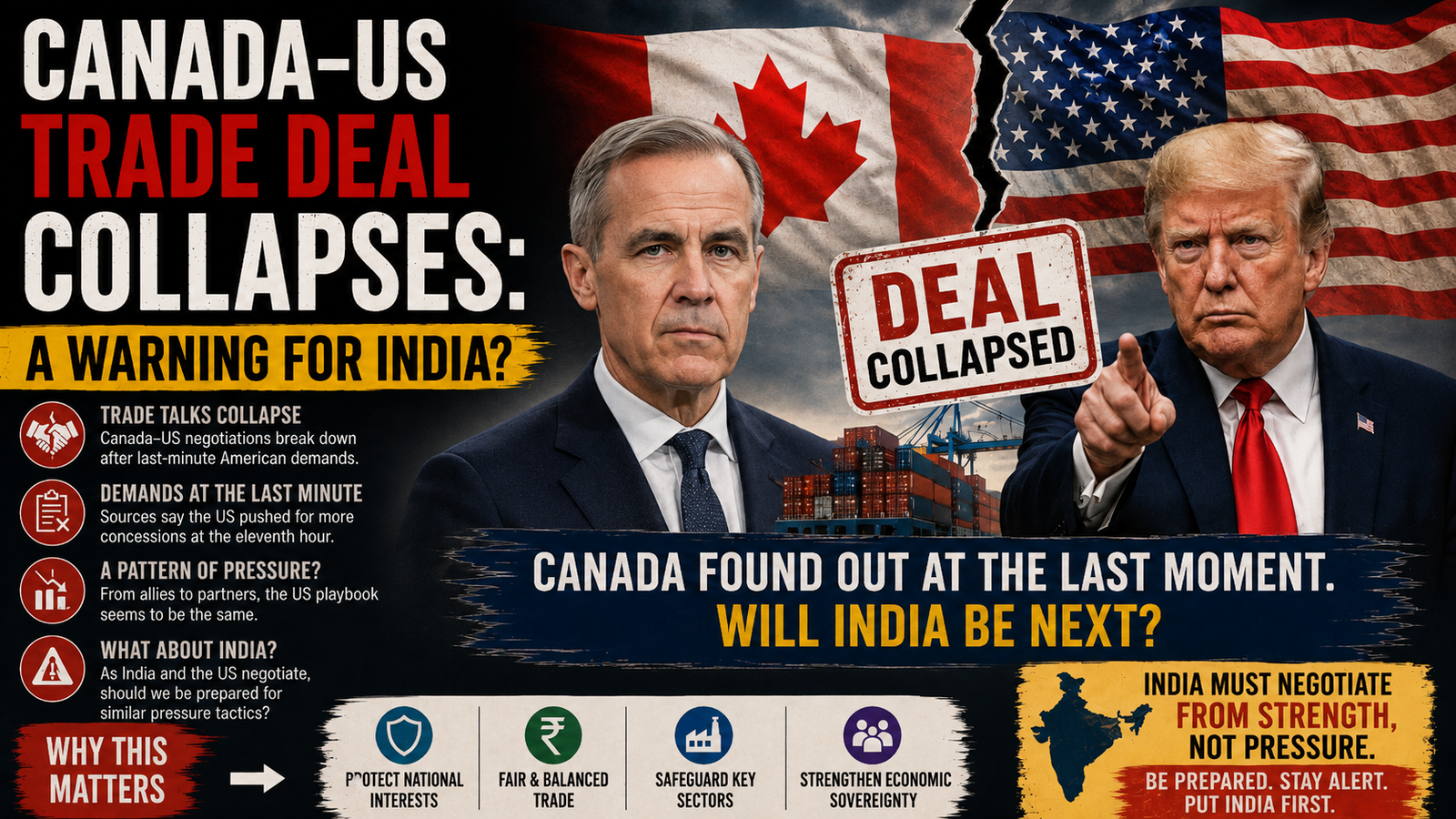
Canada and the United States appeared close to ending their damaging tariff dispute. Within hours, however, the negotiations collapsed, new American tariffs took effect and Canada announced dollar-for-dollar retaliation.
Canadian Prime Minister Mark Carney accused Washington of introducing unacceptable demands at the last moment. The United States blamed Canada for refusing previously discussed terms.
Whatever happened inside the negotiating room, the breakdown offers an important warning for India: verbal assurances and preliminary frameworks are not enough when negotiating with an administration willing to change tariff terms quickly.
What Happened to the Canada–US Trade Deal?
Negotiators spent three intensive days in Washington attempting to finalise an agreement.
The proposed deal was expected to reduce American tariffs on Canadian-made vehicles from 25% to 15%. Tariffs on Canadian steel and aluminium could also have been reduced from 50% to 25%, subject to import quotas.
As late as August 20, Canadian officials said the two sides were “very close” to an agreement.
But the talks collapsed before the deadline. The United States then imposed 50% tariffs on approximately $20 billion worth of Canadian products, including furniture, wine, clothing, dairy products, cement and sporting equipment.
Canada suspended negotiations and announced retaliatory tariffs on American steel, electronics, appliances, dairy products and agricultural equipment beginning September 8.
The sudden reversal damaged relations between two countries that share deeply integrated industries and one of the world’s largest trading relationships.
Did the United States Change the Deal?
According to Reuters’ account of the negotiations, Carney said the United States introduced new terms during the final stage that were unfair, economically damaging and harmful to Canadian sovereignty.
The reported disagreements included:
- Restrictions on Canada’s ability to sign trade agreements with other countries
- Disputes over tariffs on Canadian-made trucks
- Demands affecting Canadian cultural and language protections
- Pressure on Canada to align some of its tariffs with Washington
- Inadequate relief for steel, aluminium and automotive exports
The most controversial proposal reportedly involved limiting Canada’s freedom to negotiate independent trade agreements. Carney rejected this as a sovereignty issue.
However, the American account is different. US Trade Representative Jamieson Greer said Canada declined to finalise terms discussed earlier and demanded additional concessions on steel, automobiles, aluminium and softwood lumber.
Therefore, saying that the United States “cheated” is an interpretation, not an independently established fact. What is clear is that both sides left the negotiations with sharply different understandings of what had been agreed.
That alone raises serious concerns about the reliability of informal trade commitments.
Why Canada Feels Betrayed
Canada is not simply another trading partner. It is one of America’s closest allies, a NATO member and a central part of the North American industrial supply chain.
Canadian and American companies jointly manufacture vehicles, aircraft, machinery and defence equipment. Components frequently cross the border several times before a finished product reaches consumers.
Canada is also part of the US–Mexico–Canada Agreement, which President Donald Trump signed during his first term.
If even this relationship can be exposed to sudden tariffs and last-minute demands, other countries have a valid reason to question whether political friendship provides meaningful economic protection.
The lesson is uncomfortable: under the current approach, Washington may view trade agreements less as permanent commitments and more as instruments that can be renegotiated when the United States believes it has additional leverage.
Could the Same Happen to India?
Yes, the risk exists—but the outcome is not predetermined.
India and the United States announced a framework for an interim trade agreement in February 2026. Under the proposed arrangement, the United States would apply an 18% tariff to many Indian goods, while India would reduce barriers on several American industrial and agricultural products.
India also indicated plans to purchase large quantities of American energy, aircraft, technology and other products over five years.
But a framework is not the same as a completed and legally secured trade agreement.
By July, the two countries had still not reached a final consensus. Indian officials reportedly wanted guarantees that India would receive a tariff advantage over competitors and would not face additional American duties after making long-term concessions.
Those concerns now appear even more reasonable after Canada’s experience.
India Must Protect Its Red Lines
India should not rush into an agreement simply to announce a diplomatic success. It must ensure that any final deal protects national interests in several sensitive areas.
Agriculture and Dairy
India’s farming and dairy sectors support millions of livelihoods. Sudden exposure to heavily subsidised American agricultural products could create significant economic and political disruption.
Future American Tariffs
India needs a legally enforceable safeguard allowing it to suspend concessions if Washington introduces new tariffs through national-security, forced-labour or excess-capacity investigations.
The February US–India trade framework already states that either country may modify its commitments if agreed tariffs change. This protection must remain clear and enforceable in the final agreement.
Technology and Export Controls
India should avoid a situation in which it opens its market but later faces American restrictions on semiconductors, artificial-intelligence hardware, aviation equipment or other strategic technologies.
Energy Commitments
Any commitment to buy American oil, gas or coal should remain based on competitive prices and India’s energy security—not political pressure to abandon reliable suppliers.
Can the United States Be Trusted?
India should cooperate with the United States, but trust must be based on enforceable commitments rather than personal relationships or public statements.
The United States remains an essential technology, investment and export partner. Walking away from the relationship would not serve India’s interests.
Blind dependence would be equally unwise.
India’s best strategy is to negotiate firmly, preserve access to alternative markets and maintain strong relationships with Europe, the United Kingdom, Russia, the Gulf, ASEAN and other emerging economies.
A country with multiple economic options is harder to pressure at the negotiating table.
Conclusion
The collapse of the Canada–US trade deal shows how quickly an apparently final agreement can unravel when new demands appear near the deadline.
It does not prove that every negotiation with Washington will fail. But it demonstrates that strategic partnership does not guarantee predictable trade treatment—even for one of America’s closest allies.
India should continue its trade negotiations with the United States, but it must insist on balanced concessions, protection for farmers, safeguards against future tariffs and an enforceable dispute-settlement mechanism.
The real lesson from Canada is simple: negotiate with America, but never surrender economic flexibility before the agreement is signed, enforceable and protected against unilateral changes.
Frequently Asked Questions
Why did the Canada–US trade talks fail?
Canada said the United States introduced unfair last-minute conditions involving trade sovereignty, vehicles and cultural protections. Washington said Canada rejected previously discussed terms and demanded further concessions.
What tariffs did the United States impose on Canada?
The United States imposed 50% tariffs on approximately $20 billion worth of selected Canadian exports.
Is the India–US trade deal complete?
No. The two countries announced an interim framework in February 2026, but negotiations over the final agreement and tariff assurances have continued.
Could India face new US demands at the last moment?
It is possible. India is therefore seeking competitive tariff treatment and protection from additional US duties after it makes market-access concessions.
Disclaimer: This article is based on publicly available government statements and credible media reporting available at the time of publication. Canada and the United States have presented conflicting accounts of why negotiations failed. Terms such as “betrayal,” “cheating” or “moving the goalposts” represent political interpretations rather than independently proven legal conclusions. Trade policies, tariffs and negotiations may change rapidly; readers should consult official Canadian, Indian and US government sources for the latest information.